


Gangliosides Analysis Service
LC-MS/MS Gangliosides Analysis for Sialylated Glycosphingolipid Profiling
Creative Biolabs provides research-use-only gangliosides analysis services for profiling, annotation, and quantification of sialylated glycosphingolipids, including GM, GD, GT, and GQ series species. Built on our glycosphingolipids analysis expertise, this service supports intact species profiling, targeted LC-MS/MS readouts, and custom ganglioside biomarker analysis for cell-surface glycosphingolipid research.
Service Scope
- Targeted or semi-targeted analysis of GM1, GM2, GM3, GD1, GD2, GD3, GT1, GT3, GQ1, and custom panels.
- Relative quantification, absolute quantification where standards are available, group comparison, and pathway-level interpretation.
- Method planning for cultured cells, tissues, serum, plasma, lipid extracts, and enriched membrane or GSL fractions.
Gangliosides Analysis Background
Gangliosides are specialized glycosphingolipids characterized by one or more sialic acid residues attached to a glycan headgroup and a ceramide lipid anchor. Their structural diversity supports studies in neuroscience, oncology, immune regulation, cell-surface marker research, differentiation biology, and membrane microdomain organization. However, ganglioside profiling is rarely a simple extension of general lipidomics because glycan headgroup variation, ceramide backbone heterogeneity, and matrix effects can obscure low-abundance species.
Creative Biolabs develops ganglioside analysis methods around the research question rather than forcing every sample into the same lipid panel. We help define target classes, assess abundance expectations, select chromatography and MS strategies, and report findings with clear annotation confidence.
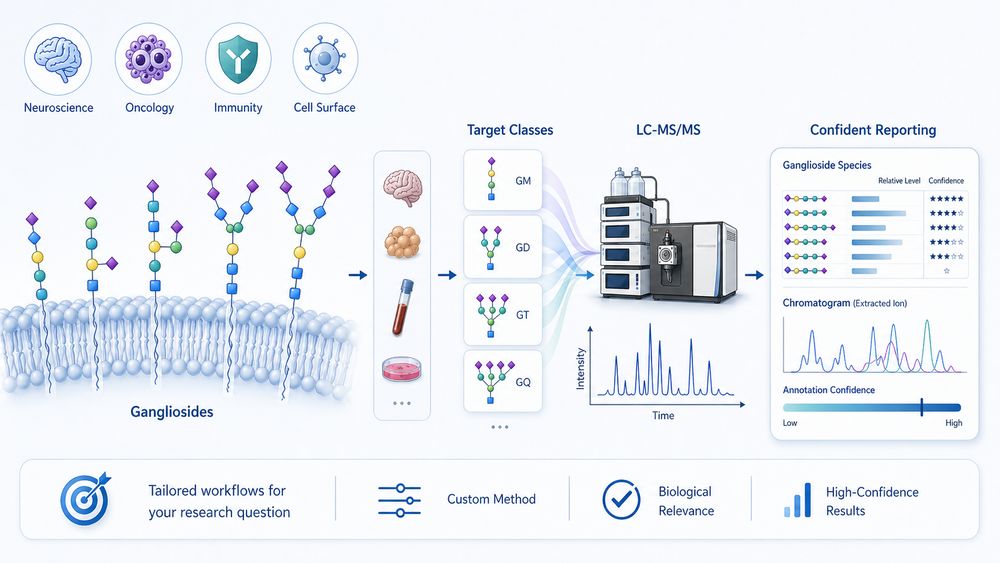
Fig.1 Ganglioside analysis background.
Why Ganglioside Analysis Is More Complex Than General Lipidomics
Gangliosides contain one or more labile sialic acid residues, making them susceptible to in-source fragmentation during ESI. If ionization conditions are too harsh, GT/GQ or other high-order gangliosides may lose sialic acid residues and appear as GD-like or GM-like signals. Without source condition assessment, such fragments can distort annotation, quantification, and biological interpretation.
Labile Sialic Acids
Sialic acid loss can convert high-order signals into misleading lower-order features if source conditions are not evaluated.
Multiple Charge States
Ganglioside polarity and acidic headgroups generate complex charge-state patterns that require careful transition and adduct selection.
Isomeric Complexity
Positional isomers, linkage isomers, and class-related species may overlap without optimized chromatography or standards.
Low Abundance
Rare species in serum, tissue, or membrane fractions may need feasibility testing, enrichment, or focused panel design.
Soft Ionization Tuning
Source parameters are reviewed to reduce avoidable sialic acid loss and improve confidence in intact species assignment.
Fragmentation-Aware Review
MS/MS interpretation considers class-specific fragments, potential in-source ions, and matrix-dependent response behavior.
Optimized Separation
HILIC, RP-LC, UHPLC, HRMS/MS, or multidimensional approaches may be selected according to class and isomer resolution needs.
Transparent Limits
Reports distinguish confident annotation, tentative assignment, relative quantification, and standard-supported absolute quantification.
Our Gangliosides Analysis Services and Method Options
Creative Biolabs supports targeted ganglioside quantification service and semi-targeted intact profiling for custom research panels. Common targets include GM1, GM2, GM3, GD1, GD2, GD3, GT1, GT3, and GQ1, while extended panels can be developed for project-specific species. Depending on study goals, we can provide relative abundance comparison, standard-supported absolute quantification, retention time documentation, MS/MS evidence, and pathway-aware summaries.
What Problems Our Ganglioside Profiling Helps Researchers Solve
Researchers often need more than a list of detected lipids. They may need to compare tumor cell lines, neural cells, edited models, drug-treated samples, or differentiation systems to understand whether ganglioside remodeling has occurred. Our service supports research target evaluation, cell-surface glycosphingolipid profiling, pathway disturbance assessment, and analytical readouts for antibody target research or mechanistic studies.
Target Ganglioside Detection
Focused analysis of GD2, GD3, GM2, GM3, and additional target species in selected research matrices.
Group Comparison
Relative or standard-supported quantitative comparison across sample groups, time points, or treatment conditions.
Cell-Surface Marker Research
Analytical support for projects investigating glycosphingolipid markers, membrane fractions, or GSL-enriched samples.
Recommended Ganglioside Profiling Workflow
Standard globoside or general lipid analysis workflows are often insufficient for gangliosides because sialylated species require dedicated extraction, softer source evaluation, and fragmentation-aware annotation. Our workflow aligns the analytical path with target class, matrix, expected abundance, and quantification mode.
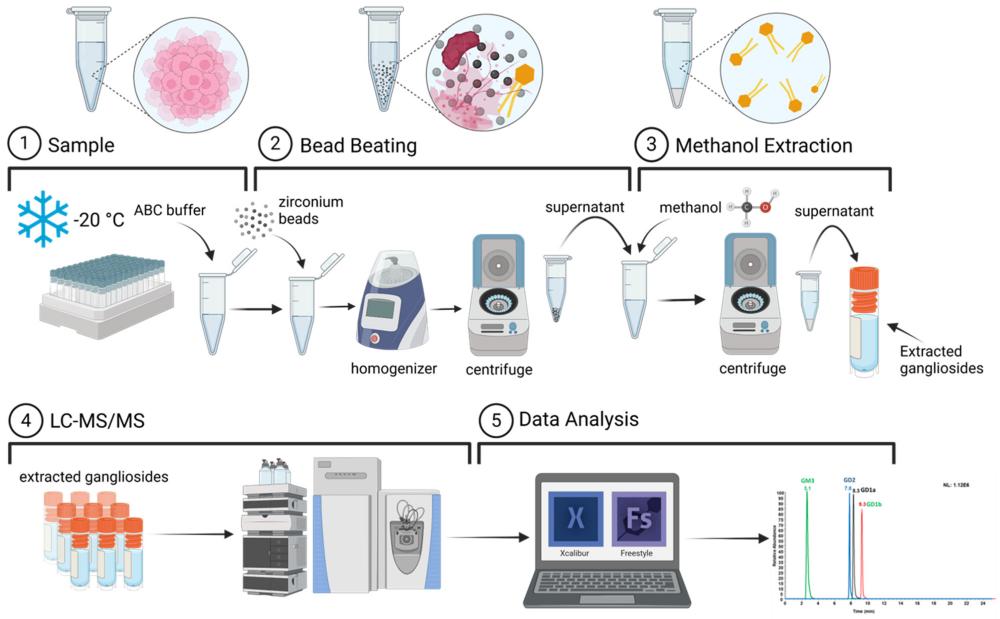
Fig.2 Published workflow for ganglioside extraction and LC-MS data analysis.1
Define Targets
Clarify target classes, research question, matrix, and comparison design.
Assess Samples
Review expected abundance, extraction risk, normalization plan, and feasibility needs.
Optimize Extraction
Adapt extraction for polar, sialylated GSLs and matrix-dependent recovery.
Acquire Data
Run LC-MS/MS or HRMS acquisition with source condition review.
Report Results
Deliver annotation, quantification, QC metrics, and pathway-level summaries.
Sample Requirements for Gangliosides Analysis
We can support cultured cells, tumor cell lines, neural cells, tissues, brain samples, serum, plasma, lipid extracts, cell membrane fractions, and enriched GSL fractions. For rare matrices or low-abundance targets, a pilot run can help define sensitivity and extraction feasibility before larger-scale profiling.

Suggested Submission Information
- Sample type, species or model information, storage condition, and extraction status.
- Target ganglioside list, such as GM3, GM2, GD2, GD3, GT1, or GQ1 species.
- Cell number, harvest method, membrane enrichment status, and normalization preference for cell-surface studies.
- Sample number, group design, expected abundance, and required statistical comparison.
- Desired quantification mode and whether upstream GSL pathway nodes should be included.
Deliverables and Data Outputs
Deliverables are tailored to the selected analysis mode. Intact species-level profiling reports the most defensible species calls under the chosen method, while full structural elucidation requires additional evidence and may not be achievable for every isomer without authentic standards.
Typical Deliverables
- Detected ganglioside class and species table with retention time and abundance values.
- Target panel results, MRM transitions or MS/MS spectra, QC metrics, and normalization method.
- Group comparison summary with notes on annotation confidence and quantification limitations.
- Source-fragmentation assessment notes where relevant, especially for GT/GQ and high-order species.
- Pathway-level summary integrating HexCer, LacCer, or related GSL nodes when included.

Why Choose Creative Biolabs for Gangliosides Analysis
Ganglioside-Specific Extraction
Project planning considers polar sialylated GSL recovery, sample matrix, enrichment status, and normalization early in the workflow.
Fragmentation-Aware Interpretation
Soft ionization/source parameter optimization helps reduce misleading sialic acid loss and supports more defensible annotation.
Transparent Reporting
We clearly separate intact species profiling, isomer-aware annotation, standard-supported quantification, and full structural claims.
Start a Gangliosides Analysis Project
Share your target ganglioside series, sample matrix, sample number, desired quantification mode, and whether upstream GSL pathway nodes should be included. Creative Biolabs will help match the project to an appropriate LC-MS/MS, UHPLC-MS/MS, HILIC-QQQ-MS/MS, RP-LC-MS/MS, or HRMS/MS strategy for research-use-only analysis.
Published Data Supporting Ganglioside Profiling
Recent studies have optimized LC-MS workflows for intact ganglioside profiling and isomeric separation, while multiplexed targeted methods now allow gangliosides to be analyzed together with GlcCer, LacCer, Gb3, and other pathway-relevant GSLs. This direction supports pathway-aware and structurally informed lipidomics rather than simple total ganglioside measurement.
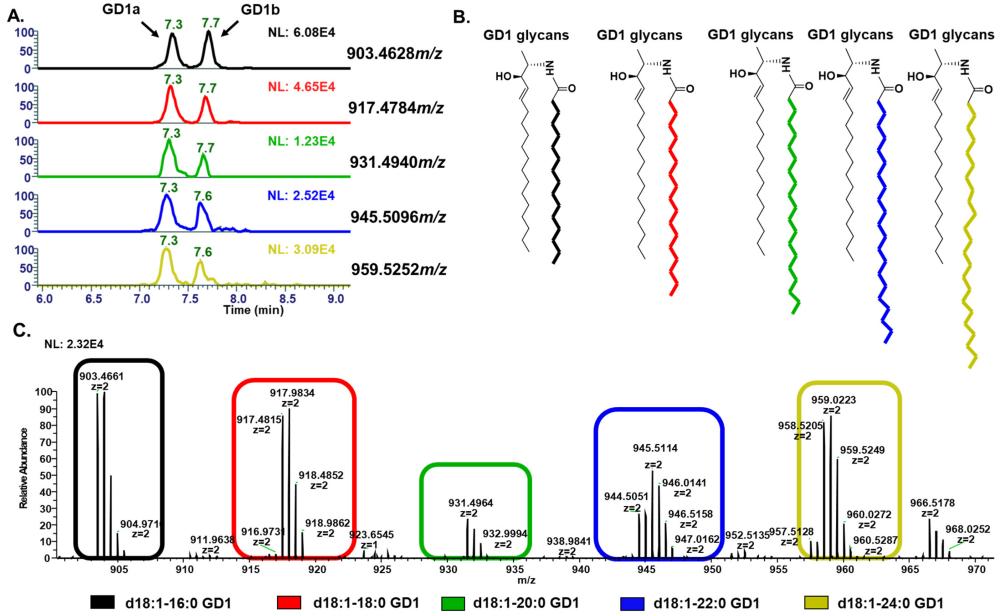
Fig.3 Intact ganglioside isomer separation and ceramide heterogeneity.1
How Published Evidence Supports Service Planning
Literature on gangliosides analysis by LC-MS/MS reinforces several practical points that shape project design: extraction conditions influence recovery, chromatographic settings affect isomer separation, and annotation should be interpreted with the limits of standards and fragmentation behavior in mind. For custom ganglioside profiling service projects, these considerations help define whether the study should prioritize targeted quantification, intact profiling, or broader pathway coverage.
Customer Review
Recommended Products
These related research-use product categories can support glycan-focused assay development, target evaluation, and companion studies around glycolipid or glycoepitope recognition.
Carbohydrate Antigen Products
A research-use collection of carbohydrate antigens, including oligosaccharides, nucleosides, monosaccharides, neoglycolipids, and glycans, suitable for glycan-focused binding studies and assay development.
Learn MoreMonoclonal Antibody Products
Designed for precise glycoepitope recognition, these monoclonal antibody products support specificity-focused glycan profiling, cell-surface marker research, and assay development workflows.
Learn MorePolyclonal Antibody Products
These polyclonal antibody products offer broad epitope recognition and flexible use in glycoantigen detection, immunoassays, and other research applications that benefit from high sensitivity.
Learn More