
1. Study framing
We review sample type, biological groups, target cerebrosides, isomer requirements, quantification level, and expected concentration range.


Creative Biolabs delivers cerebroside analysis with isomer-aware profiling, GlcCer/GalCer differentiation, and fit-for-purpose quantification tailored to sample matrix and study goals.
Creative Biolabs helps researchers move beyond a generic hexosylceramide signal when the study requires molecular-species profiling, glucosylceramide/galactosylceramide differentiation, or quantitative comparison. Our cerebrosides analysis service extends the glycosphingolipids analysis service with a project design matched to sample matrix, isomer question, ceramide-chain coverage, and the level of quantification needed for the downstream study.
A useful plan begins by defining the result that would change the customer’s interpretation. Some projects need a broad HexCer profile to compare conditions. Others need to separate GlcCer from GalCer, measure selected species against standards, or examine how long-chain base and fatty-acyl composition shift within each isomer class. These objectives require different chromatographic separation, calibration, and reporting depth.
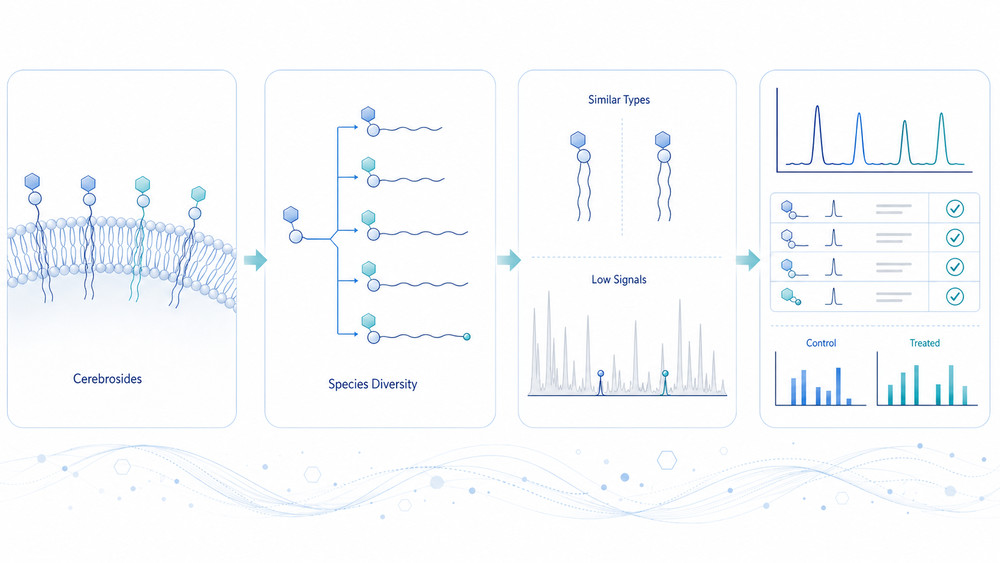
GlcCer and GalCer are diastereomeric monohexosylceramides with the same nominal composition for a matched ceramide backbone. Conventional lipidomics can therefore report a combined HexCer class even when the biological interpretation depends on the attached glucose or galactose. At the same time, variation in long-chain base, fatty-acyl length, unsaturation, and hydroxylation creates a large molecular-species space.
The service can be configured as broad profiling, targeted isomer-aware analysis, relative comparison, or absolute quantification for selected analytes.
Profiling addresses which cerebroside species are detectable and how their distributions differ across conditions. Annotation can incorporate precursor and fragment information, retention behavior, long-chain-base composition, fatty-acyl features, and comparison with available standards. When isomer separation is not part of the method, results are reported as HexCer rather than assigning glucose or galactose without sufficient evidence.
Relative quantification is appropriate for many discovery and group-comparison studies, particularly when the panel includes species lacking authentic standards. Absolute quantification is most defensible for a defined target set with suitable calibration and internal standards. We discuss the required accuracy, number of groups, expected concentration range, and available standards before selecting the quantitative route.
| Service Component | Best Suited For | Output Emphasis |
|---|---|---|
| Cerebroside class profiling | Surveying HexCer abundance and molecular-species distribution across samples. | Annotated species list, relative abundance, and group-level patterns. |
| GlcCer/GalCer differentiation | Separating the two monohexosylceramide classes when isomer identity affects interpretation. | Class-resolved or species-resolved signals with method and confidence notes. |
| Targeted molecular-species analysis | Following selected long-chain-base and fatty-acyl combinations. | Target list, retention and transition evidence, and comparative abundance. |
| Relative quantification | Comparing groups when complete authentic-standard coverage is unnecessary or unavailable. | Normalized response, fold difference, and statistical-ready tables as scoped. |
| Absolute quantification | Measuring selected analytes against suitable standards and calibration. | Concentrations for validated target species, with calibration and quality information. |
The separation strategy should be chosen before data acquisition because a standard reversed-phase method may resolve lipid-chain variants while leaving matched GlcCer and GalCer unresolved.
| Analytical Approach | What It Resolves Well | Important Limitation |
|---|---|---|
| Reversed-phase LC-MS | Ceramide-chain variants and broad HexCer profiles. | Matched GlcCer and GalCer may coelute or remain difficult to assign. |
| HILIC or normal-phase separation | Polar headgroup stereochemistry and GlcCer/GalCer class separation. | Retention can be sensitive to stationary phase, solvent system, matrix, and standards. |
| Targeted MS/MS with standards | Confirms transitions and supports selected-species quantification. | Fragmentation alone may not fully distinguish every isomer without separation. |
| Ion mobility or other orthogonal separation | Adds gas-phase or multidimensional evidence for difficult species. | Availability, resolving power, and reference data determine practical benefit. |
Choose the service according to the decision the data must support. This page is the more focused route when cerebroside biology, GlcCer/GalCer discrimination, or defined cerebroside species are central. For broader class-level coverage or larger HexCer panels, consider our hexosylceramide lipidomics analysis.
| Customer Need | Recommended Route |
|---|---|
| Cerebroside biology, GlcCer/GalCer discrimination, or defined cerebroside species | Cerebrosides Analysis |
| Broader HexCer lipidomics, class-level profiling, or larger HexCer panels | Hexosylceramide Lipidomics Analysis |
For method-selection background, see the Cerebrosides Analysis Guide and the Hexosylceramide Lipidomics Analysis Guide.
Each study is assembled around the matrix and the required distinction rather than forcing all samples into one universal lipidomics method.
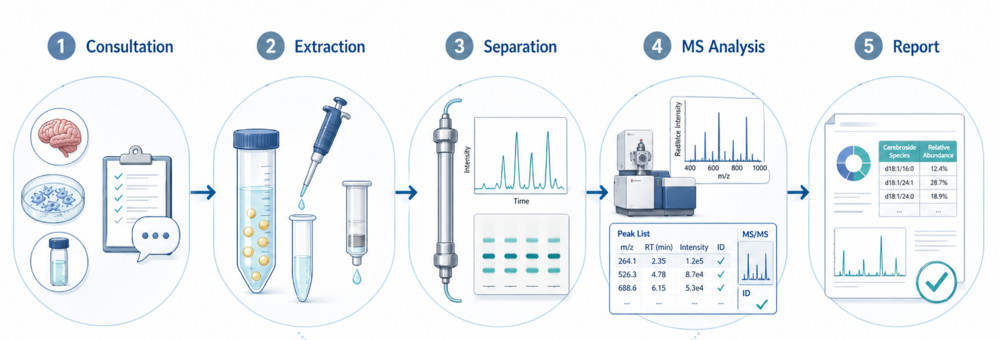
We review sample type, biological groups, target cerebrosides, isomer requirements, quantification level, and expected concentration range.
The lipid-extraction route, internal standards, aliquoting, and matrix-specific controls are selected with attention to scarce or low-abundance samples.
Chromatographic and mass-spectrometric conditions are aligned with either broad species coverage, GlcCer/GalCer resolution, or a targeted panel.
Signals are filtered and annotated using retention, fragments, standards, blank behavior, and calibration evidence appropriate to the scope.
Class and molecular-species results are summarized with quality notes, confidence boundaries, and interpretation relevant to the customer’s research question.
Sample quantity cannot be separated from matrix, expected abundance, panel breadth, and quantitative goal. A targeted study may require less analytical breadth but stronger standards and calibration, while an untargeted profile may prioritize coverage and group consistency.
Determines extraction behavior, background lipids, and suitable normalization.
Defines batch design, randomization, comparison strategy, and expected data structure.
Affects recovery, stability, and whether pilot or targeted analysis is appropriate.
Clarifies whether combined HexCer, class-resolved GlcCer/GalCer, or selected molecular species are needed.
Determines standard requirements, calibration, and the claims supported by the final data.
Appropriate to the selected matrix and panel.
Cerebroside or HexCer annotations with stated isomer resolution.
Relative abundance or concentration results according to the agreed quantitative design.
Chromatograms, extracted-ion traces, spectra, calibration information, or quality summaries relevant to the project.
Separates confirmed assignments, probable annotations, unresolved isomers, and matrix-related limitations.
Identification confidence depends on the evidence available for each species rather than on mass accuracy alone. Creative Biolabs can incorporate matrix-matched blanks, pooled quality-control samples, internal standards, retention evidence, and carryover review according to the analytical scope. These controls are especially important when low-abundance HexCer species occur near more abundant sphingolipids or when matrix suppression changes across sample groups.
Assignments are reported at the level supported by the data. A species supported by chromatographic separation and suitable reference evidence can be interpreted more specifically, whereas unresolved GlcCer/GalCer signals remain at the HexCer level. This approach keeps analytical uncertainty visible in the final species table and prevents an isomer assumption from becoming a biological conclusion.
Compare GlcCer, GalCer, and selected chain variants across pathway perturbations.
Characterize GalCer-rich profiles and related molecular-species changes in research models.
Measure cerebroside patterns associated with GBA1, GALC, or related pathway changes.
Evaluate class- or species-level differences across defined research cohorts without clinical interpretation.
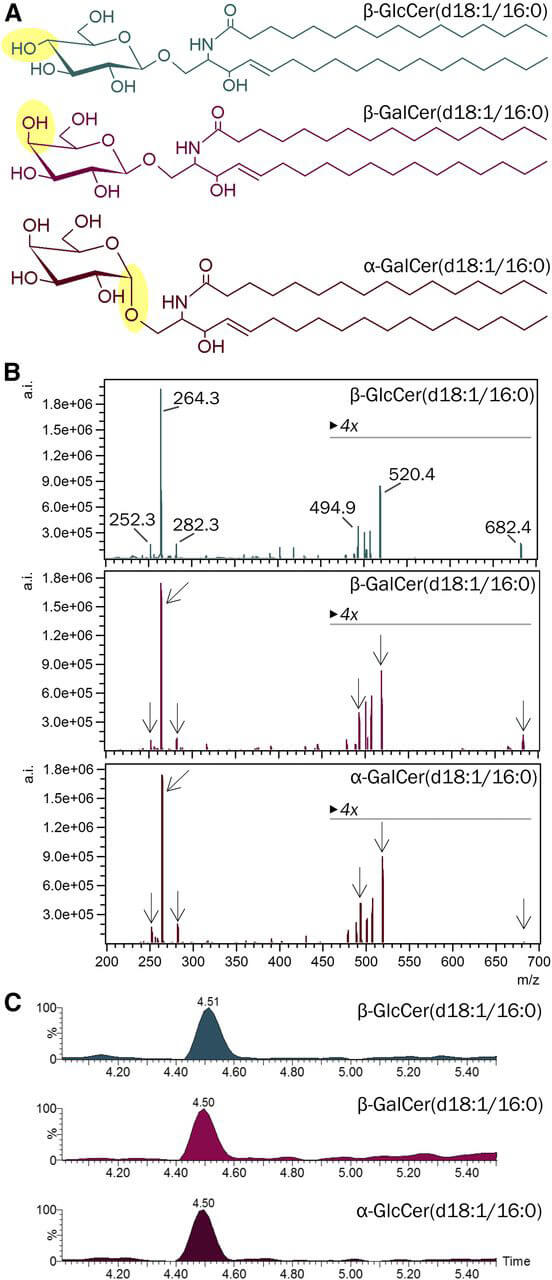
von Gerichten and colleagues demonstrated diastereomer-specific analysis of GlcCer and GalCer using hydrophilic-interaction chromatography coupled with tandem mass spectrometry. The study shows that matched monohexosylceramides can require dedicated separation before quantitative interpretation. It provides method rationale for isomer-aware analysis, while performance remains dependent on the tested column, standards, matrices, and analyte panel.
Please share the sample matrix and species, number of samples and groups, collection and storage conditions, available sample amount, target cerebroside classes or molecular species, whether GlcCer/GalCer separation is required, the preferred relative or absolute quantitative level, available standards, extraction status, and the downstream comparison. Creative Biolabs uses these details to scope the analytical panel and a defensible confidence level efficiently.