


Sulfatides Analysis Service
Research-Use Sulfatide Profiling, Annotation, and Quantification
Creative Biolabs provides research-use-only sulfatides analysis services for profiling, structural annotation, and relative or absolute quantification of sulfated galactosylceramide species in biological and lipid-rich samples. As part of our glycosphingolipids analysis capabilities, this sulfatide analysis service supports neuroscience, sphingolipid metabolism, renal biology, immune regulation, and membrane biology studies that require interpretable molecular species-level data.
Service Focus
- Targeted sulfatide profiling for cells, tissues, biofluids, lipid extracts, and enriched lipid fractions.
- Negative-mode LC-MS/MS or HRMS/MS method design for sulfate-containing glycosphingolipids.
- Annotation confidence reporting to separate confirmed, probable, and putative assignments.
Why Sulfatides Require Targeted Analytical Design
Sulfatides are sulfated glycosphingolipids enriched in myelin and other specialized tissues. Their sulfate group often supports strong response in negative ion mode, but it also shapes fragmentation behavior and can make method development less straightforward than routine lipid analysis. Collision energy must be carefully optimized. Excessive energy may cause sulfate-related fragments or neutral loss to dominate the spectrum, reducing information from the ceramide backbone and fatty acyl chain. Insufficient energy may weaken structural confirmation and lower confidence in species assignment.
Analytical design becomes more demanding when samples contain long-chain and very-long-chain fatty acyl species, hydroxylated species, low-abundance components, or myelin-rich matrix interference. Modern glycosphingolipid analysis also faces isomeric and isobaric overlap, ion suppression, and strong dependence on extraction quality. For sulfatide biomarker analysis or mechanistic lipid studies, the analytical goal is not only to detect a broad sulfatide signal, but to convert it into a reproducible, species-resolved profile.
- Negative-ion acquisition can improve sulfatide response, but transition choice and collision energy require molecule-aware optimization.
- Hydroxylated and nonhydroxylated sulfatide species may behave differently during extraction, separation, and fragmentation.
- Complex tissue and biofluid matrices can suppress low-abundance species unless cleanup and normalization are planned early.
- Species-level sulfatide profiling helps distinguish total class-level change from selective acyl-chain remodeling.
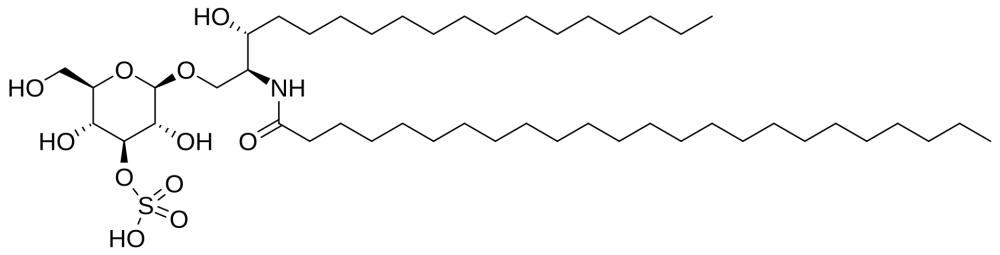
Fig.1 Sulfatide structure.
Sulfatide Analysis Challenges and Method Options
Our method selection is driven by the sample matrix, expected abundance, target list, and quantification goal. Creative Biolabs can support targeted sulfatide profiling, species-level quantification, comparative analysis, and method customization for sulfatide-focused research projects.
Sulfate-Driven Fragmentation
The sulfate group can produce dominant diagnostic ions, so MS/MS conditions must preserve useful structural information.
Isobaric Interference
Closely related sulfatide species may overlap without adequate chromatographic separation or accurate-mass support.
Low-Abundance Readouts
CSF, plasma, urine, and limited tissue samples may require pilot testing, enrichment, or matrix-specific cleanup.
Annotation Confidence
Not every signal should be reported as a definitive structure when standards or diagnostic fragments are limited.
LC-MS/MS or UPLC-MS/MS
Suitable for sensitive targeted sulfatide quantification with optimized negative-mode transitions.
HRMS/MS Annotation
Accurate mass and MS/MS information can improve confidence for expanded sulfatide profiling.
Lipid Class Cleanup
Optional enrichment or fractionation may be considered for complex, lipid-rich, or low-abundance matrices.
Tissue Distribution Support
MALDI-MS or imaging-MS may be discussed when spatial sulfatide distribution is central to the research question.
Our Sulfatides Analysis Services
Creative Biolabs designs sulfatide analysis around the research question rather than using a fixed generic lipid method. We can profile common sulfatide molecular species and extend the target list when sample type, standards, and expected abundance support a broader method.
Recommended Workflow for Sulfatides Analysis
A structured workflow helps reduce ambiguity before acquisition and makes final data easier to interpret. For low-abundance or unusual matrices, a pilot run may be recommended before full-scale sulfatide LC-MS/MS analysis.
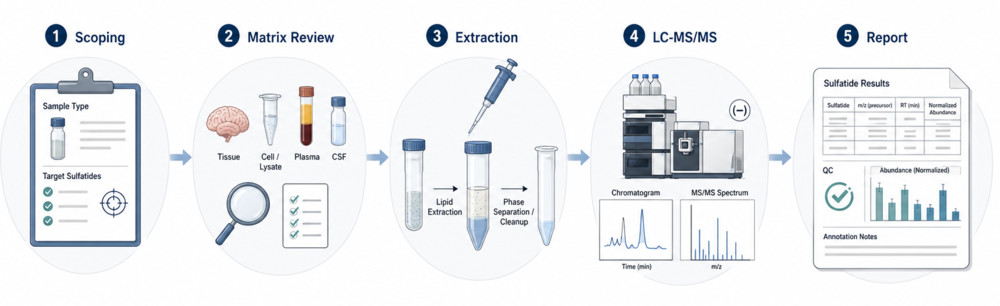
Fig.2 Sulfatides analysis workflow overview.
Scoping
Define sample type, target sulfatides, quantification preference, and comparison design.
Sample Review
Assess expected abundance, lipid complexity, sample amount, and cleanup requirements.
Extraction
Perform lipid extraction and matrix cleanup with sulfatide-aware recovery considerations.
Acquisition
Run negative-mode LC-MS/MS or HRMS/MS with transition and collision energy evaluation.
Reporting
Deliver normalized abundance tables, annotation notes, QC summary, and a technical report.
Sample Types We Can Support
We can support cells, tissues, brain-region samples, serum or plasma, CSF for research use, urine, lipid extracts, and enriched lipid fractions. Detection depth depends on sample amount, preservation, matrix complexity, target abundance, and whether standards or reference materials are available.
Suggested Submission Information
- Sample type, sample number, group design, and expected sulfatide target list.
- Sample amount, storage conditions, extraction history, and freeze-thaw information.
- Preferred output format, including relative profiling or absolute quantification.
- Available standards, internal controls, pooled QC samples, or reference materials.
- Any known matrix constraints, treatment conditions, or sensitivity concerns.
Deliverables
Our deliverables are designed to help researchers understand not only whether sulfatide species are detected, but how confidently they are assigned and how abundance patterns differ across samples or groups.
Typical Deliverables
- Detected sulfatide species list with retention time and precursor or product ion information.
- Extracted ion chromatograms when applicable, abundance tables, and normalization details.
- Relative or absolute quantification results depending on standards and method design.
- QC summary, group comparison results, annotation confidence notes, and technical report.
Why Choose Creative Biolabs for Sulfatides Analysis
Creative Biolabs focuses on reliable, interpretable data rather than promising complete sulfatidome coverage under all conditions. Our strengths include sulfoglycosphingolipid-aware extraction, negative-mode LC-MS/MS method design, collision energy optimization for sulfate-containing species, and adaptability to low-abundance or matrix-rich samples. For broader research programs, sulfatide profiling can also be integrated with glycosphingolipid or sphingolipid panels to support a wider biological interpretation.
Start a Sulfatides Analysis Project
To help us design a suitable sulfatide quantification service, please share your sample type, sample number, matrix, expected sulfatide targets, quantification preference, and available standards.
Published Data Supporting Sulfatide Profiling
Published sulfatide research shows why species-level analysis is more informative than total class measurement alone. In a Journal of Lipid Research study, Blomqvist and colleagues developed an automated liquid-liquid extraction and UPLC-MS/MS workflow for sulfatides in cerebrospinal fluid (CSF), enabling quantification of 20 sulfatide species from 100 μL of CSF. The method used negative-mode MRM detection with the sulfate fragment as a shared product ion, and validation showed high extraction recovery, low variation for most species, and suitability for comparing hydroxylated and nonhydroxylated sulfatide profiles.
For research-use sulfatide analysis, these data support a practical service principle: sample preparation, chromatographic separation, transition selection, and annotation confidence should be considered together. The same study also illustrates how isobaric or near-isobaric species can interfere with accurate quantification when separation is insufficient, reinforcing the need for matrix-aware method design in custom sulfatide LC-MS/MS projects.
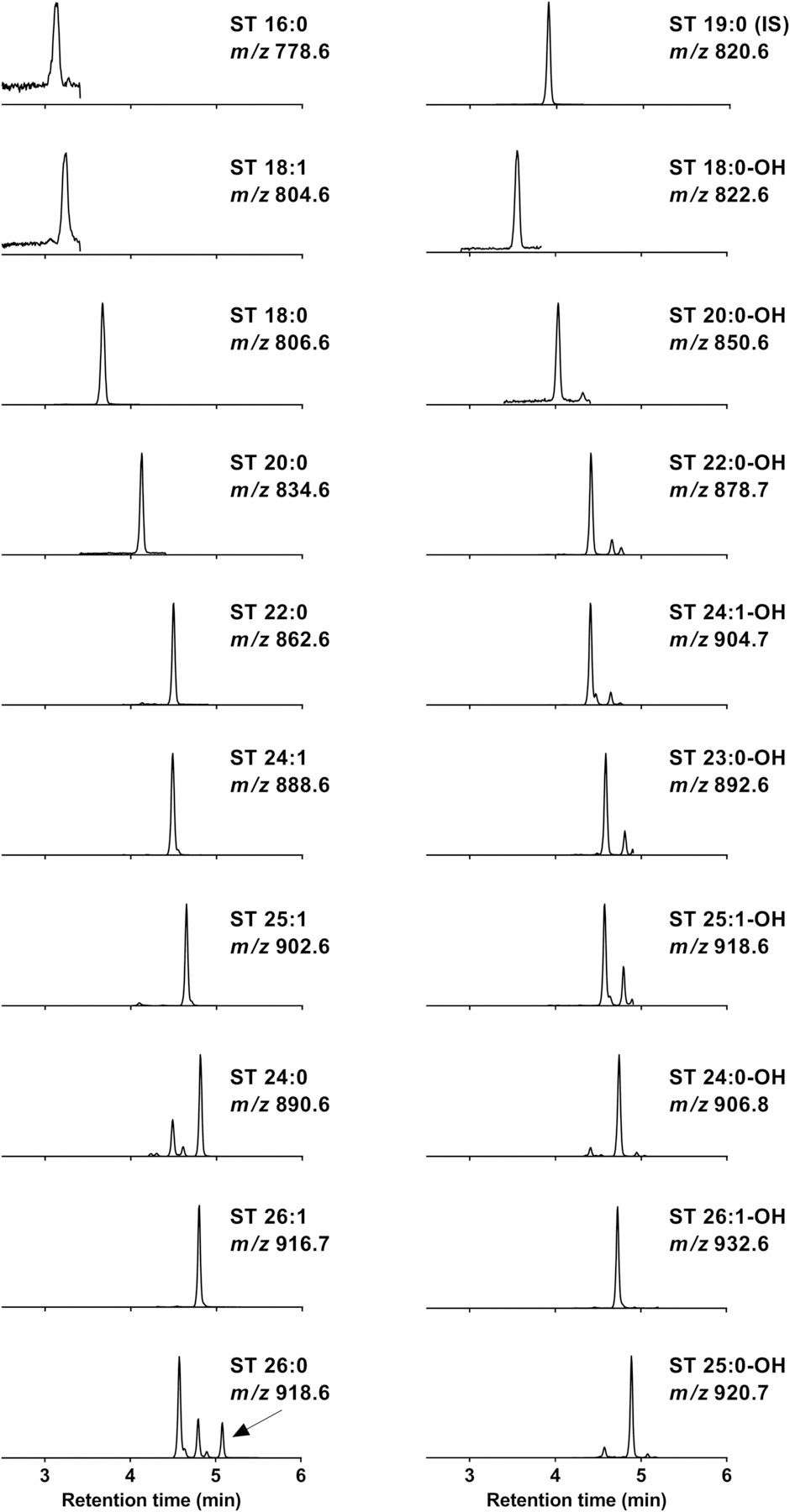
Fig.3 Extracted ion chromatograms of individual sulfatide species by UPLC-MS/MS.1
Customer Review
Recommended Products
These related anti-glycan product categories may support research workflows that require glycan-focused reagents, assay development materials, or broader glycosphingolipid investigation.
Carbohydrate Antigen Products
A research-use collection of carbohydrate antigens, including oligosaccharides, nucleosides, monosaccharides, neoglycolipids, and glycans, suitable for glycan-focused binding studies and assay development.
Learn MoreMonoclonal Antibody Products
Designed for precise glycoepitope recognition, these monoclonal antibody products support high specificity, reduced cross-reactivity, and advanced screening workflows for glycan profiling and therapeutic research.
Learn MorePolyclonal Antibody Products
These polyclonal antibody products offer broad epitope recognition, strong signal generation, and flexible use in glycoantigen detection, immunoassays, and other applications that benefit from high sensitivity.
Learn More