Etofenprox loaded Ethosome Formulation
Introduction Research Insights Products & Services Resources
The agricultural industry faces a critical turning point where the demand for effective pest control must be actively balanced with urgent environmental and safety concerns. Advanced nanotechnology is stepping in to solve this challenge, offering innovative ways to deliver active compounds safely and sustainably. At the forefront of this revolution are lipid-based carrier systems, which are redefining how agrochemicals are formulated, applied, and retained. With decades of pioneering experience, Creative Biolabs provides unparalleled expertise in the design, characterization, and scale-up of customized lipid-based delivery systems to propel your agricultural research forward.
Lipid-Based Delivery in Agriculture
Understanding the underlying mechanisms of nanotechnology in agriculture is vital for developing next-generation agrochemicals.
The Shift to Lipid-Based Systems
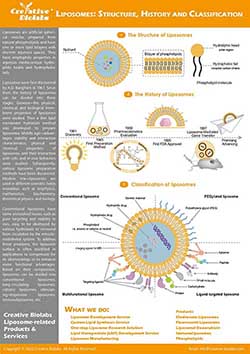
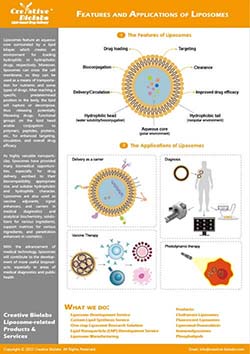
Traditional pesticide formulations often suffer from poor water solubility, rapid environmental degradation, and high non-target toxicity. Lipid-based systems, such as liposomes and ethosomes, act as protective nanocarriers. They encapsulate hydrophobic active ingredients, shielding them from premature degradation while replacing toxic solvents with biocompatible phospholipids.
Ethosomes & Penetration Enhancers
Ethosomes are specialized phospholipid vesicles containing a high concentration of ethanol. This unique composition makes them highly malleable, allowing for excellent penetration through tough biological barriers, such as plant cuticles or insect exoskeletons. The addition of natural terpenes, like geraniol, further enhances this permeation while offering intrinsic pest-repellent properties.
Targeting Ceratitis Capitata
Also known as the Mediterranean fruit fly, this invasive pest causes catastrophic damage to fruit crops globally. Effective control requires a delivery system that can remain stable on foliage (resisting rain wash-off and UV degradation) while providing a sustained release of the active insecticide (like etofenprox) to maintain long-term toxicity against adult flies.
Breakthroughs in Pest Management: The Science Behind Etofenprox Ethosomes
To guide modern agrochemical development, examining the physicochemical and biological performance of vesicular formulations is crucial. The latest scientific literature demonstrates how ethosomal technologies optimize the delivery of active agents, providing valuable blueprints for our clients' formulation research.
1. Vesicle Characterization & Stability Profiling
The foundational step in nanocarrier development is ensuring consistent structural quality. Recent studies utilizing one-step sonication methods have successfully generated ethosomes and geraniol-ethosomes with exceptionally small sizes (approximately 267 nm) and a remarkably low polydispersity index (around 0.04). These specific parameters guarantee uniform particle distribution and prevent aggregation, leading to formulations that remain highly stable over 90 days of storage at room temperature.
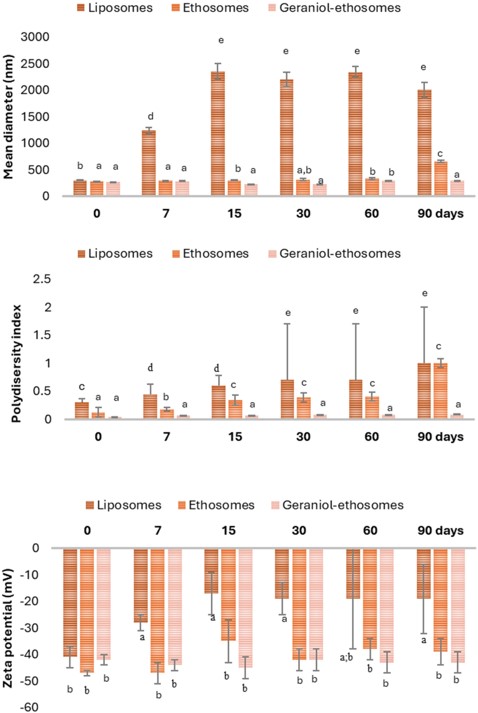 Fig. 1 Assessment of storage stability of liposomes, ethosomes and geraniol-ethosomes stored for 90 days at room temperature. 1
2. Release Kinetics & Sustained Action
Evaluating a formulation's ability to modulate the release of its active ingredient is critical for long-term efficacy. Experimental data shows that ethosomal carriers significantly slow the release of etofenprox, yielding a controlled release profile (e.g., ~57% over 24 hours) compared to the rapid dumping seen in commercial formulations. This sustained release mechanism minimizes immediate environmental toxicity spikes and extends the duration of effective pest control, reducing the frequency of application.
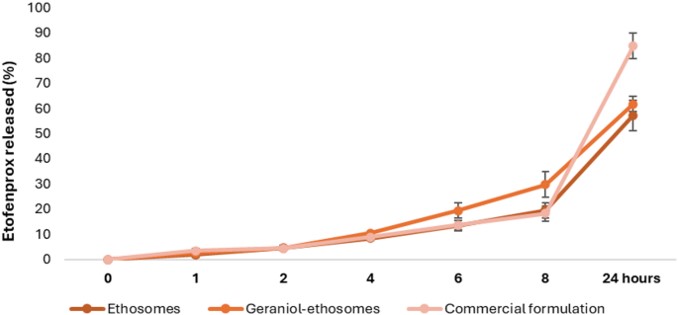 Fig. 2 In vitro release of etofenprox (%) from ethosomes, geraniol-ethosomes and commercial formulations over 24 h at room temperature. 1
3. Foliar Retention & Residue Distribution
Practical agricultural efficacy relies heavily on how well a pesticide adheres to target crops. Research highlights that ethosomes exhibit superior retention properties on plant surfaces (such as lemon leaves) under both controlled laboratory and open-field conditions. Notably, specific terpene-modified ethosomes direct the highest etofenprox residues precisely where needed, rather than accumulating non-specifically. Enhanced retention allows developers to drastically reduce the total application dose of the active ingredient, proving especially valuable during critical pre-fruiting growth stages.
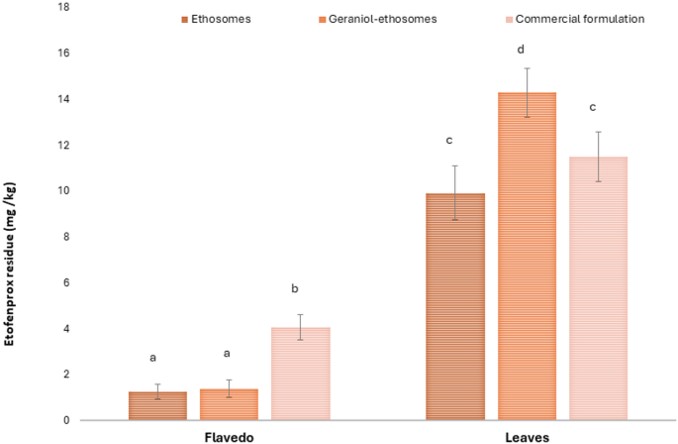 Fig. 3 Etofenprox residues (mg/kg) on leaves and flavedo after open field application of the ethosomes, geraniol-ethosomes and commercial formulation. 1
4. Biocompatibility & In Vivo Efficacy
Modern agricultural solutions must achieve efficacy without compromising safety. Laboratory bioassays confirm that advanced ethosomal formulations display excellent biocompatibility, showing no significant cytotoxic effects on human cell lines (such as HaCat keratinocytes) across various active ingredient concentrations. Simultaneously, these formulations exhibit prolonged and potent toxicity against Ceratitis capitata adults. This dual confirmation underscores the potential of lipid vesicles to bridge the gap between robust agricultural pest management and stringent environmental sustainability standards.
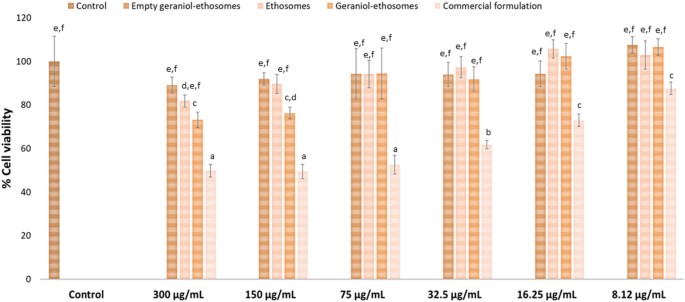 Fig. 4 Viability of keratinocytes (HaCat) incubated for 4 h with ethosomes, geraniol-ethosomes, and the commercial formulation.1
Related Services & Products
Creative Biolabs offers highly specialized services dedicated to the advancement of lipid-based drug delivery systems, including the customized development of Etofenprox-Loaded Ethosomes. Our state-of-the-art facilities and experienced scientific team support clients through every phase of formulation development. From initial design to comprehensive validation, we bridge the gap between academic innovation and industrial-scale agricultural solutions.
|
Services/Products
|
Description
|
Inquiry
|
|
Liposome & Ethosome Development
|
Custom formulation of phospholipid vesicles tailored for specific active ingredients and applications.
|
Inquiry
|
|
Comprehensive Characterization
|
Rigorous testing of size, PDI, zeta potential, long-term stability, and encapsulation efficiency.
|
Inquiry
|
|
High-Purity Phospholipids
|
Premium grade lipid components essential for stable vesicle structural integrity and formation.
|
Inquiry
|
Resources
Reference
-
Corrias, Francesco, et al. "Design, characterization, and evaluation of eco-friendly etofenprox-loaded ethosomes to control Ceratitis capitata (Diptera: Tephritidae)." Scientific Reports 15.1 (2025): 26699. Distributed under Open Access license CC BY 4.0, without modification. https://doi.org/10.1038/s41598-025-11832-y.

For Research Use Only. Not For Clinical Use