Imipenem Niosome Formulation for MRSE Biofilm
Introduction Research Insights Products & Services Resources
The persistent threat of multidrug-resistant bacterial infections demands innovative therapeutic strategies capable of bypassing complex biological defense mechanisms. Standard antibiotics like Imipenem frequently struggle to eradicate robust biofilms formed by opportunistic pathogens, leading to chronic infections and high failure rates in clinical settings. Encapsulating such potent therapeutics within advanced nanoscale carriers revitalizes their efficacy and extends their clinical utility. Recognizing this critical intersection of microbiology and nanotechnology, Creative Biolabs leverages its specialized expertise in lipid-based drug delivery systems to empower researchers and pharmaceutical developers in pioneering next-generation antimicrobial formulations.
Overcoming Microbial Fortresses: The Rise of Nanoscale Lipid Carriers
To successfully navigate the challenges of modern antibiotic resistance, it is crucial to understand the biological barriers at play and the engineered solutions designed to defeat them. The following concepts highlight the foundational principles of utilizing advanced carrier systems for challenging bacterial targets.
-
The Threat of MRSE Biofilms: Staphylococcus epidermidis is a leading cause of device-related clinical infections. When these strains become methicillin-resistant (MRSE) and form highly structured biofilms—an extracellular polymeric matrix that shields the bacteria—they become notoriously difficult to eradicate, requiring antibiotic concentrations up to 1000 times higher than planktonic cells.
-
Niosomes as Advanced Delivery Vehicles: Niosomes are highly stable, self-assembling vesicles formed from non-ionic surfactants and cholesterol. Similar to liposomes but often exhibiting superior chemical stability and lower production costs, these lipid-based carriers can encapsulate both hydrophilic and lipophilic drugs, facilitating targeted delivery and sustained release directly into the biofilm microenvironment.
-
Revitalizing Imipenem: Imipenem is a broad-spectrum beta-lactam antibiotic. While highly potent, its efficacy is severely limited by poor biofilm penetration and enzymatic degradation. Encapsulating Imipenem within a niosomal framework protects the drug from premature degradation, enhances its permeation through the biofilm matrix, and concentrates the therapeutic effect where it is needed most.
Engineering Niosomal Therapeutics for Enhanced Anti-Biofilm Efficacy
Developing an optimized nanoscale formulation requires rigorous biological validation and physicochemical characterization. Recent scientific advancements demonstrate that precisely engineered niosomes can dramatically alter the therapeutic profile of conventional antibiotics against highly resistant strains, providing a blueprint for modern drug delivery research.
Formulation Optimization & Physicochemical Characterization
Achieving the ideal carrier system requires precise tuning of the vesicle's physical properties. Research demonstrates that utilizing a thin-film hydration method can yield highly uniform niosomes with an optimal size distribution (e.g., ~190 nm) and high encapsulation efficiency (nearly 80%). These optimized metrics—often visualized through Dynamic Light Scattering (DLS) data and drug-loading charts—are significant because they ensure the colloidal stability of the formulation while maximizing the payload capacity for efficient cellular delivery.
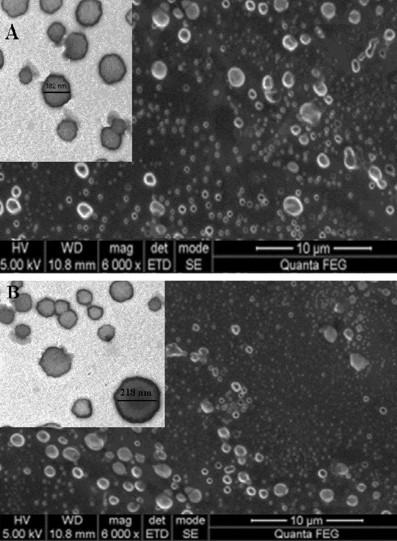 Fig. 1 Niosome-encapsulated Imipenem. 1
Antimicrobial & Anti-Biofilm Activity Assessments
The true measure of a nanocarrier lies in its ability to breach biological barriers. Advanced studies assessing Minimum Inhibitory Concentration (MIC) and Minimum Biofilm Inhibitory Concentration (MBIC) reveal that encapsulated formulations can reduce the required therapeutic doses by 4 to 6 times compared to free drugs. Furthermore, quantitative biofilm mass assays demonstrate that these optimized carriers can inhibit biofilm growth by nearly 70%. This signifies the carrier's exceptional capability to overcome structural resistance and deliver active compounds directly to the embedded microcolonies.
Molecular Profiling of Biofilm Gene Expression
To fully understand the anti-biofilm mechanisms, researchers analyze the genetic response of the bacteria. Utilizing RT-qPCR profiling, studies have shown that niosomal delivery significantly downregulates critical biofilm-associated genes, such as icaD, FnbA, and EbpS. This molecular data is pivotal; it proves that the nanocarrier system is not merely killing the bacteria via surface contact, but actively interfering with the pathogen's genetic ability to construct and maintain the biofilm matrix.
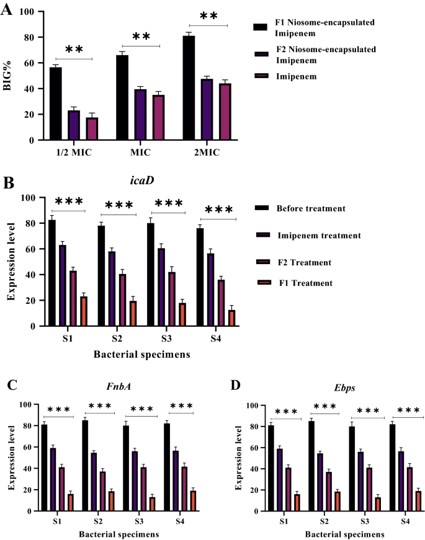 Fig. 2 The biofilm growth inhibition effect and the influence on biofilm gene expressions of Imipenem encapsulated by Niosome. 1
In Vitro Cytotoxicity & Biocompatibility Evaluation
A highly effective antimicrobial must also be safe for the host. Cytotoxicity studies, typically conducted using MTT assays on healthy human cell lines (such as HDF cells), are essential for safety validation. Formulations that maintain a cell viability of over 90% across various tested concentrations demonstrate an excellent biocompatibility profile. This critical safety data supports the potential for successful in vivo translation and eventual clinical application of the lipid-based delivery system.
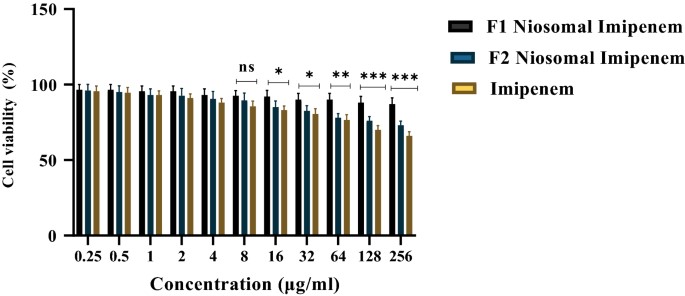 Fig. 3 Cell viability percentage of HDF cells treated with various formulations of Niosome-encapsulated Imipenem. 1
Related Services & Products
Navigating the complexities of niosomal and lipid-based formulations requires specialized technical capabilities. Creative Biolabs offers end-to-end, specialized services related to Imipenem niosome formulations, lipid-based drug delivery systems, and anti-biofilm applications. We expertly support clients from initial conjugation strategy design to rigorous biological validation, ensuring your therapeutic candidates achieve optimal efficacy, stability, and safety profiles.
|
Services/Products
|
Description
|
Inquiry
|
|
Liposome & Niosome Development
|
Custom formulation of advanced lipid-based carriers utilizing optimized thin-film hydration and extrusion techniques.
|
Inquiry
|
|
Comprehensive Characterization
|
Precise analysis of vesicle size, PDI, zeta potential, encapsulation efficiency, and drug loading capacity.
|
Inquiry
|
|
In Vitro Antimicrobial Validation
|
Robust MIC, MBIC, and anti-biofilm efficacy testing against resistant strains, including gene expression analysis.
|
Inquiry
|
|
Cytotoxicity & Safety Profiling
|
Rigorous biocompatibility screening (e.g., MTT assays) on target mammalian cell lines to ensure clinical viability.
|
Inquiry
|
Resources
Reference
-
Piri-Gharaghie, Tohid, et al. "Effects of Imipenem-containing Niosome nanoparticles against high prevalence methicillin-resistant Staphylococcus Epidermidis biofilm formed." Scientific reports 12.1 (2022): 5140. Distributed under Open Access license CC BY 4.0, without modification. https://doi.org/10.1038/s41598-022-09195-9.

For Research Use Only. Not For Clinical Use