


Anti-Glycan Antibody Affinity Maturation Service
Anti-Glycan Antibody Affinity Maturation Service
Improve the binding affinity of anti-glycan antibodies through in vitro directed evolution while tightly controlling specificity drift.
Service Focus
- Anti-glycan antibody engineering for research-use projects.
- Workflow design aligned with target format, specificity needs, and downstream readouts.
- Clear reporting to support candidate comparison and next-step planning.
Overview
Anti-glycan antibodies often require careful optimization before they can meet the sensitivity, reproducibility, or functional-readout needs of demanding research programs. A candidate may show encouraging specificity but insufficient affinity for weak IHC or IF staining, limited SPR/BLI sensitivity, low signal in cell-based binding assays, or suboptimal performance in research-model neutralization readouts. In these cases, affinity maturation can help transform a promising parental antibody into a more useful research reagent while preserving the binding profile that made the original clone valuable.
Creative Biolabs offers an Anti-Glycan Antibody Affinity Maturation Service designed for glycan-recognition antibodies where affinity improvement must be balanced against specificity retention. Using CDR mutagenesis libraries and stringent in vitro screening, we help researchers obtain higher-affinity variants from existing anti-glycan antibodies, including clones generated by hybridoma, phage display, single B cell, or other antibody discovery workflows.
Our service focuses on practical antibody optimization: defining which CDR regions and contact residues should be diversified, applying selection pressure that enriches stronger binders, and integrating specificity counter-screening to reduce the risk of unwanted glycan cross-reactivity. For projects involving closely related glycan epitopes, carrier-conjugated glycans, linker-dependent presentation, or cell-surface glycan targets, we design the maturation workflow around both affinity improvement and specificity safeguarding.
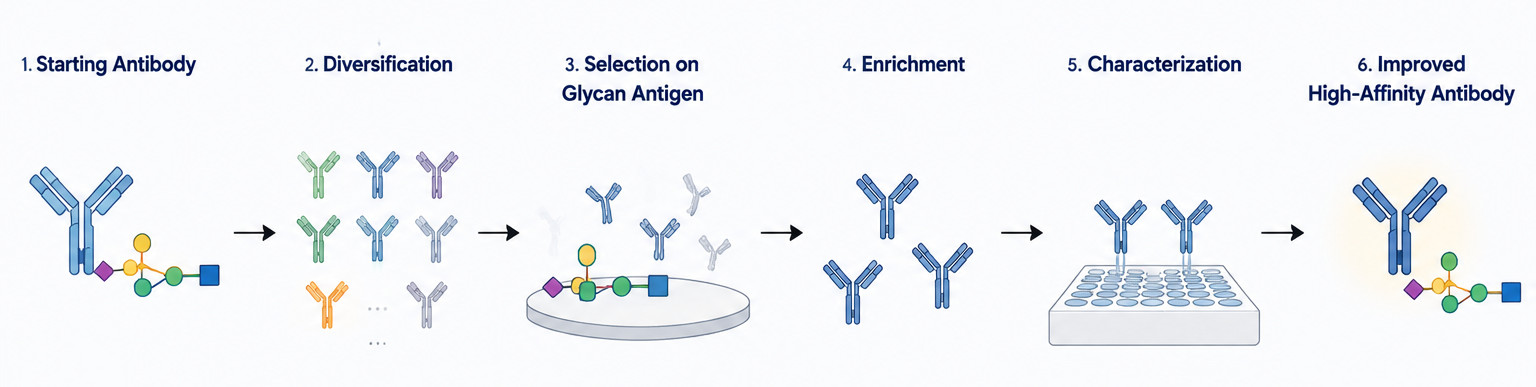
Fig.1 Anti-glycan antibody affinity maturation.
Challenges
Presentation-Sensitive Affinity
Affinity maturation for anti-glycan antibodies is technically different from routine antibody optimization against protein antigens. Glycan-antigen recognition may depend strongly on avidity, local density, branching, multivalent presentation, and the way the glycan is displayed on a carrier, array surface, cell membrane, or conjugated reagent. As a result, improving monovalent affinity through point mutations can sometimes disrupt the original multivalent binding mode, even when apparent binding strength improves in one assay format.
Specificity Drift
Another challenge is specificity drift. Glycans frequently share related monosaccharide units, linkages, terminal motifs, or backbone features. Mutations that add hydrophobic contacts, strengthen electrostatic interactions, or broaden the binding pocket may improve target signal while also increasing binding to neighboring glycans, carrier proteins, spacer linkers, or unrelated glycoconjugates. For anti-glycan antibodies, a higher binding signal is not automatically a better variant unless the original fine specificity is retained.
Dual-Screening Strategy
Creative Biolabs therefore applies a dual-screening strategy: affinity improvement plus specificity safeguarding. Rather than selecting only the strongest binders, we use counter-screening and secondary validation to remove clones that gain affinity at the expense of target discrimination. This approach is especially important for antibodies intended for research applications where glycan fine specificity, cell-binding selectivity, or assay background must be controlled.
Methods
Creative Biolabs develops customized affinity maturation workflows based on the parental antibody sequence, original antigen format, available glycan materials, intended research assays, and acceptable specificity boundaries.
Focused CDR Library Design
We construct focused CDR mutagenesis libraries around the parental antibody, using phage display and/or yeast display depending on the antibody format, target presentation, screening depth, and downstream readout needs. Library design often emphasizes CDR-H3 because of its frequent role in antigen contact and binding-pocket geometry, while also considering CDR-H1, CDR-H2, light-chain CDRs, and structurally or empirically defined contact residues. When sequence, modeling, alanine scanning, or parental binding data are available, we use them to avoid unnecessary diversification of residues that may be critical for preserving the original glycan-recognition mode.
Selection Pressure Tuning
Selection pressure is adjusted across screening rounds to enrich variants with improved binding behavior. We may lower target glycan concentration, increase wash stringency, extend dissociation time, or use competitive elution to favor clones with slower off-rates or stronger target engagement. For anti-glycan antibodies, these conditions are tuned carefully because overly aggressive selection can favor variants that bind the carrier, linker, or shared glycan motifs rather than the intended epitope.
Specificity Counter-Screening
To control specificity drift, we incorporate negative selection or counter-screening against neighboring glycans, structurally related glycans, carrier proteins, spacer linkers, unconjugated supports, and other project-relevant off-target materials. Depending on project design, counter-screening may be used during each selection round or applied as a secondary filter after enrichment. The goal is to exclude clones that appear stronger only because they have acquired broader, less desirable binding.
Affinity Ranking and Re-Validation
After enrichment, output clones are sequenced, expressed in an appropriate antibody format, and ranked by target-binding performance. We then re-validate specificity using the parental antibody as the baseline comparator. Selected variants may be analyzed by ELISA, glycan-binding assay, SPR, BLI, flow cytometry, cell-binding assays, or other research-use readouts aligned with the customer’s final application. The final recommendation prioritizes variants that show meaningful affinity improvement while retaining the desired glycan-binding profile.
Screening Readouts
Our screening readouts are selected to distinguish true antibody affinity improvement from nonspecific signal gain. For anti-glycan antibodies, this distinction is essential because stronger apparent binding can arise from avidity effects, altered carrier recognition, or broadened glycan cross-reactivity.
Typical readouts include stronger target-binding signal in the selected assay format, such as ELISA, glycan-array-style screening, display-based enrichment, or cell-based binding analysis. For kinetic assessment, SPR or BLI can be used to identify variants with slower off-rate and improved binding stability compared with the parental antibody. When cell-surface glycan recognition is relevant, improved cell-binding signal may be evaluated against antigen-positive and control cell models.
Specificity retention is assessed in parallel. We look for no significant increase in neighboring-glycan binding, carrier binding, linker binding, or other project-defined off-target reactivity. A variant that shows improved target affinity but also gains unwanted binding to related glycans may be deprioritized, even if its raw target signal is high.
This readout strategy helps customers compare variants by more than a single affinity number. It supports selection of candidates with improved binding behavior, acceptable specificity retention, and better fit for the intended research application.
Outputs
Creative Biolabs provides clear, decision-ready outputs for anti-glycan antibody affinity maturation projects. Final deliverables are customized to the agreed workflow and may include high-affinity variant sequences, parental-to-variant sequence comparison, expression and purification information when applicable, and assay data generated during screening and validation.
The performance package typically includes fold-improvement versus the parental antibody, based on the most relevant binding readout such as EC50 shift, apparent affinity, kinetic profile, or SPR/BLI-derived parameters. Where appropriate, we summarize on-rate, off-rate, binding-response curves, target signal, and cell-binding signal to support practical candidate comparison.
A specificity-retention validation report is included to document how output clones performed against neighboring glycans, carriers, linkers, and other off-target materials included in the project. This report is designed to show not only which variants improved, but also which variants preserved the intended anti-glycan specificity.
Customers also receive candidate recommendations with a sequence/performance matrix. This matrix supports straightforward comparison of each variant by sequence changes, affinity-improvement level, specificity-retention status, assay readouts, and recommended next-step use. Our team can also support follow-on antibody production, format conversion, glycan-binding characterization, or additional antibody optimization service needs for research-use programs.
Ready to Discuss Anti-Glycan Antibody Affinity Maturation Service?
Share your target format, antibody sequence or candidate information, assay goals, and project-specific specificity concerns with our team.
Customer Reviews
Recommended Products
Representative anti-glycan product categories can support antigen preparation, antibody screening, and follow-on research workflows.
Carbohydrate Antigen Products
A research-use collection of carbohydrate antigens, including oligosaccharides, nucleosides, monosaccharides, neoglycolipids, and glycans, suitable for glycan-focused antibody generation, binding studies, and assay development.
Explore Related ProductsMonoclonal Antibody Products
Designed for precise glycoepitope recognition, these monoclonal antibody products support high specificity, reduced cross-reactivity, and advanced screening workflows for glycan profiling and therapeutic research.
Explore Related ProductsPolyclonal Antibody Products
These polyclonal antibody products offer broad epitope recognition, strong signal generation, and flexible use in glycoantigen detection, immunoassays, and other applications that benefit from high sensitivity.
Explore Related Products