


Anti-Glycan Antibody BLI Binding Analysis Service
Anti-Glycan Antibody BLI Binding Analysis Service
Candidate anti-glycan antibodies often need a fast, label-free way to compare binding strength, association behavior, and dissociation trends before deeper kinetic work is planned. Creative Biolabs offers anti-glycan antibody research services that include BLI binding analysis for anti-glycan antibodies, giving research teams a practical route for clone ranking, format comparison, and early kinetic assessment.
Service Focus
- Overview
- Why BLI
- Assay Design
- Applications and outputs
Overview
Bio-layer interferometry detects binding events through changes in optical thickness at the surface of a biosensor tip. Because the assay is label-free, real-time, and compatible with parallel sample formats, it is well suited to candidate ranking when several anti-glycan antibodies must be compared under similar assay conditions.
For glycan-related projects, BLI is most useful when the goal is to compare candidates efficiently rather than to overfit complex binding behavior. It can complement ELISA, SPR, glycan microarray profiling, and cell-based assays by adding kinetic and ranking information to the decision package.
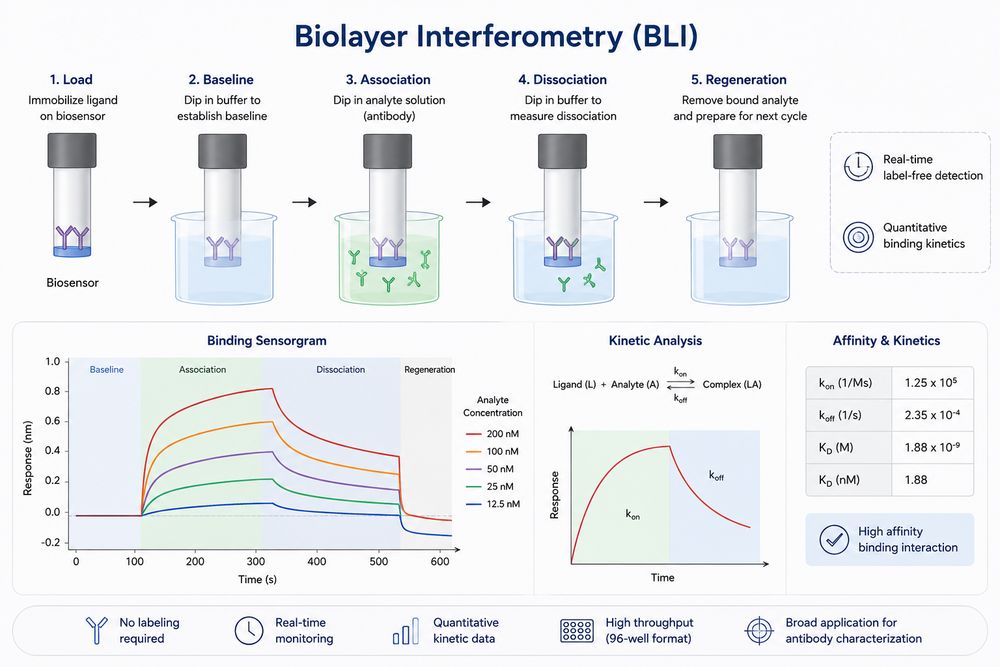
Fig.1 Biolayer Interferometry (BLI) Kinetic Binding Analysis Workflow.
Why BLI
BLI provides a simple, high-throughput format for measuring binding in a plate-based workflow. Compared with SPR, it does not require a microfluidic flow path, can run multiple samples in parallel, and often supports small-volume assays. It is therefore useful for rapid ranking, early kinetic screening, and engineering-variant comparison.
The tradeoff is that BLI may offer lower resolution than SPR for certain complex or weak interactions. For this reason, we position BLI as a practical ranking and preliminary kinetic platform, while recommending SPR or other orthogonal assays when higher-resolution modeling is required.
Assay Design
- Biosensor selection: anti-human IgG, anti-mouse IgG, streptavidin, or other formats are selected based on antibody and ligand design.
- Ligand loading control: surface density is tuned to keep response signals within a useful and interpretable range.
- Analyte concentration series: five to seven concentrations with serial dilution are commonly used for ranking and fitting.
- Buffer optimization: BSA, Tween, salt, or blocking conditions may be adjusted to reduce nonspecific binding.

Applications
| Application | How BLI Helps | Decision Value |
|---|---|---|
| Clone ranking | Compares association and dissociation behavior across candidates | Prioritizes stronger or slower-off-rate binders |
| Engineering-variant screening | Measures binding after humanization, affinity maturation, or format conversion | Checks whether modification changes binding behavior |
| Format confirmation | Tests binding after Fc, Fab, scFv, or tagged-format conversion | Supports go/no-go decisions before larger studies |
| Batch-level binding check | Provides a consistent binding readout under defined conditions | Helps confirm research-batch comparability |
Outputs
- Raw and fitted association/dissociation curves.
- KD, kon, and koff values when fitting quality supports reporting.
- Candidate ranking table with assay-condition notes.
- Method summary covering sensor type, loading strategy, buffer, and concentration series.

Published Data
Bio-layer interferometry has been widely applied for real-time, label-free characterization of biomolecular interactions in vaccine and antibody research. As summarized in the MDPI review on BLI-based strategies for vaccine development, the platform enables kinetic and affinity analysis by immobilizing one interaction partner on disposable biosensors followed by sequential exposure to analytes under a dip-and-read format . This workflow generates real-time binding sensorgrams that support quantitative extraction of kinetic parameters including association (kon), dissociation (koff), and equilibrium affinity (KD). Published case studies in the review demonstrate that BLI can resolve fine differences in antibody–antigen interactions, including epitope-specific binding changes introduced by site-directed mutagenesis and antibody competition assays. In addition, epitope binning and multivalent interaction analysis further highlight its utility in antibody selection workflows. These capabilities make BLI particularly suitable for anti-glycan antibody characterization, where subtle structural variations in glycan epitopes often result in significant differences in binding kinetics and specificity.
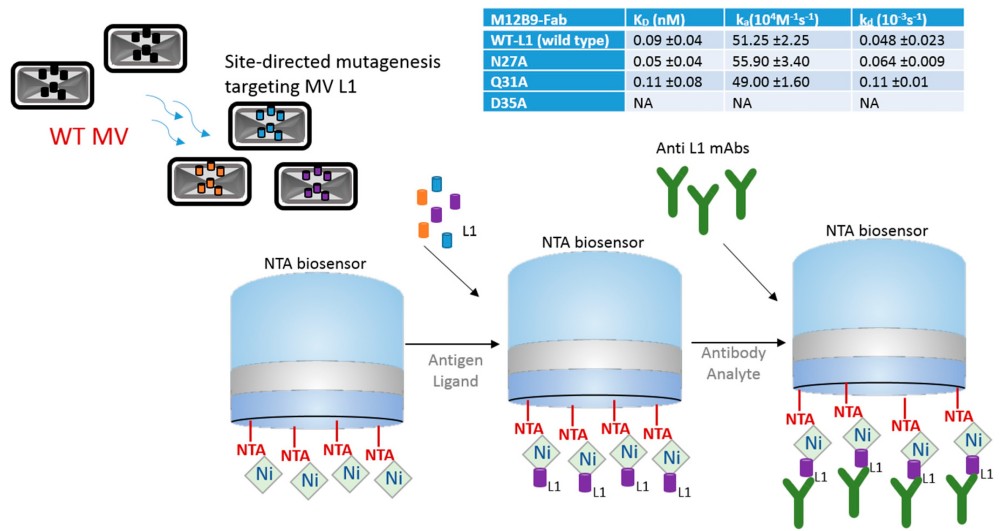
Fig.2 Bio-Layer Interferometry (BLI) Antibody Binding Kinetics and Epitope Mapping Using Site-Directed Mutagenesis.1
Why Choose Creative Biolabs
Creative Biolabs can help configure a BLI binding analysis workflow that fits your candidate format, sample volume, ranking question, and downstream validation plan.
- Fast ranking: parallel BLI runs help compare several candidates quickly.
- Flexible sensor choice: assay setup can match antibody format and ligand design.
- Clear kinetic readouts: reports include curves, fit quality, and ranking notes.
- Smart follow-up: we flag when SPR or cell-based validation would add value.
Discuss Your Anti-Glycan Antibody Project
Creative Biolabs can support assay planning, candidate comparison, and research-stage data delivery for anti-glycan antibody projects.