


Anti-Glycan Antibody Format Conversion Service
Anti-Glycan Antibody Format Conversion Service
A glycan-binding antibody may need to behave like an IgG in one experiment, a monovalent Fab in another, and an scFv in an engineering workflow. Creative Biolabs supports format decisions within our anti-glycan antibody research services by offering anti-glycan antibody format conversion for research applications where valency, orientation, expression system, or conjugation access can change the interpretation of binding data.
Key Takeaways
- Convert anti-glycan antibodies across IgG, Fab, scFv, scFv-Fc, Fab'2, and selected Fc-fusion formats while preserving research utility.
- Plan sequence, linker, expression, purification, and post-conversion comparison around glycan-specific risks such as valency and epitope accessibility.
- Use format conversion to support detection, display screening, cell binding, engineering preparation, or defined conjugation workflows.
- Receive converted materials, purity assessment, binding-retention data, and practical guidance for the next experiment.
Overview
Anti-glycan antibodies are especially sensitive to molecular format because many glycan epitopes are small, multivalent, and context-dependent. Converting an antibody from IgG to Fab, scFv, scFv-Fc, Fab'2, or Fc-fusion format can reveal whether observed binding is driven by intrinsic paratope recognition, avidity, steric orientation, or Fc-mediated presentation.
Our service supports research-use conversion across common antibody formats, including IgG, Fab, Fab'2, scFv, scFv-Fc, and selected Fc-fusion designs. Each project is planned around the intended assay, expression requirements, and the need to compare converted formats against the starting molecule.
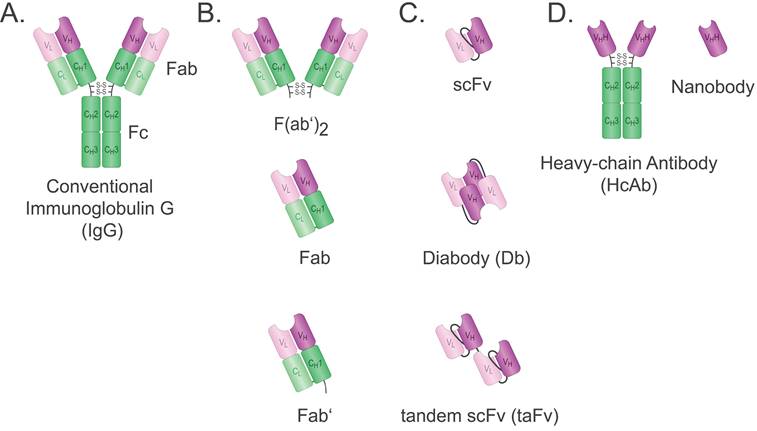
Fig.1 Antibody and antibody fragments.1
Why Convert
Format conversion is not simply a cloning exercise. It is a way to adapt the same binding specificity to different analytical and engineering questions.
-
Downstream detection: Full IgG may be preferred for ELISA and secondary-antibody detection, whereas Fab or scFv may reduce avidity artifacts in SPR or BLI studies.
-
Display screening: scFv formats are commonly used for phage or yeast display workflows when a sequence needs to enter affinity maturation or library-based selection.
-
Cell binding: Monovalent Fab can help estimate true single-site binding to cell-surface glycans without the extra signal contributed by bivalent IgG engagement.
-
Engineering preparation: scFv or Fab formats may simplify humanization, linker design, or variant-library construction.
-
Conjugation needs: Fab'2 or engineered fragments can expose sites useful for labeling, immobilization, or defined conjugation strategies.
Services We Offer
Creative Biolabs can begin with sequence analysis and format design, then proceed through codon optimization, signal-peptide selection, linker design, expression-vector construction, transient expression, purification, and format-specific binding verification. The conversion route is selected according to the desired molecule, expected expression host, and downstream assay sensitivity.
For projects that require direct comparability, we recommend parallel testing of the parental and converted formats under matched antigen-presentation conditions. This helps distinguish a true loss of recognition from changes caused by valency, steric access, or assay orientation.
Special Considerations for Glycan
Glycan recognition brings several format-specific risks that should be addressed before the converted molecule is treated as functionally equivalent to the original antibody.
-
Valency effects: IgG-to-Fab conversion may sharply reduce apparent signal when the original assay depended on bivalent or clustered binding.
-
Epitope accessibility: A compact scFv can improve access in some contexts but may also change orientation toward shallow glycan epitopes.
-
Aggregation tendency: Some scFv constructs expose hydrophobic or unstable regions after conversion, so expression, purification, and monodispersity checks are important.
-
Linker influence: scFv orientation and linker length can affect folding, expression yield, and antigen recognition, especially for paratopes that rely on precise VH/VL pairing.
Outputs
Project outputs can include expression plasmids, purified converted protein, purity assessment, and binding-retention data comparing the converted molecule with the starting antibody. For suitable projects, the final package may include ELISA, SPR, or cell-binding comparison results with notes on format-related interpretation.
Creative Biolabs aims to make the converted format usable for the next experiment, not just structurally redesigned on paper. When a converted molecule shows reduced binding or expression challenges, we provide practical recommendations for redesign, alternative format selection, or assay adjustment.
Why Choose Creative Biolabs
Creative Biolabs helps researchers convert anti-glycan antibodies into formats that better fit different assays and research goals. We focus on keeping the antibody's binding ability while making the new format useful for the next experiment.
-
Multiple format options
We support common formats such as IgG, Fab, scFv, scFv-Fc, and Fab'2, depending on the planned application. -
Binding-focused design
We consider how format changes may affect glycan binding, especially when the original signal depends on antibody valency or antigen presentation. -
Careful sequence and linker design
For scFv and related formats, we help design suitable VH/VL orientation and linker sequences to support proper folding and expression. -
Post-conversion validation
After conversion, we can compare the new format with the original antibody by ELISA, SPR, or cell-binding assays to check whether binding is retained.
Customer Reviews
Recommended Products
Carbohydrate Antigen Products
A research-use collection of carbohydrate antigens, including oligosaccharides, nucleosides, monosaccharides, neoglycolipids, and glycans, suitable for glycan-focused antibody generation, binding studies, and assay development.
Learn MoreMonoclonal Antibody Products
Designed for precise glycoepitope recognition, these monoclonal antibody products support high specificity, reduced cross-reactivity, and advanced screening workflows for glycan profiling, diagnostics, and therapeutic research.
Learn MorePolyclonal Antibody Products
These polyclonal antibody products offer broad epitope recognition, strong signal generation, and flexible use in glycoantigen detection, immunoassays, and other applications that benefit from high sensitivity.
Learn MoreFrequently Asked Questions
Not always. Removing bivalency can reduce apparent binding when the IgG signal depends on avidity or clustered glycan presentation. We recommend parallel comparison so format-driven signal changes are interpreted correctly.
Yes. scFv-Fc design can be considered when clients need Fc-mediated detection, increased apparent size, or bivalent presentation while retaining an scFv-derived binding unit. Linker and orientation choices are reviewed carefully.
Useful inputs include VH/VL sequences, current antibody format, desired target format, known expression history, antigen or cell-binding data, and the assay or engineering workflow that motivates the conversion.
Binding retention may be assessed by ELISA, SPR, BLI, flow cytometry, or another fit-for-purpose method. The best format depends on antigen form, expected affinity, sample amount, and whether valency effects should be minimized.
References
Khilji, Sana Khan, et al. "Smaller Size Packs a Stronger Punch - Recent Advances in Small Antibody Fragments Targeting Tumour-Associated Carbohydrate Antigens." Theranostics 13.9 (2023): 3041-3063. Distributed under Open Access license CC BY 4.0, without modification. https://doi.org/10.7150/thno.80901