


Glycovariant Research Assay Development Service
Custom Development for Glycovariant Readouts, Specificity Profiling, and Cross-Reactivity Control
Within our Anti-Glycan Antibody Research Services, Creative Biolabs supports research-stage development of assays aimed at defined glycosylation variants, glycoform-enriched protein subpopulations, or site-associated glycan features. These projects are typically used for biomarker exploration, mechanism studies, candidate verification, translational feasibility review, and antibody specificity or cross-reactivity assessment. We help turn an early glycovariant hypothesis into a practical assay prototype with clearer specificity boundaries and a more defensible interpretation path.
Project Focus
- Support for custom assay design when total protein measurement does not provide sufficient biological resolution.
- Evaluation of off-target glycan binding through matrix-aware controls, related-structure comparisons, and orthogonal confirmation logic.
- Flexible selection of assay principles, including glycan microarray-based specificity assessment and other target-matched research formats.
Scientific Background of Glycovariant Assay Development
Many disease-associated signals are not driven only by protein abundance. They can emerge from site-specific glycosylation remodeling, selective glycoform enrichment, or altered presentation of glycan epitopes. For that reason, when using antibodies targeting the protein backbone, conventional total antigen assays (e.g., standard ELISA or Western blot) may miss the more informative layer of glycosylation biology even when the underlying protein is measurable. However, assays incorporating anti-glycan antibodies or lectins can partially resolve this limitation by directly probing glycan features. A research assay designed around the relevant glycovariant can provide more informative biological resolution and a closer connection to the question being tested.
This matters especially when researchers are comparing small cohorts, model systems, or longitudinal samples and need to determine whether an observed signal reflects a true glycosylation-associated change rather than a generic shift in total protein. It also matters when anti-glycan antibodies are involved, because antibody specificity, cross-reactivity, and off-target interactions can strongly affect data interpretation. Our development strategy therefore combines glycovariant-focused assay design with structured specificity profiling from the beginning.
- Glycosylation is non-template-driven and naturally heterogeneous across samples and sites.
- Different glycoforms on the same protein may require different capture and detection logic. For example, high-mannose structures can be captured by ConA lectin, while complex sialylated glycochains may require anti-sLeX antibodies or SNA lectin for specific detection.
- Low-abundance glycovariants are often masked by complex matrices and high-background species.
- Research-stage development still requires attention to specificity, linearity, precision, and matrix effect.
- Research-use readouts must define method boundaries clearly (e.g., LoD/LoQ, dynamic range, interference thresholds) before any larger study expansion.
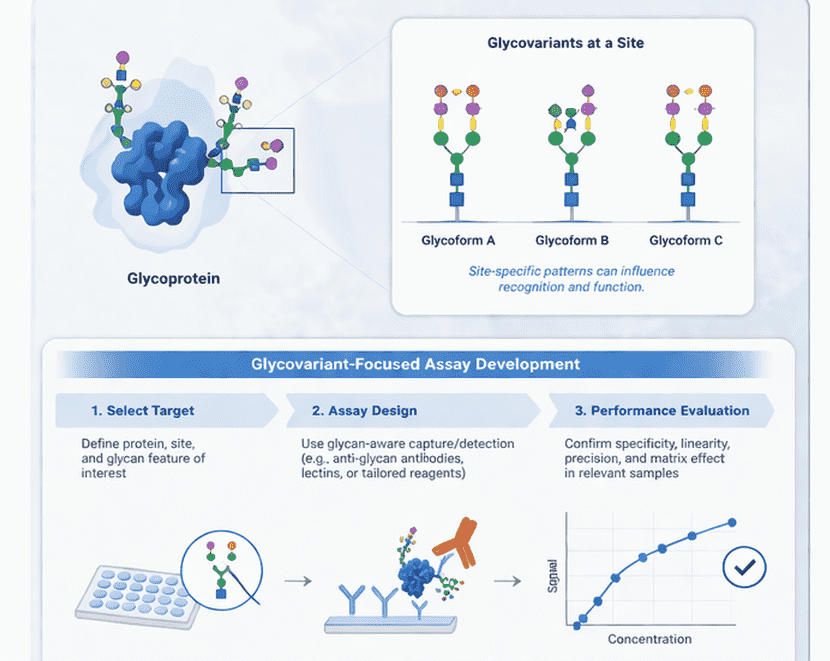
Fig.1 Glycovariant assay development.
Why Glycovariant Assays Matter and What Makes Them Difficult
Glycovariant projects can be highly informative, but they are rarely plug-and-play. The development path depends on the biology of the target, the sample matrix, the expected abundance range, and the type of off-target risk that must be controlled.
Microheterogeneity
Natural glycan diversity means the intended signal can be spread across closely related structures rather than one clean analyte.
Site Dependence
Two glycosylation sites on the same protein can behave differently, making generic reagent choices unreliable.
Matrix Interference
Serum, plasma, lysates, or conditioned media can hide low-level glycovariants behind abundant background components.
Specificity Pressure
Cross-reactivity, off target glycan binding, and weakly selective binders can create attractive but misleading readouts.
Feasibility First
We review target evidence, matrix context, and likely measurable windows before a larger build is recommended.
Format Matching
Assay format selection depends on the target and sample context rather than forcing every project into one standard platform.
Orthogonal Logic
Complementary verification helps distinguish true glycovariant signals from total protein shifts or non-specific interactions.
Research-Grade Metrics
Performance is assessed against the current research question so the output is practical, interpretable, and scalable.
What We Can Support
Our role is not to promise one universal assay answer. Instead, we provide modular support around target review, glyco-epitope selection, assay architecture, reagent pairing, and early analytical characterization so that a vague glycovariant concept can become a more decision-ready research tool.
Problems We Help Researchers Address
- Total biomarker levels are measurable but not sufficiently discriminative.
- Discovery data suggest a disease-associated glycoform that now needs a targeted readout.
- Candidate biomarker screening needs a smaller-scale assay framework before broader expansion.
- Different batches, models, or matrices must be compared with more reproducible glycosylation-aware logic.
Why Researchers Choose This Service
- Development strategy is built around glycoform biology rather than generic assay templates.
- Orthogonal evidence is prioritized to reduce false interpretation of glycan-associated changes.
- Early-stage uncertainty is handled through feasibility review instead of premature overcommitment.
- Outputs include method boundaries and optimization direction, not only a single endpoint number.
Our Glycovariant Assay Development Workflow
Our workflow is designed for research-stage assay construction, specificity planning, and efficient decision-making at early project stages.

Fig.2 Glycovariant research assay development workflow overview.
Review
Confirm target biology, glycan features, project scope, and sample origin.
Design
Select the assay principle, critical reagents, controls, and specificity checkpoints.
Build
Build the prototype readout and optimize the major variables that influence performance.
Confirm
Use orthogonal methods to verify that the observed signal is consistent with the intended glycovariant.
Evaluate
Generate fit-for-purpose research data and define feasible next optimization steps within the project scope.
Sample Types and Sample Requirements
Sample planning is one of the main determinants of whether a glycovariant project will yield an interpretable readout. We therefore encourage researchers to provide both biological context and material details at project start.

Suggested Submission Items
- Target name, known glycosylation clues, and the preferred signal interpretation goal.
- Sample type such as serum, plasma, cell culture supernatant, purified glycoprotein, tissue lysate, or qualified clinical research specimens when appropriate.
- Available comparators, benchmark binders, negative controls, or related glycans for cross-reactivity review.
- Expected concentration range, matrix constraints, storage conditions, and available volume per sample when known.
- Any requested custom specificity assay, cross-reactivity service, or glycan microarray specificity analysis element.
Project Output
Deliverables are defined according to project scope, but the aim is always to provide a usable research package rather than an isolated signal readout.
Typical Deliverables
- Assay development summary and recommended workflow for the evaluated target.
- Preliminary performance observations, raw and processed readouts, and control strategy notes.
- Specificity profiling observations, cross-reactivity findings, and discussion of off-target risk when applicable.
- Feasibility conclusions, method limitations, and next-step recommendations for further optimization.

Have a Candidate Glycoprotein, Glycan Signature, or Early Omics Signal?
We can help assess whether it is suitable for translation into a research-use glycovariant assay and outline a more practical development path with clearer specificity expectations.
Published Data
Published studies on glycoform-selective immunoassays offer practical evidence for how assay architecture, capture-reagent background, and glycan-directed detection strategy can shape the clarity and interpretability of glycovariant readouts.
Aglycosylated Capture Antibodies Improve Glycoform-Selective Assay Readability
A representative open-access study described an aglycosylated antibody-lectin coupled immunoassay platform, ALIQUAT, for glycoform-selective measurement of tumor markers. Using AFP and AFP-L3 as a model system, the authors showed that an aglycosylated capture antibody retained practical quantitative performance in a standard sandwich assay for total AFP, while also enabling clearer lectin-coupled detection of the AFP-L3 glycoform. By comparison, conventional glycosylated capture antibodies produced high background and weak assay discrimination in the AFP-L3 format because lectins also interacted with Fc glycans on the antibody itself. For glycovariant research assay development, this study provides direct support for why capture-reagent glycosylation, background control, and glycoform-oriented assay design should be considered together from the beginning of assay development.
- Aglycosylated capture antibodies can preserve workable quantitative performance for total target measurement.
- Reducing Fc glycan-derived lectin interference can improve the clarity of glycoform-selective assay readouts.
- Published feasibility data support early assessment of linearity, background signal, and interference during glycovariant assay development.
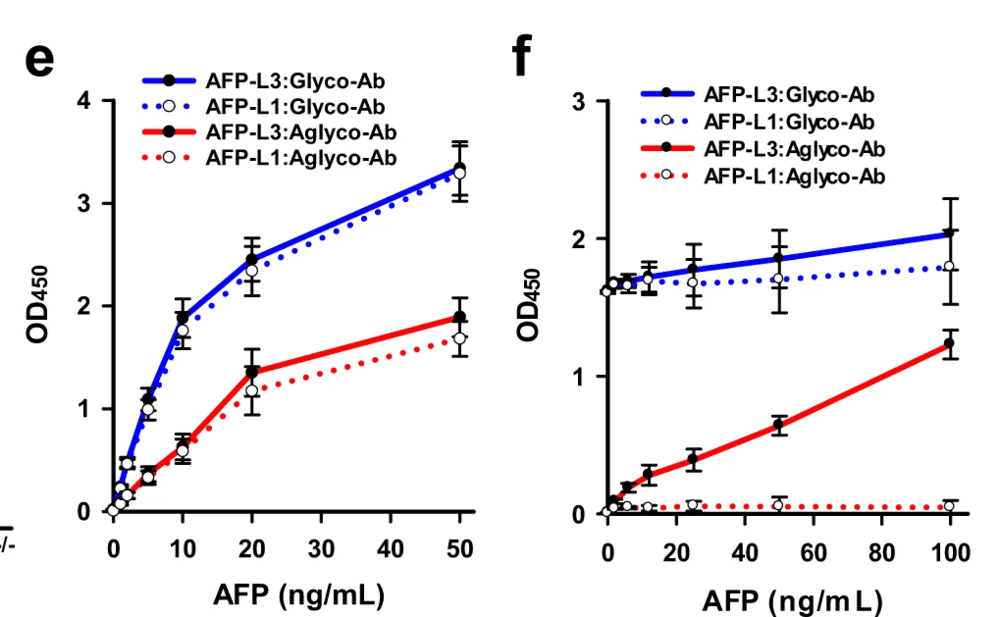
Fig.3 Quantitative comparison of total AFP and AFP-L3 assays showing the practical assay feasibility of an aglycosylated capture antibody and its improved performance in glycoform-selective AFP-L3 detection.1
Customer Review
Recommended Products
The following product categories can support glycan-related research workflows, reagent sourcing, and follow-on assay development.
Carbohydrate Antigen Products
Useful for antigen preparation, related-structure comparison, and glycan-focused assay design when specificity profiling requires defined glycan materials.
Learn MoreMonoclonal Antibody Products
Suitable for projects that need higher selectivity, tighter control of cross-reactivity, and more defined reagent behavior during glycan-focused assay development.
Learn MorePolyclonal Antibody Products
Useful when broader recognition is needed for exploratory research, signal screening, or early-stage assessment of glycan-associated changes across sample sets.
Learn More