


Anti-Glycan Antibody Glycan Microarray Profiling Service
When an anti-glycan antibody has already shown glycan-binding activity, the next question is not simply whether it binds, but how broadly, how selectively, and against which neighboring motifs. Creative Biolabs supports this deeper characterization through anti-glycan antibody research services, using glycan microarray profiling for anti-glycan antibodies that maps binding patterns across diverse glycan structures for research-stage candidate comparison.
Discuss Your ProjectProfiling Focus
- Binding breadth and motif selectivity review
- Cross-reactivity pattern interpretation
- Candidate comparison across glycan structures
Overview
Our anti-glycan antibody glycan microarray profiling service is designed for secondary or deep profiling after initial activity has been observed by ELISA, primary glycan screening, purified-antigen binding, or clone-level testing. Instead of treating the array as a first-pass discovery screen, the workflow uses high-density glycan presentation to define the antibody's binding fingerprint in greater structural detail.
The resulting profile helps researchers understand whether a candidate recognizes a narrow glycan epitope, a family of related motifs, or a broader structural pattern that may create useful coverage or unwanted cross-reactivity. The service is especially useful when several antibodies appear positive in an early assay but differ in fine specificity, signal intensity, or tolerance for neighboring glycan modifications.
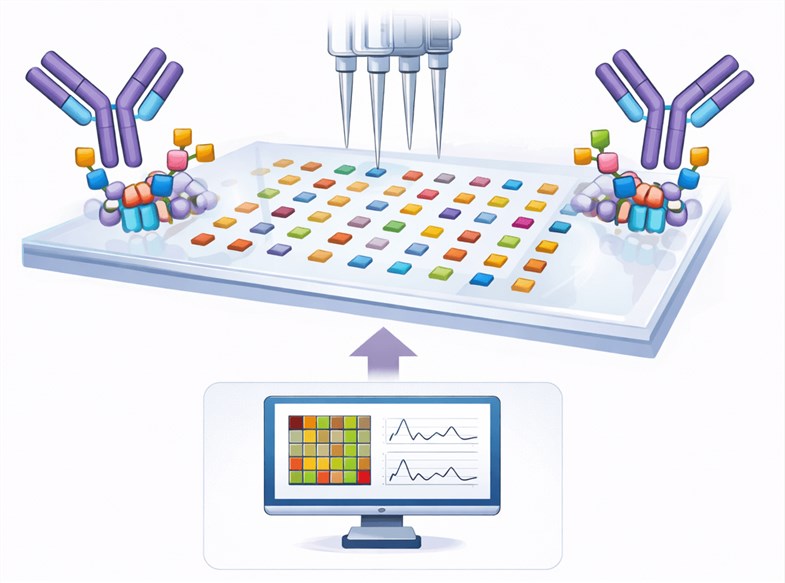
Fig.1 Glycan microarray profiling.
Service Scope
We accept several candidate formats when the sample has already been shown to have glycan-binding activity. The profiling depth, dilution plan, and reporting emphasis are adjusted according to the sample type and the research question.
- Purified antibodies: multi-concentration profiling to compare signal range, saturation behavior, and specificity.
- Serum samples: broad anti-glycan spectrum analysis for research programs that need an overview of antibody reactivity.
- Engineered variants: side-by-side comparison before and after sequence, format, or Fc-region modification.
- Hybridoma clones: fine specificity classification to support clone prioritization and follow-up validation.
Panel Design
Panel selection is planned around the level of resolution needed. A broad panel is useful when the likely recognition pattern is unknown, while a dense analog panel is preferred when the target glycan is known but neighboring linkage, branching, or substitution effects must be separated.
| Panel Option | Best Fit | Typical Readout |
|---|---|---|
| Broad glycan library | Candidates needing global specificity mapping across natural and synthetic glycans | Binding distribution across mammalian, microbial, and plant-related motifs |
| Disease- or pathogen-related custom panel | Programs focused on a defined biological source or antigen class | Target-class reactivity and off-target pattern review |
| Structural analog panel | Candidates with a known target motif requiring fine discrimination | Effect of linkage, branching, substitution, and terminal-residue changes |

Data Analysis
Raw array signals are transformed into a profile that can be interpreted across samples and across glycan structures. The analysis may include bidirectional heatmap clustering, signal-intensity grouping, motif enrichment, sample similarity mapping, and cross-reactivity review.
For multi-candidate projects, the report highlights which antibodies cluster together, which candidates show distinctive motif preference, and which glycans may require follow-up confirmation by ELISA, SPR, BLI, or cell-based assays.
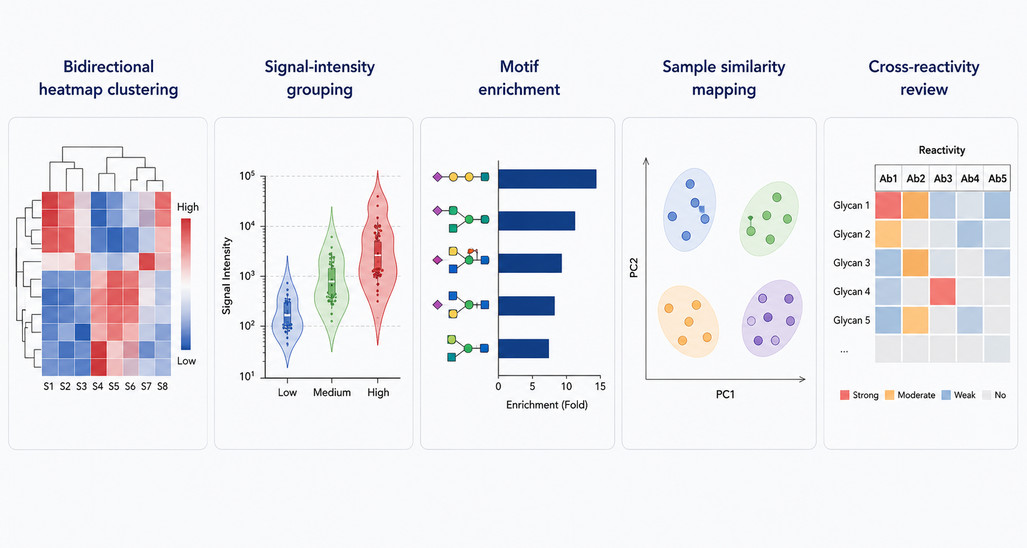
Fig.2 Glycan microarray profiling data analysis overview.
Outputs
Typical Deliverables
- Full binding-profile report with array-level signal summaries.
- Candidate motif annotations for likely specificity drivers.
- Cross-reactivity hotspot notes for structurally related glycans.
- Follow-up assay recommendations for orthogonal validation.

Why Choose Creative Biolabs
- Deep glycan coverage: we can profile candidates against broad or focused glycan panels.
- Clear specificity view: reports emphasize motifs, cross-reactivity, and candidate differences.
- Flexible sample fit: purified antibodies, serum, variants, and clones can be accommodated.
- Practical next steps: we recommend suitable follow-up assays for confirmation.
Discuss a Profiling Project
Creative Biolabs can help design a glycan microarray profiling plan that matches your antibody format, known target information, and follow-up validation needs.