Antibody-Lectin Sandwich Research Assay Development Service
Creative Biolabs develops antibody-lectin sandwich research assays with
orientation-aware reagent pairing, background control, matrix assessment, and transparent glycoform
interpretation across comparative research studies.
Creative Biolabs develops research assays for teams that need to ask whether a defined
glycan feature is present on a defined protein target. Our antibody-lectin sandwich research assay development
service sits within Anti-Glycan
Antibody Research Services and can begin from an existing immunoassay, target protein, candidate
antibody, candidate lectin, or project-specific sample matrix.
The assay is most useful when total protein abundance alone does not answer the research question. An
antibody provides target identity, while a lectin contributes sensitivity to a defined carbohydrate motif.
That combination can reveal relative glycoform differences, but only when reagent-derived glycans, blocking
materials, epitope accessibility, and matrix interference are addressed during development.
Why Antibody-Lectin Sandwich Assays Need Specialized Design
Capture antibodies are glycoproteins, many common blockers contain glycan-bearing proteins, and lectins
recognize families of structures rather than a single molecular species. As a result, a strong signal can arise
from the captured target, the capture reagent, the blocker, other matrix glycoproteins, or a combination of
these sources. Specialized design is needed to assign the signal with reasonable confidence.
Glycan accessibility: Capture can mask a glycan motif or alter how it is presented to the
lectin.
Reagent background: Fc glycans or glycoprotein blockers may be recognized by the detection
lectin.
Lectin breadth: A lectin preference is not equivalent to exact structural identification
and may change with density or context.
Matrix interference: Serum, plasma, lysate, or culture medium can contain competing
glycoproteins and endogenous binders.
Comparative interpretation: The format is generally stronger for relative group comparisons
than for complete glycan structural assignment.
Our Antibody-Lectin Sandwich Assay Development Services
Development is organized around feasibility, reagent pairing, assay orientation, background reduction, matrix
behavior, and the intended research comparison. Creative Biolabs can adapt the depth of work from an early
feasibility study to a more developed research protocol with documented conditions and pilot sample data. Exact
scope depends on the starting reagents and how much analytical confidence the downstream study requires.
Reagent Pair and Assay Format Screening
Candidate antibodies and lectins are assessed as functional pairs, not as independent high-performing
reagents. The antibody needs to capture the target without blocking the glycan region of interest, while the
lectin needs to respond to the relevant feature while maintaining manageable background. Detection labels,
secondary reagents, plate chemistry, and incubation order are reviewed as part of the pair.
Specificity and Matrix Assessment
Controls may include target-negative material, deglycosylated or enzymatically modified samples, competing
sugars, lectin omission, antibody omission, matrix blanks, spike-recovery designs, or alternative lectins.
The specific control set follows the glycan hypothesis and sample type. The purpose is to determine which
part of the signal can be attributed to the target-associated glycan feature.
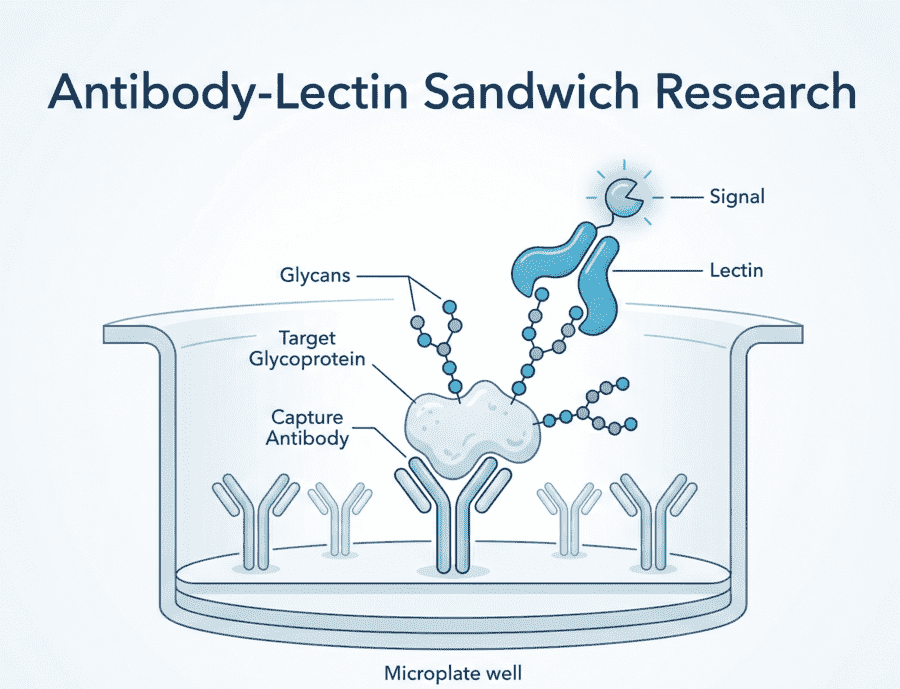
Fig.1 Antibody-lectin sandwich assay overview.
Selecting the Right Assay Orientation
Orientation
Where It Can Help
Main Risk
Useful Controls
Antibody capture / lectin detection
Clear target identity and adaptation from an existing target-specific immunoassay
Capture-antibody glycans and masked target glycan motifs
Oxidized or aglycosylated capture reagent, lectin omission, deglycosylated target
Lectin capture / antibody detection
Enrichment of a glycan-feature-positive population before target detection
Broad capture of matrix glycoproteins and lower certainty that enrichment is target-specific
Capture-first designs are often the more controlled starting point for a known target, but lectin-first or
inhibition formats may be informative when motif enrichment or accessibility is the central question.
Orientation is selected from the target biology and reagent behavior rather than by applying one format to every
glycoprotein.
When an Antibody-Lectin Sandwich Assay Is - and Is Not -
the Right Choice
This format is best suited to a defined protein target and a defined lectin-sensitive glycan feature when the
main goal is a comparative research readout. For a broader target-associated glycovariant assay strategy,
consider glycovariant
research assay development. If the decision requires complete glycan structure, linkage, site
localization, or occupancy, a glycosylation
analysis workflow is more appropriate.
Our Assay Development Workflow
Fig.2 Workflow overview for antibody-lectin sandwich assay development.
Specify the target protein, glycan feature, sample matrix, study groups, and the conclusion the assay
is expected to support.
Assess antibody epitopes, lectin preferences, reagent glycosylation, available standards, expected
signal range, and potential background sources.
Establish capture and detection orientation, coating, blocking, incubation, washing, and readout
conditions, while incorporating matched negatives, competitors, enzymatic controls, or reagent-only
controls as appropriate.
Evaluate representative samples together with dilution behavior, repeatability, spike recovery or
parallelism where applicable, matrix effects, and the usable response range.
Summarize selected conditions, pilot results, specificity and reproducibility observations, remaining
limitations, and recommended next steps.
Project Requirements and Deliverables
A project may begin with customer-supplied reagents, a target
and sample set, or only a glycoform hypothesis. Requirements and outputs are defined according to whether the
goal is feasibility, orientation selection, optimization, matrix adaptation, or pilot research testing.
Project Input
Project Requirements
Connects lectin selection and epitope accessibility to a biologically meaningful hypothesis.
Defines the starting reagent set and identifies gaps that affect feasibility.
Guides dilution, pretreatment, blocker choice, and interference controls.
Supports pilot design and prevents post hoc interpretation of ambiguous signal.
Clarifies whether the project needs a feasibility report, recommended conditions, or a documented
research protocol.
Project Output
Deliverables and Transfer Scope
Feasibility findings and the rationale for the selected assay orientation.
Reagent-pair screening data and recommended antibody-lectin combinations when included.
Documented coating, blocking, incubation, washing, and detection conditions generated during the
project.
Raw and processed pilot data, control results, and observations on matrix behavior or
reproducibility.
A technical report that distinguishes optimized conditions, unresolved limitations, and work that
remains necessary before broader use.
Controls That Make Glycoform-Dependent Signal
Interpretable
A target-linked signal becomes more interpretable when orthogonal controls support the same explanation.
Depending on the glycan hypothesis and matrix, useful controls can include deglycosylated or enzymatically
modified target, a relevant competitor sugar, target-negative material, lectin omission, antibody omission,
matrix blanks, and reagent-background controls. We select the control set to distinguish target-associated
glycan signal from capture-reagent, blocker, detection, or matrix effects.
Research Applications
Glycoprotein process or cell-state comparison
Compare target-associated lectin reactivity across matched research samples.
Glycoform-focused biomarker research
Test whether a chosen glycan motif on a known protein differs between defined groups.
Mechanism studies
Evaluate how perturbation, enzyme treatment, or pathway changes alter a target-linked glycan signal.
Research assay feasibility
Determine whether available reagents and sample matrix justify broader assay development.
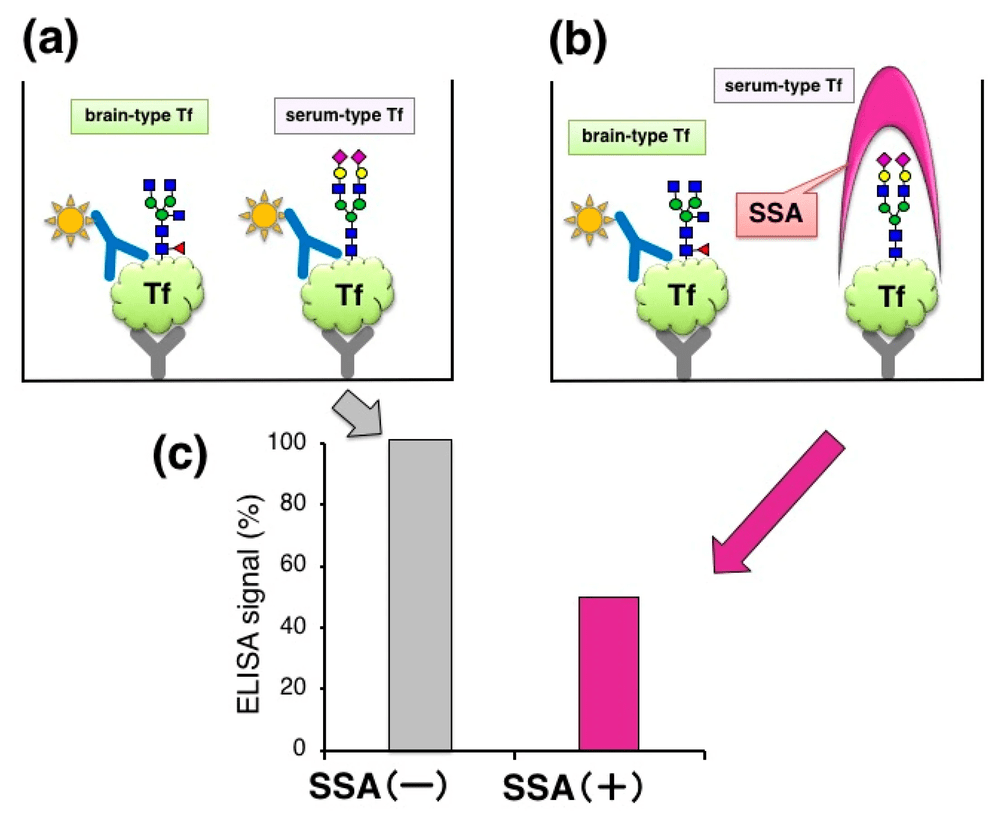
Ito and colleagues evaluated a lectin-inhibition strategy for distinguishing α2,6-sialylated transferrin from
related transferrin glycoforms. In the assay, Sambucus sieboldiana agglutinin (SSA), which recognizes
sialylα2,6galactose, reduced antibody binding to native serum transferrin. To test glycan specificity, the
authors compared untreated transferrin with periodate-treated Tf, asialo-Tf generated by sialidase digestion,
and agalacto-Tf produced by subsequent β-galactosidase treatment. SSA inhibited the signal from α2,6-sialylated
serum Tf but not the modified glycoforms, supporting glycan-dependent rather than general inhibition. The extent
of inhibition also varied among anti-transferrin antibodies, indicating that antibody epitope position and
reagent configuration can influence assay response. These findings illustrate why glycoform-specific assays
require matched glycan controls, appropriate lectin selection, and reagent-aware assay design before a signal
can be confidently attributed to a particular terminal glycosylation feature.
Fig.3 SSA binding to α2,6-sialylated transferrin selectively interferes with antibody recognition,
illustrating the principle of lectin-assisted glycoform-specific detection.¹
Discuss Your Antibody-Lectin Assay Concept
Please provide the target protein, glycan motif of interest, known glycosylation information, available
antibodies and lectins, existing assay conditions, sample matrix, expected abundance, study groups, standards
or controls, preferred readout, and whether the immediate goal is feasibility, orientation selection,
optimization, or pilot sample testing.
Scope My
Glycoform-Sensitive Research Assay
Frequently Asked Questions
Which assay orientation is usually preferred?
Antibody capture followed by lectin detection is often the more controlled starting point because target
identity is established before glycan readout. Lectin capture can help when motif enrichment is needed, but
it usually has greater matrix-background risk. The preferred orientation depends on epitope accessibility
and reagent behavior.
Why can the capture antibody create background?
Most capture antibodies contain Fc glycans that may be recognized by the detection lectin. Background can
also come from glycoprotein blockers or secondary reagents. Controls, alternative antibody formats, chemical
treatment, or aglycosylated reagents may be considered, depending on the lectin and the intended glycan
feature.
Can the assay identify the complete glycan structure?
No. A lectin-associated signal indicates recognition consistent with the lectin preference under the assay
conditions. It does not define the full glycan, linkage, branch, site, or occupancy. Structural assignment
generally requires orthogonal glycomics or glycoproteomics methods designed for the specific ambiguity.
What sample matrices can be evaluated?
Purified proteins, culture supernatants, serum, plasma, tissue extracts, or other research materials may be
considered. Matrix suitability depends on target abundance, endogenous glycoproteins, competing substances,
and available controls. A pilot dilution and interference assessment is often useful before a larger
comparative study.
Does assay development produce a locked protocol?
Not necessarily. Early projects may appropriately end with a feasibility conclusion, preferred orientation,
recommended reagent pair, and documented limitations. A more mature project can continue into optimization
and pilot testing. The transfer depth is defined before work begins so the deliverable matches the research
decision.
What information is useful for project scoping?
Share the target, glycan hypothesis, antibodies, lectins, antigen or standard, sample matrix, expected
concentration, current assay information, planned sample contrasts, and intended readout. Creative Biolabs
will use these details to identify background risks and an appropriate development depth. For Research Use
Only. Not For Clinical Use.
References
Ito, Hiromi, Kyoka Hoshi, Takashi Honda, and Yasuhiro Hashimoto. Lectin-Based Assay for Glycoform-Specific
Detection of alpha2,6-Sialylated Transferrin and Carcinoembryonic Antigen in Tissue and Body Fluid. Molecules 23.6 (2018): 1314. Distributed under Open Access license CC BY 4.0, without modification. https://doi.org/10.3390/molecules23061314
Project Inquiry
!For Research Use
Only.Not for clinical or diagnostic use.