
5-Fluorouracil (5-FU) induced Diarrhea Modeling & Pharmacodynamics Service
Introduction
Diarrhea is a common gastrointestinal condition characterized by increased stool frequency, loose or watery stools, and urgency of defecation. It can be classified into acute, persistent, and chronic types based on duration. Acute diarrhea, lasting less than two weeks, is often caused by infections (viral, bacterial, or parasitic), food poisoning, or medication side effects. Persistent diarrhea lasts between two and four weeks, while chronic diarrhea persists beyond four weeks and is frequently associated with underlying conditions such as inflammatory bowel disease (IBD), irritable bowel syndrome (IBS), malabsorption syndromes, or chronic infections. Mechanistically, diarrhea may result from increased intestinal secretion, reduced absorption, increased motility, or inflammation-induced mucosal damage. It can lead to serious complications like dehydration, electrolyte imbalances, and nutritional deficiencies, especially in vulnerable populations. Understanding the etiology and pathophysiology of diarrhea is essential for developing effective treatments. Creative Biolabs offers a range of well-established and customizable animal models to evaluate the efficacy of anti-diarrheal therapies. These models support preclinical research by simulating various diarrhea types and mechanisms, enabling accurate drug assessment and mechanistic studies.
Disease Models and Applications
The 5-Fluorouracil (5-FU)-Induced Diarrhea Model is commonly used to mimic chemotherapy-induced diarrhea, a common side effect of 5-FU-based cancer treatments. In this model, rodents are administered 5-FU intraperitoneally, which induces acute diarrhea characterized by increased stool frequency, dehydration, and weight loss. The model is used to assess the impact of various drugs on gastrointestinal function, as well as to investigate the mechanisms of diarrhea associated with chemotherapy. The advantages of the 5-FU model include its well-established nature, ability to simulate chemotherapy-induced intestinal injury, and reproducibility in different laboratories. However, a limitation is that it may not fully represent other forms of diarrhea, such as infection-related or inflammatory bowel disease-associated diarrhea. Despite this, the 5-FU model remains an essential tool for screening potential therapeutic agents for diarrhea management.
Simulates: The 5-Fluorouracil (5-FU)-Induced Diarrhea Model simulates chemotherapy-induced diarrhea, which occurs because of intestinal mucosal damage caused by 5-FU. This model helps to replicate the clinical manifestations of diarrhea in patients undergoing chemotherapy, such as frequent loose stools, dehydration, and weight loss.
Evaluates Drugs: This model is utilized to evaluate the efficacy of various drugs aimed at preventing or alleviating chemotherapy-induced diarrhea. These include anti-inflammatory agents, antidiarrheal drugs, and agents that protect the gastrointestinal lining, such as probiotics, antiemetics, and agents targeting intestinal motility. Additionally, drugs that promote mucosal healing and restore gut barrier integrity are commonly tested using this model.
Measurements
We offer a variety of measurements for evaluating drug efficacy in the 5-Fluorouracil (5-FU)-Induced Diarrhea Model, utilizing an array of advanced technologies, including but not limited to:
- General observations: body weight, stool consistency, frequency of defecation, gastrointestinal bleeding, and overall health status.
- Immunohistochemistry: Evaluation of immune cell infiltration (e.g., T-cells, macrophages) in intestinal tissues to assess inflammatory responses.
- Cytokine profiling (e.g., ELISA): Measurement of inflammatory mediators such as TNF-α, IL-6, and IL-1β, which are commonly upregulated in diarrhea-related inflammation.
- Hematology analysis and serum biomarkers: Monitoring of liver enzymes, electrolyte imbalances, and other biomarkers indicative of intestinal stress or injury.
- Gene/protein expression profiling via RT qPCR and Western blot techniques: Analysis of gene expression and protein levels related to gut barrier function, cell turnover, and inflammation.
In addition to established models of diarrhea, our team also specializes in developing novel animal models tailored to specific research needs. We assist in experimental design, model selection, and data analysis to ensure a customized and effective approach for your research.
Related Services
In addition to the 5-Fluorouracil (5-FU) induced Diarrhea Model, we also offer various other diarrhea models induced by different methods to accommodate a wide range of research needs.
Advantages
- Extensive Model Portfolio: We offer a wide range of well-established and validated animal models for both acute and chronic diarrhea, including chemotherapy-induced and pathogen-related models.
- Customized Study Design: Our team tailors each study to your specific research objectives, including drug type, dosing schedule, biomarkers, and evaluation endpoints.
- Experienced Scientific Team: With deep expertise in gastrointestinal pharmacology and preclinical modeling, our scientists provide expert guidance throughout your project.
- Advanced Technologies: We utilize state-of-the-art techniques such as ELISA, RT-qPCR, immunohistochemistry, Western blotting, and digital histopathology to ensure accurate and high-quality data.
- High Reproducibility & Data Quality: All models are conducted under standardized protocols with rigorous quality control to ensure consistency and reproducibility across studies.
Work with Us
- Summarize the project requirements and fill in the information collection form.
- Sign a CDA from both parties to further communicate information, such as targets.
- Select an animal model, discuss experimental design, and determine assay parameters.
- Project costing and project schedule forecasting.
- We provide a detailed project plan, including the required sample quantities, methods, and protocols.
- Both parties confirm the project details and start the project.
- Confirm the timeline of the project.
- We provide periodic results and information on the animal's condition.
- We will work together to make project adjustments as necessary.
- We provide a comprehensive project report promptly.
- We arrange transportation for the produced samples.
- We provide a discussion of the project results and help to arrange the next steps.
- Data storage and archiving.
FAQs
-
Q1: What are the typical endpoints measured in this model?
A1: Key endpoints include body weight loss, stool consistency, frequency of defecation, histological changes in the gastrointestinal tract, and inflammatory marker levels in serum and tissues.
-
Q2: How long does the 5-Fluorouracil-induced diarrhea model last?
A2: The model typically lasts for 5-7 days following 5-FU administration, with acute diarrhea symptoms appearing within the first 24-48 hours post-treatment.
-
Q3: Can this model be used to test new anti-diarrheal drugs?
A3: Yes, the 5-FU-induced diarrhea model is specifically designed to evaluate the efficacy of anti-diarrheal agents, including those aimed at reducing inflammation, improving intestinal barrier function, and normalizing motility.
-
Q4: Do you offer support for data analysis and interpretation?
A4: Yes, our scientific team provides full support in experimental design, data analysis, and interpretation, ensuring that the findings from your research are robust and actionable.
Published Data
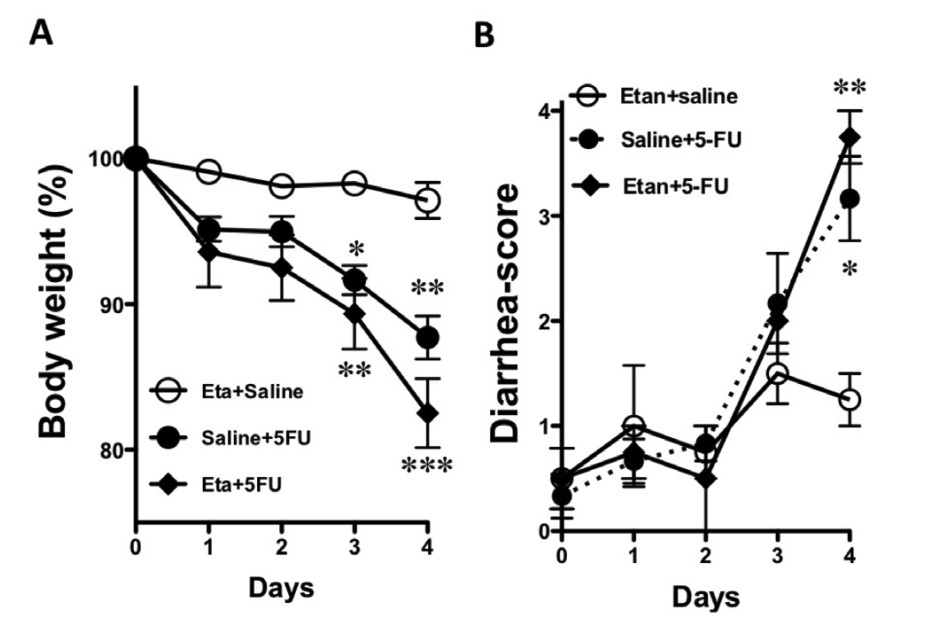 Fig.1 Effect of the administration of etanercept on the 5-FU-induced changes in body weight and the diarrhea-score.1
To investigate the underlying mechanisms of 5-fluorouracil (5-FU)-induced diarrhea, which are still not fully understood, this article conducted an experiment focusing on the potential involvement of the mucosal immune system and aquaporins (AQPs), as suggested by growing evidence. As illustrated in Figure 1A, treatment with etanercept did not reverse the 5-FU-induced weight loss. Moreover, administration of etanercept slightly worsened 5-FU-induced diarrhea, although the difference was not statistically significant (Figure 1B).
Reference
- Sakai, Hiroyasu et al. "5-Fluorouracil induces diarrhea with changes in the expression of inflammatory cytokines and aquaporins in mouse intestines." PloS one vol. 8,1 (2013): e54788. DOI:10.1371/journal.pone.0054788. Distributed under an Open Access license CC BY 4.0, without modification.
For Research Use Only.