
- Summarize the project requirements and fill in the information collection form.
- Sign a CDA from both parties to further communicate information, such as targets.
- Select an animal model, discuss experimental design, and determine assay parameters.
- Project costing and project schedule forecasting.
Atrial Fibrillation Modeling & Pharmacodynamics Services
Introduction
Atrial fibrillation (AF) is the most prevalent sustained cardiac arrhythmia, characterized by irregular and rapid electrical activity in the atria. This chaotic rhythm significantly increases the risk of stroke, heart failure, and reduces patient quality of life. AF can arise from various factors, including underlying heart conditions, hypertension, obesity, and genetic predispositions.
Developing effective interventions requires sophisticated preclinical tools. Creative Biolabs provides a variety of well-established, translationally relevant AF models to rigorously evaluate the efficacy and safety of novel therapies.
Available Atrial Fibrillation Models at Creative Biolabs
The development of effective therapies for AF relies heavily on robust preclinical models that accurately mimic human pathophysiology. These models are essential for elucidating disease mechanisms, identifying novel therapeutic targets, and testing drug efficacy and safety. Model construction typically involves inducing atrial electrical or structural remodeling to create a substrate for sustained arrhythmia, enabling comprehensive study of AF initiation and perpetuation.
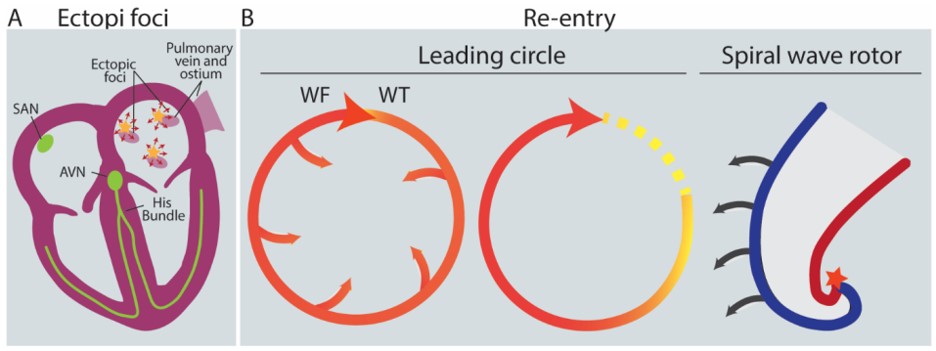 Fig.1 Types of triggers for AF.1,3
Creative Biolabs offers cutting-edge AF models for mechanistic studies and preclinical drug evaluation:
-
Pacemaker induced Atrial Fibrillation Model
- Modeling: This widely used model employs chronic rapid atrial pacing in dog, inducing significant electrical and structural atrial remodeling over several weeks. This leads to reproducible, sustained AF, closely mimicking human chronic AF, and is invaluable for studying long-term therapeutic effects on AF progression and reversal.
- Animal species: dog
-
Acetylcholine induced Atrial Fibrillation Model
- Modeling: This pharmacological model acutely induces transient AF via acetylcholine administration. It is particularly useful for investigating acute electrophysiological mechanisms, rapidly screening compounds modulating atrial excitability or conduction, and quickly assessing immediate antiarrhythmic effects.
- Animal species: dog
Evaluation Platform
Creative Biolabs offers a comprehensive evaluation platform, integrating advanced instruments and diverse testing methodologies to provide in-depth insights into your AF research:
- Biochemical Analysis: Measurement of inflammatory markers, oxidative stress indicators, and fibrosis biomarkers.
- Molecular Analysis: Gene expression (qPCR), protein expression (Western blot, immunohistochemistry), and miRNA profiling.
- Cellular Analysis: Isolated cardiomyocyte electrophysiology, calcium handling, and cell viability assays.
- Histopathological Analysis: Assessment of atrial fibrosis (e.g., Masson's trichrome staining), inflammation, and structural remodeling.
- Electrophysiological Tests: Surface ECG, intracardiac electrogram recordings, programmed electrical stimulation for AF inducibility, and effective refractory period measurements.
- Imaging: Echocardiography for cardiac function and atrial size, optical mapping for electrical propagation.
Applications
Simulation of Diseases: These models effectively simulate different forms of AF, including chronic persistent AF, paroxysmal AF, and AF associated with comorbidities such as heart failure, hypertension, and diabetes, allowing for context-specific therapeutic development.
Evaluation of Drugs: They are ideal for evaluating the efficacy and safety of a wide range of pharmacological agents, including novel antiarrhythmic drugs, ion channel modulators, anti-fibrotic agents, and drugs targeting autonomic nervous system regulation.
Optimization of Therapies: Beyond pharmacotherapy, our models are instrumental in refining non-pharmacological interventions such as catheter ablation strategies, assessing their long-term effectiveness, and understanding the mechanisms of rhythm control.
Related Cardiovascular Models
Our Advantages
- Diverse Animal Species: While this page focuses on dogs, our expertise extends across a wide variety of animal species, ensuring the most appropriate model for your specific research needs.
- Integrated Evaluation: We provide one-stop, seamless evaluation capabilities, encompassing both in vitro and in vivo studies, delivering comprehensive data from cellular to systemic levels.
- Expert Team and Robust Systems: Our professional team of seasoned biologists, coupled with a perfect management system, ensures high-quality, reproducible results and efficient project execution.
- Customized Study Designs: We excel in developing bespoke study designs and protocols tailored precisely to meet your unique research objectives.
Work with Us
Inquiry Stage
Project Start
- We provide a detailed project plan, including the required sample quantities, methods and protocols.
- Both parties confirm the project details and start the project.
- Confirm the timeline of the project.
Project Progress
- We provide periodic results and information on the animal's condition.
- We will work together to make project adjustments as necessary.
Project Completion
- We provide a comprehensive project report promptly.
- We arrange transportation for the produced samples.
- We provide a discussion of the project results and help to arrange the next steps.
After-Sales Support
- Data storage and archiving.
Contact Us
With extensive experience in preclinical efficacy studies, Creative Biolabs is an exceptional research partner poised to guide your decisions regarding the most suitable models for your specific research needs. We are dedicated to developing customized study designs and protocols that precisely align with our clients' objectives. Please contact us for further information on the models detailed above, or if you wish to explore the development of a novel model.
FAQs
-
Q1: How do you ensure the reproducibility and reliability of your pacemaker-induced AF model?
A: We employ standardized surgical procedures for pacemaker implantation and rigorous pacing protocols. Continuous ECG monitoring confirms AF induction and maintenance, and we perform detailed electrophysiological and histological assessments to ensure consistent electrical and structural remodeling across animals.
-
Q2: Can your acetylcholine-induced AF model be adapted to study chronic AF?
A: The acetylcholine-induced model primarily focuses on acute AF induction and its immediate mechanisms. While it's not designed for chronic AF per se, it can be combined with other chronic remodeling models or used to assess acute antiarrhythmic effects in a pre-existing remodeled atrium.
-
Q3: What specific parameters do you measure to evaluate drug efficacy in your AF models?
A: We measure a range of parameters, including AF inducibility, duration, and burden, atrial effective refractory period, conduction velocity, and changes in action potential duration. We also assess structural remodeling markers like fibrosis and atrial dilation, alongside relevant biochemical and molecular indicators.
-
Q4: Is it possible to customize the study design for a specific compound or research question?
A: Absolutely. Creative Biolabs prides itself on offering highly customized study designs and protocols. We work closely with your team to understand your specific research objectives and tailor the model, endpoints, and experimental setup accordingly to ensure optimal results.
-
Q5: Can your evaluation platform identify potential proarrhythmic effects of compounds?
A: Yes, our comprehensive electrophysiological assessment, including detailed ECG analysis and programmed electrical stimulation, is designed to detect both antiarrhythmic and potential proarrhythmic effects. We carefully monitor for any adverse changes in cardiac conduction or repolarization.
Published Data
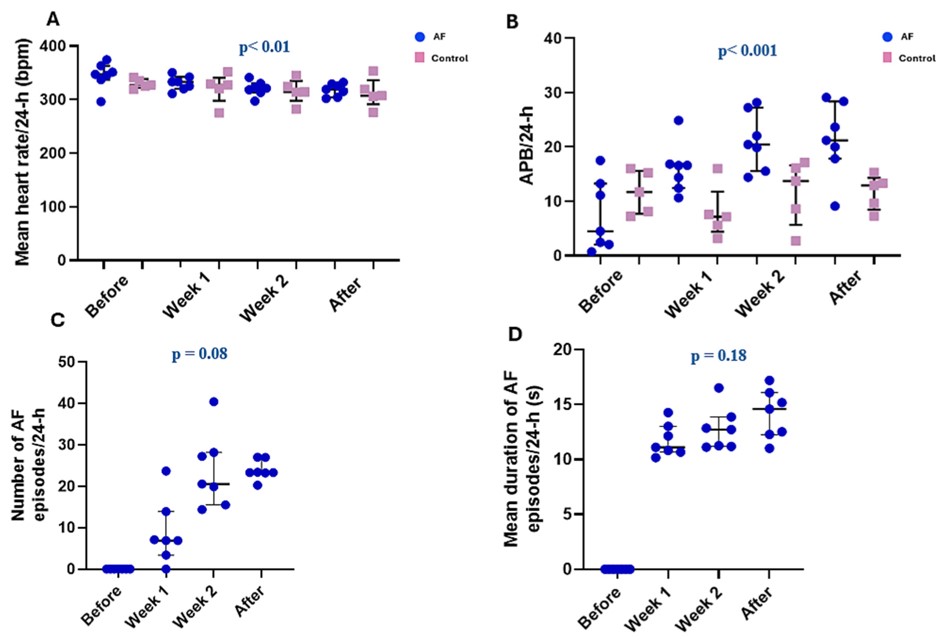 Fig.2 Spontaneous Arrhythmic Burden in the electrically stimulated (AF) and non-stimulated (control) rats.2,3
This research characterized a rat model of AF induced by long-term transesophageal atrial burst pacing. The study demonstrated that after 10 days of pacing, all AF-group rats exhibited spontaneous AF. Furthermore, heart rate variability analysis revealed a progressive increase in the standard deviation of RR intervals, and molecular analysis showed significant changes in left atrial RNA levels of Hcn4 (higher) and Pitx2 (lower), indicating their critical mechanistic roles. This work validates the model's ability to induce spontaneous AF and provides insights into associated autonomic and molecular remodeling, making it invaluable for testing antiarrhythmic strategies.
References
- Cofiño-Fabres, Carla et al. "Towards Improved Human In Vitro Models for Cardiac Arrhythmia: Disease Mechanisms, Treatment, and Models of Atrial Fibrillation." Biomedicines vol. 11,9 2355. 23 Aug. 2023, DOI:10.3390/biomedicines11092355.
- Balan, Alkora Ioana et al. "Atrial Fibrillation Begets Atrial Fibrillation in Small Animals: Characterization of New Rat Model of Spontaneous Atrial Fibrillation." Biomedicines vol. 13,3 704. 13 Mar. 2025, DOI:10.3390/biomedicines13030704.
- Distributed under Open Access license CC BY 4.0, without modification.
For Research Use Only.
Online Inquiry