
Growth Hormone-Releasing Hormone (GHRH) induced Acute Kidney Injury Modeling & Pharmacodynamics Service
Creative Biolabs offers a range of well-established models to evaluate drug efficacy for AKI. These models allow researchers to simulate various mechanisms of kidney injury, from ischemia to nephrotoxicity, and to assess the effectiveness of potential therapeutic agents. By using these models, researchers can investigate the underlying causes of AKI and test novel treatments aimed at mitigating renal damage, improving kidney function, and ultimately enhancing patient outcomes.
Introduction
Acute Kidney Injury (AKI) is a rapid decline in kidney function, characterized by an abrupt increase in serum creatinine levels or a reduction in urine output. It can result from a variety of causes, including ischemia, nephrotoxins, infections, and systemic diseases. AKI is classified into three main types: prerenal (caused by insufficient blood flow), intrinsic (due to direct damage to the kidney tissue), and postrenal (resulting from obstruction of urine flow). It is a common and serious condition in hospitalized patients, particularly those in intensive care units, and is associated with high mortality rates. The pathophysiology of AKI involves complex mechanisms such as oxidative stress, inflammation, tubular injury, and altered hemodynamics, leading to kidney dysfunction and, in severe cases, failure. Early recognition and timely intervention are crucial to prevent progression to chronic kidney disease (CKD). Despite advances in treatment strategies, AKI remains a major global health concern due to the lack of effective biomarkers for early detection and the absence of specific therapies to mitigate kidney damage.
Growth Hormone-Releasing Hormone (GHRH)-Induced Acute Kidney Injury Model
The Growth Hormone-Releasing Hormone (GHRH)-Induced Acute Kidney Injury Model is used to simulate kidney damage caused by hormone imbalances and related inflammatory responses. In this model, rodents are administered GHRH, leading to elevated levels of growth hormone, which induces kidney dysfunction through various mechanisms, including oxidative stress, endothelial injury, and inflammatory cell infiltration. This model mimics certain aspects of AKI seen in clinical conditions where hormone dysregulation or excessive growth hormone release occurs. The GHRH-induced injury is characterized by tubular damage, inflammation, and impaired renal function, making it a useful tool for testing therapeutic strategies targeting hormone-related kidney injury. One of the strengths of this model is its relevance to hormonal influences on renal pathology, offering insights into specific mechanisms of AKI. However, a potential limitation is that it primarily mimics AKI related to hormonal disruptions, so it may not fully represent other forms of kidney injury like those induced by nephrotoxins or ischemia.
- Simulates: This model simulates kidney injury resulting from hormonal imbalances and elevated growth hormone levels, providing insights into kidney dysfunction related to endocrine disturbances.
- Evaluates Drugs: It is particularly suitable for evaluating drugs that target inflammatory responses, oxidative stress, and kidney cell protection mechanisms associated with hormone-induced renal injury.
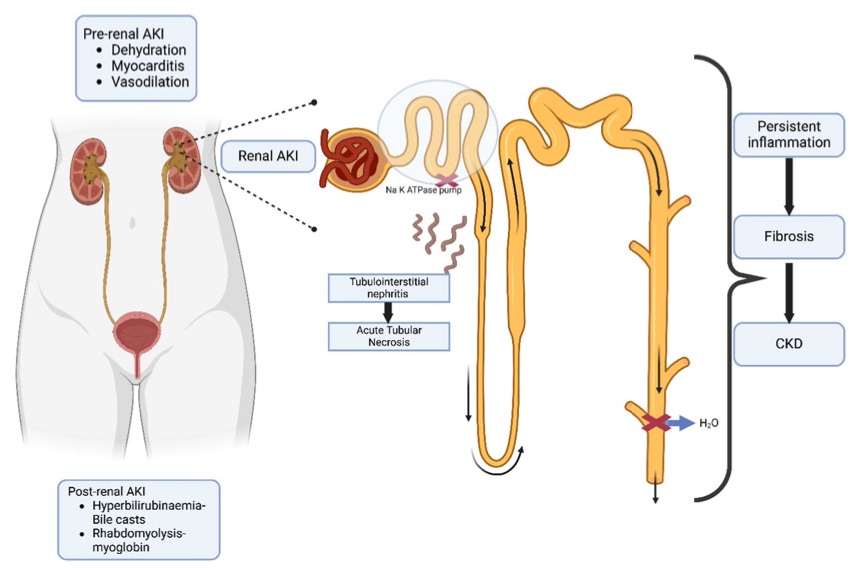 Fig. 1 Pathophysiology and mechanisms of acute kidney injury and chronic kidney disease in leptospirosis.1
Evaluation Platform
- Animals: Mouse, Rat.
-
Measurements
We offer a variety of measurements to evaluate drug efficacy in the GHRH-induced AKI model, utilizing advanced technologies:- General Observations: Body weight, kidney function (serum creatinine, BUN), mortality rate, and clinical scoring.
- Histopathology: Kidney tissue staining (H&E, PAS) to assess tubular injury, necrosis, and inflammation.
- Inflammatory Markers: Cytokine profiling via ELISA to measure levels of TNF-α, IL-6, and IL-1β.
- Oxidative Stress Analysis: Biomarkers like malondialdehyde (MDA) and glutathione (GSH) to evaluate oxidative damage.
- Gene/Protein Expression Profiling: RT-PCR and Western blot to measure expressions of key renal injury markers (e.g., TGF-β, collagen I).
These measurements enable researchers to assess the effects of therapeutic agents on multiple aspects of renal function and injury.
Related Services
In addition to the GHRH-induced AKI model, we offer models induced by various agents such as cisplatin, glycerol, and LPS. These models provide a comprehensive platform for evaluating kidney injury mechanisms and testing potential therapies.
Our advantages
- Comprehensive Support: From experimental design to data analysis, our expert team ensures customized research support.
- Advanced Techniques: Use of cutting-edge technologies for accurate and reproducible results.
- Wide Range of Models: Access to various AKI models to assess drug efficacy across different injury mechanisms.
- Flexibility: We tailor models to meet your specific research needs, offering the most suitable solution for your project.
- Reproducibility and Reliability: Proven models that guarantee high-quality, consistent results for robust data analysis.
Work with Us
- Summarize the project requirements and fill in the information collection form.
- Sign a CDA from both parties to further communicate information, such as targets.
- Select an animal model, discuss experimental design, and determine assay parameters.
- Project costing and project schedule forecasting.
- We provide a detailed project plan, including the required sample quantities, methods, and protocols.
- Both parties confirm the project details and start the project.
- Confirm the timeline of the project.
- We provide periodic results and information on the animal's condition.
- We will work together to make project adjustments as necessary.
- We provide a comprehensive project report promptly.
- We arrange transportation for the produced samples.
- We provide a discussion of the project results and help to arrange the next steps.
- Data storage and archiving.
FAQs
-
1. What types of kidney injury can the GHRH model simulate?
The GHRH-induced AKI model primarily simulates hormone-induced kidney dysfunction, such as that seen in conditions of excessive growth hormone release.
-
2. Can this model be used to assess drugs targeting oxidative stress?
Yes, this model is ideal for evaluating drugs that modulate oxidative stress, inflammation, and kidney cell injury pathways.
-
3. How long does the GHRH-induced AKI model take to show results?
The model typically shows significant renal dysfunction within 48-72 hours after GHRH administration, with assessments continuing for several days.
Reference
- Sethi, Astha et al. "Kidney involvement in leptospirosis: a systematic review and meta-analysis." Infection vol. 53,3 (2025): 785-796. Distributed under Open Access license CC BY 4.0, without modification. https://doi.org/10.1007/s15010-025-02492-1
For Research Use Only.