
Rett Syndrome Modeling & Pharmacodynamics Service
Introduction
As a premier partner in neurodevelopmental research, Creative Biolabs' platform leverages a profound understanding of Rett Syndrome (RTT), a complex X-linked disorder driven by MECP2 mutations, to provide high-fidelity modeling and translational solutions. Affecting approximately 1 in 10,000 live female births, RTT remains a significant challenge as current clinical management is primarily palliative and symptomatic, highlighting an urgent need for transformative disease-modifying therapies. By capturing the critical window between early asymptomatic development and the onset of clinical regression, we offer a specialized suite of Global Knockout (KO), Conditional Knockout (CKO/Flox), and Humanized Knock-in (KI) models that accurately reflect the phenotypic variability of both classical and atypical RTT. Our advanced evaluation matrix integrates clinical-grade biomarkers, such as respiratory plethysmography and in vivo Electrocardiogram (ECG), with high-resolution synaptic plasticity assays to precisely quantify the therapeutic rescue of Excitatory/Inhibitory (E/I) balance. This sophisticated infrastructure is purpose-built to accelerate the development of AAV gene therapies and novel synaptic modulators, ensuring that every candidate is validated against the most rigorous standards of pharmacological and functional efficacy.
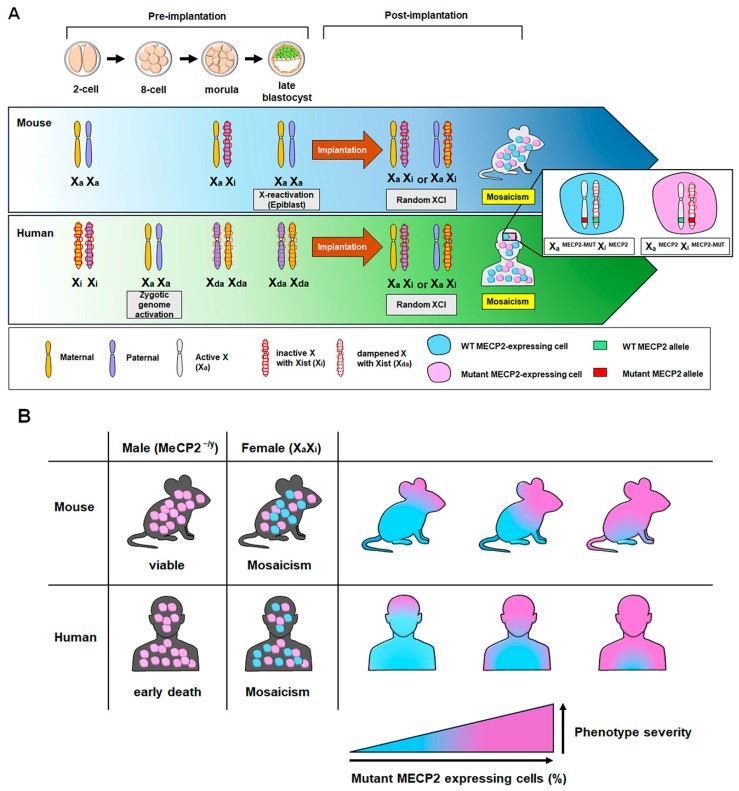 Fig.1 Despite species-specific differences in early X-chromosome regulation, both mice and humans converge on post-implantation random X-inactivation, resulting in a mosaic expression pattern that dictates sex-dependent MECP2 phenotypes, where males suffer uniform severity while female severity scales with the proportion of mutant-expressing cells.1
Available Rett Syndrome Model
Our integrated gene-editing suite empowers researchers to transition from genetic discovery to clinical milestones. With an extensive library (e.g., Mecp2, REST) and synaptic-related rodent models, we provide the tools to decode cell-type-specific mechanisms and streamline the R&D pipeline for RTT therapeutics.
| RTT Model | Models | Application Values | Animal Species |
| Gene Editing Models | Global KO: Prpf40a, Syn1, Retn, Relt, Igh-7, Golga5, CKO/Flox: Mecp2, Rest, Ret, Retn, Relt, Golga5, Dhx30, Pdgfrb, Pdgfra, Grin1, Itgb3, Il2ra, Igf2, Braf, Fgf23, KI: Humanized REST. | Mecp2 models are the gold standard for RTT, used to study neuronal maturation, synaptic plasticity, and cell-type specific study (e.g., GABAergic vs. Glutamatergic neurons). Models like Grin1 and Syn1 are used to study the E/I imbalance and synaptic dysfunction typical of RTT. Essential for validating AAV-mediated gene therapies, protein-to-DNA binding modulators, synaptic stabilizers, and small molecules targeting synaptic plasticity or growth factor pathways (e.g., Pdgfra, Igf2). | Mouse, Rat |
Evaluation Platform
To ensure the highest standards of data integrity and translational relevance, our platform employs a rigorous and standardized evaluation matrix designed to capture the full spectrum of the RTT phenotype. By integrating clinical-grade monitoring technology with high-resolution molecular analytics, we provide a multidimensional validation suite that ensures every data point is both reproducible and physiologically significant. Our advanced infrastructure allows for the precise correlation of genetic intervention with functional rescue, providing the robust evidence required to de-risk your therapeutic pipeline and accelerate the transition to clinical trials.
- Motor & Neurological Scoring: We perform longitudinal monitoring of disease progression by combining Phenotypic Aggregate Scoring, a weekly assessment of mobility, gait, hindlimb clasping, and tremors, with quantitative Rotarod and Grip Strength assays to evaluate deficits in motor coordination and muscular endurance.
- Respiratory & Autonomic Function: We utilize whole-body plethysmography to precisely monitor respiratory patterns and detect apneas or irregular breathing cycles, which serve as critical translational biomarkers for RTT progression.
- Cognitive & Social Behavior: We evaluate cognitive and social domains through the Three-Chamber Social Test to assess social withdrawal, alongside Fear Conditioning and Novel Object Recognition (NOR) assays to quantify hippocampal-dependent memory and learning impairments.
- Advanced Neurophysiology: We provide high-resolution neurological insights by combining in vivo EEG and evoked potentials to analyze cortical synchronization and sensory processing deficits, with dendritic spine analysis to quantify synaptic density and maturation in the hippocampus and cortex.
Applications
- Gene Therapy Efficacy & Safety Validation: Our platform validates AAV therapies by quantifying regional vector biodistribution, utilizing MECP2 Duplication models to define safe therapeutic windows, and correlating protein restoration with the functional rescue of respiratory and motor deficits.
- Synaptic Modulator & Small Molecule Testing: We evaluate therapeutic compounds by testing synaptic modulators to restore E/I balance, assessing growth factor mimetics (IGF-1/BDNF) to promote neuronal maturation, and validating read-through agents designed to bypass Mecp2 nonsense mutations.
- Advanced Mechanistic & Pathogenesis Research: Our platform leverages an extensive CKO and KI model library to dissect RTT pathology by isolating cell-type specific contributions (e.g., in astrocytes or interneurons), mapping neural circuit disruptions via in vivo EEG, and investigating the epigenetic regulation of protein-DNA binding dynamics and transcriptional landscapes.
- Pharmacodynamics (PD) & Longitudinal Lead Optimization: Our platform establishes dose-response curves and durability of effect through high-sensitivity translational biomarkers (Plethysmography/EEG) and longitudinal studies, integrating robust phenotypic scoring with automated tracking for reproducible data.
Our Advantages
- Diverse Model Library: We offer a premier collection of Mecp2 global KO, cell-specific Floxed, and Humanized KI (T158M/R168X) models in both mice and rats, enabling precise disease mimicry and sequence-specific drug validation.
- Translational Biomarker Suite: Our platform features clinical-grade Whole-Body Plethysmography and In Vivo EEG, providing high-sensitivity readouts for respiratory and neurological rescue that correlate directly with human RTT symptoms.
- Rigorous Data Integrity: We ensure reproducible results through blinded scoring, automated behavioral tracking, and absolute protein quantification, providing the robust data packages required for IND filings.
- Deep Mechanistic Expertise: Beyond standard phenotyping, we offer high-resolution Dendritic Spine Analysis and E/I Balance profiling to dissect the cellular and circuit-level efficacy of candidate therapeutics.
- Integrated Gene Therapy Support: We provide a specialized one-stop workflow for AAV candidates, including regional biodistribution studies and safety profiling using MECP2 Duplication models to ensure proper therapeutic dosing.
Work with Us
- Summarize the project requirements and fill in the information collection form.
- Sign a CDA from both parties to further communicate information, such as targets.
- Select an animal model, discuss experimental design, and determine assay parameters.
- Project costing and project schedule forecasting.
- We provide a detailed project plan, including the required sample quantities, methods, and protocols.
- Both parties confirm the project details and start the project.
- Confirm the timeline of the project.
- We provide periodic results and information on the animal's condition.
- We will work together to make project adjustments as necessary.
- We provide a comprehensive project report promptly.
- We arrange transportation for the produced samples.
- We provide a discussion of the project results and help to arrange the next steps.
- Data storage and archiving.
FAQs
-
Q: Which Mecp2 mouse model is most suitable for my gene therapy study?
A: It depends on your objective. The Global Mecp2-KO (male) is the "gold standard" for rapid efficacy testing due to its severe, predictable phenotype. However, for studying mosaicism or long-term safety, Female Mecp2+/- mice are preferred. For sequence-specific therapies (like ASO), our Humanized KI models (e.g., T158M) are essential to ensure target engagement.
-
Q: How do you ensure the reproducibility of behavioral data in RTT models?
A: To ensure maximum data reliability, we mitigate variability through a three-layer rigor framework: maintaining standardized environmental conditions to minimize stress-induced noise, implementing blinded scoring protocols where technicians remain unaware of treatment groups, and utilizing automated tracking systems for assays like Rotarod and Open Field to eliminate human bias and ensure objective, reproducible results.
-
Q: Can your platform detect the risk of MECP2 Duplication Syndrome during gene restoration?
A: Yes. Since MECP2 is dosage-sensitive, overexpression can be toxic. We utilize MECP2 Duplication models as a safety benchmark and perform absolute protein quantification via Wes to ensure that your therapeutic delivery stays within the precise physiological window.
-
Q: What is the typical timeline for a longitudinal RTT pharmacodynamics study?
A: A standard study usually spans 8 to 16 weeks. This includes baseline screening, a treatment phase (starting typically at 4–6 weeks of age when symptoms emerge), and longitudinal monitoring of motor, respiratory, and cognitive functions.
-
Q: What are your primary readouts for "Functional Rescue"?
A: We focus on clinically translatable biomarkers to ensure therapeutic relevance, utilizing whole-body plethysmography to quantify apnea indices and respiratory variability, in vivo EEG to monitor cortical synchronization and seizure activity, and high-resolution dendritic spine analysis to evaluate the structural restoration of synaptic density.
-
Q: Do you offer Rat models for RTT, or only Mouse models?
A: We offer both. While mice are excellent for high-throughput screening, our Mecp2-Flox SD Rat models are ideal for complex behavioral assays and surgeries (like serial CSF sampling or complex EEG electrode implantation) that require a larger brain size and more sophisticated cognitive repertoires.
-
Q: Why use female Mecp2+/- mice if their symptoms take longer to appear?
A: While male KOs are useful for rapid screening, RTT is a female-dominant disorder. Female models account for X-chromosome inactivation (XCI) and are essential for proving that a therapy is effective in a mosaic cellular environment.
-
Q: Can you measure Hand Stereotypies in mice?
A: We use hindlimb clasping and repetitive grooming behavior as preclinical proxies for the hand stereotypies seen in RTT patients.
Published Data
The anti-Semaphorin 4D (SEMA4D) antibody improves disease phenotypes by regulating upregulated SEMA4D in RTT mouse neurons, thereby inhibiting the aberrant activation of astrocytes and microglia while simultaneously repairing cytoskeletal damage in mutant astrocytes; this represents its core molecular mechanism.
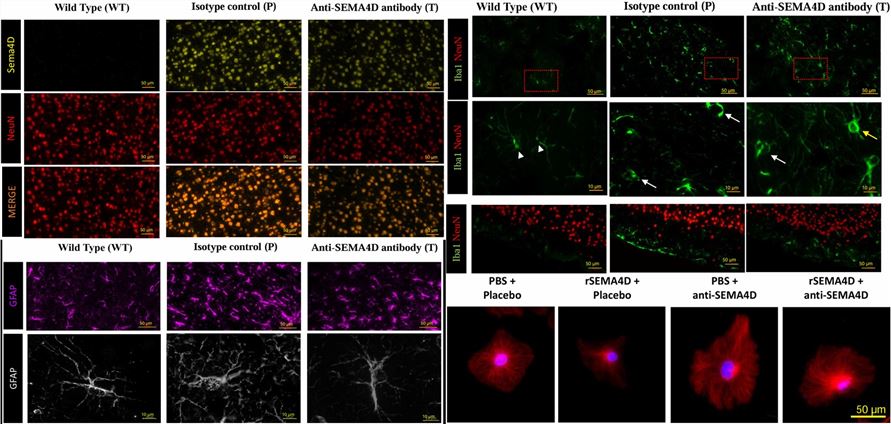 Fig. 2 SEMA4D and neuronal (NeuN) expression, Ionized calcium-binding adaptor protein-1 (Iba1)+ cells, and Glial fibrillary acidic protein (GFAP) expression in brains, anti-SEMA4D antibody in the cytoskeleton of C57BL/6 (WT) and Mecp2T158A/y mice.2
References
- Choi, Gyutae et al. "MECP2 Dysfunction in Rett Syndrome: Molecular Mechanisms, Multisystem Pathology, and Emerging Therapeutic Strategies." International Journal of Molecular Sciences vol. 26,17 8277. Distributed under Open Access license CC BY 4.0, without modification. https://doi.org/10.3390/ijms26178277
- Mao, Yilin et al. "Anti-Semaphorin 4D Rescues Motor, Cognitive, and Respiratory Phenotypes in a Rett Syndrome Mouse Model." International Journal of Molecular Sciences vol. 22,17 9465. Distributed under Open Access license CC BY 4.0, with modification. https://doi.org/10.3390/ijms22179465
For Research Use Only.