
Inflammation & Immunological Disease Modeling & Pharmacodynamics Services
Creative Biolabs offers a variety of well-established disease models to evaluate the efficacy of treatments for Inflammation & Immunological Diseases. These models simulate human disease conditions, enabling the assessment of potential therapies and advancing research in the field.
Introduction
Inflammation and immunological diseases encompass a wide range of disorders caused by abnormal immune system responses. These conditions can lead to chronic inflammation, tissue damage, and impaired organ function. Common examples include rheumatoid arthritis, lupus, inflammatory bowel disease (IBD), multiple sclerosis, and psoriasis. Inflammation plays a crucial role in the pathogenesis of these diseases, often involving dysregulated immune responses such as overactivation of immune cells or autoimmunity, where the immune system attacks the body's own tissues. The clinical manifestations can vary, from joint pain and skin lesions to systemic symptoms like fever and fatigue. The underlying mechanisms involve complex interactions between genetic, environmental, and immunological factors, which result in prolonged inflammation and immune dysfunction. Understanding these mechanisms is critical for developing effective treatments. Many immunological diseases are treated with immunosuppressive drugs, biologics, and targeted therapies aimed at modulating the immune response.
Inflammation & Immunological Disease Models
Our inflammation and immunological disease models are built using various methods, including chemical induction, genetic modification, and immune cell manipulation to simulate human-like immune responses. These models are characterized by their ability to replicate both the acute and chronic phases of disease, offering comprehensive platforms to study inflammation's progression and treatment responses.
- Adjuvant induced Arthritis (AIA) Model
- Collagen induced Arthritis Model
- Collagen Antibody induced Arthritis (CAIA) Model
- Antigen induced Arthritis Model
- Zymosan A (ZIA) induced Rheumatoid Arthritis (RA) Model
- MOG35-55 induced EAE Mice Model
- PLP induced EAE Mice Model
- MBP induced EAE Rat Model
- Cuprizone induced EAE Model
- Spontaneous Systemic Lupus Erythematosus (SLE) Mouse models
- Induced Models of Systemic Lupus Erythematosus
- SLE Patient PBMC Reconstitution-Lupus-like Model
- Imiquimod (IMQ) induced Psoriasis Rodent Models
- IL-23 induced Psoriasis Mouse Model
- Diethylstilbestrol induced Mouse Vaginal Epithelial Mitosis Model
- The Mouse Tail Model of Psoriasis
- Monosodium Urate (MSU) induced Peritonitis Model
- Zymosan induced Peritonitis Model
- Dinitrofluorobenzene (DNFB) induced Atopic Dermatitis Model
- House Dust Mite (HDM) induced Atopic Dermatitis Model
- Oxazolone (OXZ) induced Atopic Dermatitis Model
- Ovalbumin (OVA) induced Atopic Dermatitis Model
- Calcipotriol (MC903) induced Atopic Dermatitis Model
- Fluorescein Isothiocyanate (FITC) induced Atopic Dermatitis Model
- Ovalbumin (OVA) & Calcipotriol (MC903) induced Atopic Dermatitis Model
- LPS induced Rodent Sepsis Model
- Cecum Ligation and Puncture (CLP) induced Sepsis Model
- 2-HIT Sepsis Model
- Escherichia Coli induced Sepsis Models
- Submandibular Gland (SG) Protein induced Sjogren's Syndrome Mice Model
- Monosodium Urate induced Air-pouch Model of Gouty Arthritis in Rats
- Monosodium Urate induced Gouty Arthritis in Rats
- Acute GVHD Model
- Chronic GVHD Model
- Anti-DNP-IgE Antibody induced Urticaria Model
- P0180-199 Peptide induced Experimental Autoimmune Neuritis Rat Model
- Experimental Autoimmune Uveitis (EAU) Models
- LPS induced Uveitis Models
- Graves' Ophthalmopathy Models
- Allergic Conjunctivitis Models
- Bacterial Conjunctivitis Models
- Infectious Keratitis Models
- Capsaicin induced Corneal Neuritis Models
- Antigen induced EAMG Model
- Transgenic Mice Spontaneous EAMG Model
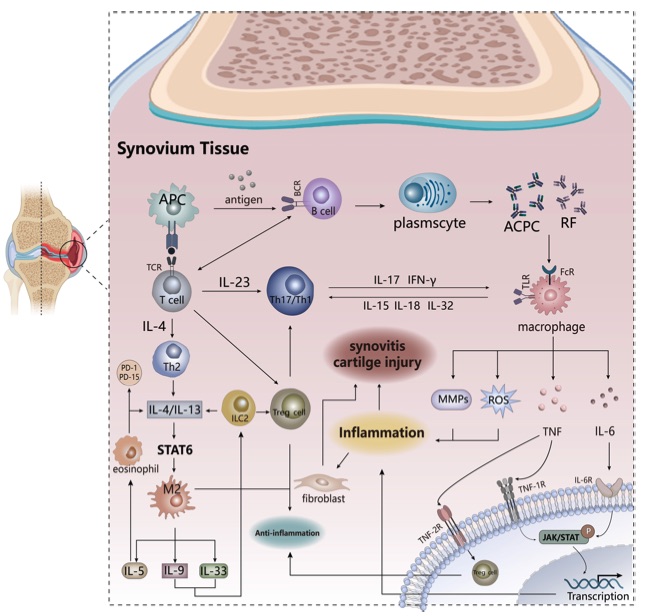 Fig. 1 The pathogenesis of RA.1,3
Evaluation Platform
- Animals: Mouse, Rat, Hamster, Rabbit, Cat, Dog, NHPs.
-
Measurements
We provide an extensive range of measurements for assessing drug efficacy in inflammation and immunological disease models, utilizing advanced technologies such as:- General Observations: Monitoring body weight, mortality, clinical signs of inflammation (e.g., redness, swelling), and behavioral changes (e.g., pain response).
- Histopathology: Infiltration of immune cells (T-cells, macrophages) in target tissues using H&E and immunohistochemical staining.
- Cytokine Profiling (ELISA): Quantification of key inflammatory cytokines like TNF-α, IL-6, IL-1β, and IFN-γ.
- Hematology & Serum Analysis: Measurement of immune cell counts, liver enzymes, and markers of kidney function or inflammation.
- Gene/Protein Expression Profiling: RT-PCR, Western blotting for inflammatory markers and immune cell activation pathways.
In addition to these standard methods, we tailor measurements to the specific requirements of your research project to provide comprehensive data and support every stage of your investigation.
Products
| Inflammation & Immunological Disease Models | Species | Sample Type | Catalog # | ||
| Adjuvant-Induced Arthritis (AIA) Models | Lewis Rat | Left ankle [FFPE block] | ZAJJ-0524-JJ1 | ||
| SD Rat | Left ankle [FFPE block] | ZAJJ-0524-JJ2 | |||
| MIA-induced Osteoarthritis | SD Rat | Left knee joint [FFPE block] | ZAJJ-0524-JJ3 | ||
| OVX-Induced Osteoporosis | SD Rat | Serum | Urine | Femoral bone [FFPE block] | ZAJJ-0524-JJ4 |
| Carrageenan-Induced Paw Edema Model | SD Rat | Paw [FFPE block] | ZAJJ-0524-JJ5 | ||
| DSS-Induced Acute IBD Model | Mouse | Colon [FFPE block] | Fecal | ZAJJ-0524-JJ6 | |
| DSS-Induced Chronic IBD Model | Mouse | Colon [FFPE block] | Fecal | ZAJJ-0524-JJ7 | |
| TNBS-Induced Acute IBD Model | SD Rat | Colon [FFPE block] | | Fecal | ZAJJ-0524-JJ8 | |
Applications
- Testing anti-inflammatory drugs for chronic conditions like rheumatoid arthritis and psoriasis.
- Assessing immune-modulating treatments for autoimmune diseases such as lupus and multiple sclerosis.
- Evaluating antibiotics, antivirals, and anti-fungal agents in infection-related inflammation models.
- Preclinical assessment of novel biologics and monoclonal antibodies for inflammation and immune-related diseases.
- Research on inflammatory bowel disease (IBD) therapies, including Crohn's disease and ulcerative colitis.
Our advantages
- Customized Solutions: We offer tailored models to suit the specific needs of your research, ensuring the highest relevance to your project.
- Comprehensive Data Support: Our models provide detailed information, from histological analysis to cytokine profiling, helping you make informed decisions.
- Expert Consultation: Our experienced scientific team supports model selection, experimental design, and data interpretation, ensuring high-quality results.
- Cutting-Edge Technology: We use advanced techniques for biomarker detection and drug evaluation, providing robust, reproducible results.
- Reliable Outcomes: Our disease models are validated and consistently generate reproducible results, enhancing the predictability of drug efficacy.
Work with Us
- Summarize the project requirements and fill in the information collection form.
- Sign a CDA from both parties to further communicate information, such as targets.
- Select an animal model, discuss experimental design, and determine assay parameters.
- Project costing and project schedule forecasting.
- We provide a detailed project plan, including the required sample quantities, methods, and protocols.
- Both parties confirm the project details and start the project.
- Confirm the timeline of the project.
- We provide periodic results and information on the animal's condition.
- We will work together to make project adjustments as necessary.
- We provide a comprehensive project report promptly.
- We arrange transportation for the produced samples.
- We provide a discussion of the project results and help to arrange the next steps.
- Data storage and archiving.
FAQs
-
1. What diseases can be modeled using your platforms?
We offer models for a wide range of inflammation and immunological diseases, including autoimmune disorders, chronic inflammation, and infectious diseases.
-
2. Are the models customizable?
Yes, we tailor our disease models to suit your specific research needs, from drug efficacy testing to immune response analysis.
-
3. How can I select the right model for my study?
Our team of experts can help guide you in choosing the most suitable model based on your therapeutic target and research goals.
-
4. Do you provide data analysis services?
Yes, our scientific team offers full support, including experimental design, data collection, and analysis, ensuring high-quality outcomes.
-
5. What types of measurements can be used to evaluate drug efficacy?
We offer a broad range of assays, including histology, cytokine profiling, gene/protein expression analysis, and more, tailored to your project needs.
Published Data
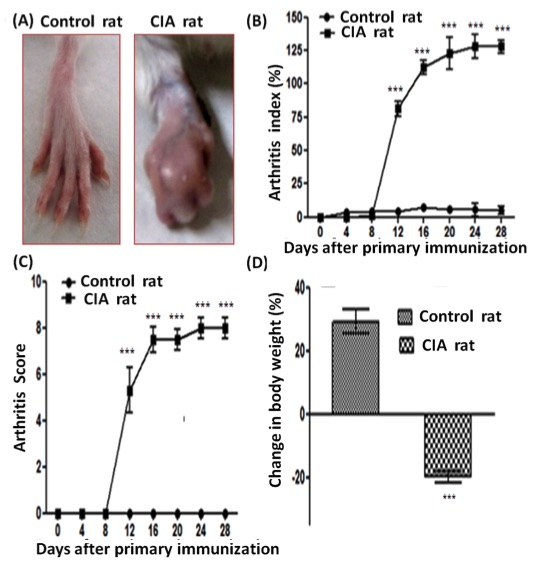 Fig. 2 Representative photographs of hind paws of control and CIA rats.2,3
Collagen induced arthritis (CIA) was induced in rats by immunization with type II collagen, as illustrated in Figure 2(A). The clinical signs of arthritis, characterized by mild periarticular erythema and edema, were first observed in the hind paws approximately 10 days post-immunization. The disease progressed in both frequency and severity over time, reaching a plateau in the peak CIA response between days 15 to 30, with a mean Arthritis Index (AI) of 125.01 [Figure 2(B)]. No significant enlargement of the hind paw diameter was observed over the course of the study. The severity of hind paw swelling and erythema progressively worsened, with maximum arthritis scores of approximately 8 recorded between days 12 and 30 in rats immunized with type II collagen [Figure 2(C)]. No macroscopic evidence of swelling or erythema was noted in the control rats.
Case Study
You can find the most appropriate model to evaluate the efficacy of your drug candidate.
 Inflammatory & Immunological Disease Models in Creative Biolabs.pdf
For Research Use Only.