
- Summarize the project requirements and fill in the information collection form.
- Sign a CDA from both parties to further communicate information, such as targets.
- Select an animal model, discuss experimental design, and determine assay parameters.
- Project costing and project schedule forecasting.
Pericarditis Modeling & Pharmacodynamics Services
Introduction
Pericarditis, an inflammation of the heart's protective sac (the pericardium), is a significant global health concern. This condition can stem from various causes, including viral infections, autoimmune disorders, and post-cardiac injury syndromes, often leading to severe chest pain, shortness of breath, and potentially life-threatening complications like cardiac tamponade or constrictive pericarditis. Given the high rates of recurrence and the limited targeted therapies currently available, there is a substantial unmet medical need.
At Creative Biolabs, we offer a range of meticulously developed and well-established preclinical models to effectively evaluate the efficacy of novel therapeutic strategies for pericarditis.
Available Pericarditis Model at Creative Biolabs
Developing effective treatments for pericarditis necessitates robust and predictive preclinical models that accurately mirror the complex inflammatory and fibrotic processes observed in human patients. These models are crucial for screening new drug candidates, elucidating disease mechanisms, and identifying potential biomarkers. Our strategies for model construction focus on inducing a controlled, reproducible inflammatory response within the pericardium, enabling comprehensive evaluation of therapeutic interventions.
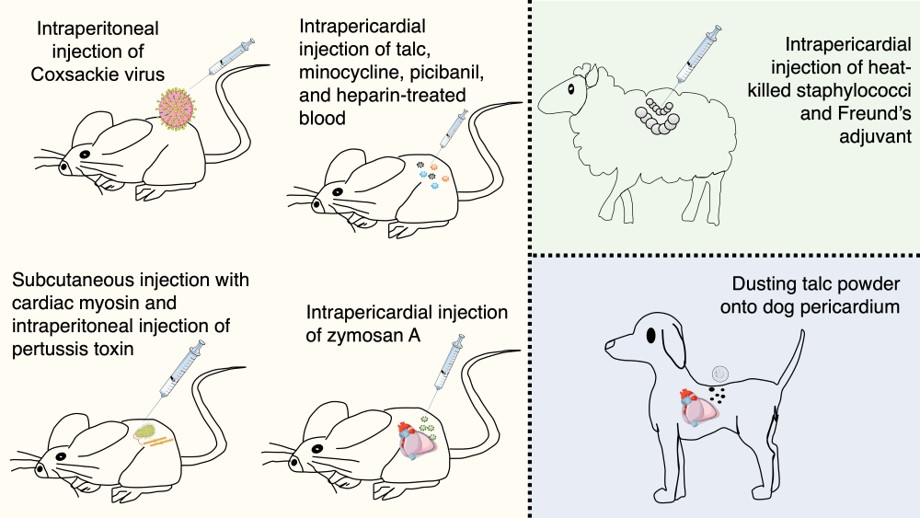 Fig.1 The acute pericarditis models.1
Our team provides the following rodent pericarditis model for comprehensive preclinical evaluation of novel compounds targeting this inflammatory cardiac condition:
Zymosan A (ZIA) induced Pericarditis Model - This cutting-edge model, established via intrapericardial zymosan A injection in rodents (typically mice), activates the NLRP3 inflammasome, driving pro-inflammatory cytokines such as IL-1β production. This reliably produces classical inflamed pericardium features like effusion, thickening, and increased inflammatory markers, closely mimicking acute human pericarditis. The model's responsiveness to known anti-inflammatory agents (NSAIDs, NLRP3 inhibitors, IL-1 blockers) proves its predictive power for therapeutic efficacy.
Evaluation Platform
Creative Biolabs' comprehensive evaluation platform employs a suite of advanced techniques to provide in-depth insights into disease progression and therapeutic efficacy. We offer:
- Biochemical Analysis: Measurement of key inflammatory cytokines (e.g., IL-1β, IL-6, TNF-α), chemokines, and acute phase reactants (e.g., C-reactive protein, CRP) in serum, pericardial fluid, and tissue homogenates.
- Molecular Analysis: Quantitative real-time PCR (RT-qPCR) for gene expression analysis of inflammatory mediators and fibrotic markers.
- Cellular Analysis: Flow cytometry and immunohistochemistry for detailed immune cell profiling (e.g., macrophages, lymphocytes, neutrophils) within pericardial tissue and draining lymph nodes.
- Histopathological Evaluation: Hematoxylin and Eosin (H&E) staining for inflammatory cell infiltration and edema, Masson's Trichrome for collagen deposition, and specific immunostains for cellular markers.
- Imaging Assessment: Non-invasive echocardiography to assess cardiac function, quantify pericardial effusion, and monitor pericardial thickening.
Applications
Disease Simulation: Our model accurately simulates acute pericarditis and can be adapted to investigate aspects of recurrent pericarditis and the progression towards constrictive pericarditis, providing a robust platform for understanding disease pathology.
Drug Evaluation: It is ideally suited for evaluating a broad spectrum of therapeutic agents, including novel anti-inflammatory drugs, immunomodulators, specific cytokine inhibitors (e.g., IL-1β blockers), NLRP3 inflammasome inhibitors, and anti-fibrotic compounds.
Therapeutic Development: The model supports the development of next-generation therapies by enabling comprehensive mechanistic studies, facilitating the discovery and validation of novel biomarkers, and assessing the efficacy of combination therapeutic regimens.
Related Cardiovascular Models
Our Advantages
- Diverse Animal Species: While our core expertise lies in rodent models, our capabilities extend to various animal species, ensuring flexibility for your research needs.
- Integrated Evaluation: We offer a seamless, one-stop solution for both in vivo and in vitro evaluation, providing comprehensive data from a single partner.
- Expert Team and Quality Systems: Our highly professional team, coupled with a perfect management system and GLP-compliant facilities, ensures the highest standards of scientific rigor and data integrity.
Work with Us
Inquiry Stage
Project Start
- We provide a detailed project plan, including the required sample quantities, methods and protocols.
- Both parties confirm the project details and start the project.
- Confirm the timeline of the project.
Project Progress
- We provide periodic results and information on the animal's condition.
- We will work together to make project adjustments as necessary.
Project Completion
- We provide a comprehensive project report promptly.
- We arrange transportation for the produced samples.
- We provide a discussion of the project results and help to arrange the next steps.
After-Sales Support
- Data storage and archiving.
Contact Us
At Creative Biolabs, our strength lies in our extensive experience and dedication to advancing cardiovascular research. We are committed to guiding our clients through every step of their preclinical journey. We invite you to connect with our scientific team to explore how our pericarditis model can significantly accelerate your therapeutic development efforts.
FAQs
-
Q1: How do you confirm the successful induction of pericarditis in your models?
A: We employ a multi-faceted approach to confirm successful pericarditis induction. This includes gross pathological examination for pericardial effusion and thickening, histopathological analysis of pericardial tissue for inflammatory cell infiltration, and biochemical quantification of inflammatory markers like IL-1β and CRP in biological samples.
-
Q2: Can your model differentiate between acute and chronic pericarditis?
A: Our core zymosan A model primarily recapitulates acute pericarditis. However, by extending the observation period and modifying the induction protocol, the model can be adapted to study aspects of chronic inflammation and the progression towards fibrotic changes, offering insights into recurrent or constrictive forms of the disease.
-
Q3: What key biomarkers can be assessed using your platform?
A: Our platform allows for the assessment of various critical biomarkers. These include inflammatory cytokines such as IL-1β, IL-6, and TNF-α, acute phase reactants like CRP, and fibrotic markers such as collagen deposition and α-SMA expression, providing a comprehensive molecular and cellular profile.
-
Q4: Is your model suitable for evaluating anti-fibrotic therapies?
A: Yes, our model is indeed suitable for evaluating anti-fibrotic therapies. While primarily an inflammatory model, the sustained inflammation can lead to early fibrotic changes. We assess these changes through histopathological staining for collagen and molecular analysis of pro-fibrotic gene expression, enabling the evaluation of compounds designed to mitigate fibrosis.
-
Q5: Can you customize the study design for specific research needs?
A: Absolutely. We pride ourselves on our flexibility and client-centric approach. Our scientific team works closely with each client to customize study designs, including dose-response studies, different treatment regimens, and tailored endpoint assessments, ensuring the experimental setup precisely aligns with your research goals.
-
Q6: How do you ensure the reproducibility of its models?
A: We ensure the high reproducibility of its models through rigorously standardized protocols, stringent quality control measures, and extensive internal validation studies. Our experienced technicians and scientists adhere to strict operational procedures, minimizing variability and ensuring consistent and reliable experimental outcomes.
Published Data
A study investigated the role of miR-146a in myocardial fibrosis within a rat constrictive pericarditis model. The project results demonstrated dynamic changes in miR-146a expression over time in the model, showing an initial increase followed by a decrease. Crucially, the study concluded that miR-146a suppressed myocardial fibrosis by inhibiting target genes (TRAF6 and IRAK1) via the TLR-4 signaling pathway, offering key insights into the molecular mechanisms driving fibrosis in constrictive pericarditis.
Reference
- Bonaventura, Aldo et al. "Novel Pathophysiological, Diagnostic and Therapeutic Concepts in Acute and Recurrent Pericarditis." Reviews in cardiovascular medicine vol. 24,3 77. 3 Mar. 2023, DOI:10.31083/j.rcm2403077. Distributed under Open Access license CC BY 4.0, without modification.
For Research Use Only.
Online Inquiry