
High Order Structure Analysis
Monoclonal antibody (mAb) drugs constitute the largest class of protein therapeutics currently on the market. Analysis of high-order structure (HOS) is a key component in defining mAb’s critical quality attributes (CQAs) that forms a critical part of the ICH Q6B guideline and part of the comparability studies. Creative Biolabs, as an expert in antibody development and characterization, provides HOS analysis as part of our antibody structural analysis services using a suite of orthogonal techniques.
Introduction to Antibody HOS
Unlike small molecule therapeutics whose conformations can be absolutely defined by constitution and stereochemistry, biopharmaceuticals are distinguished by the requirement for folding into higher order structures, including secondary, tertiary, and quaternary structures, for therapeutic function. The secondary structure refers to highly regular substructures, e.g., α-helices/β-sheets, while the tertiary structure refers to the three-dimensional structure. The quaternary structure refers to multi-subunit complexes of mAbs. It is widely known that perturbations in HOS can impact the stability, safety, and efficacy of mAb products, resulting in increased potential for immunogenicity and/or loss of biological activity.
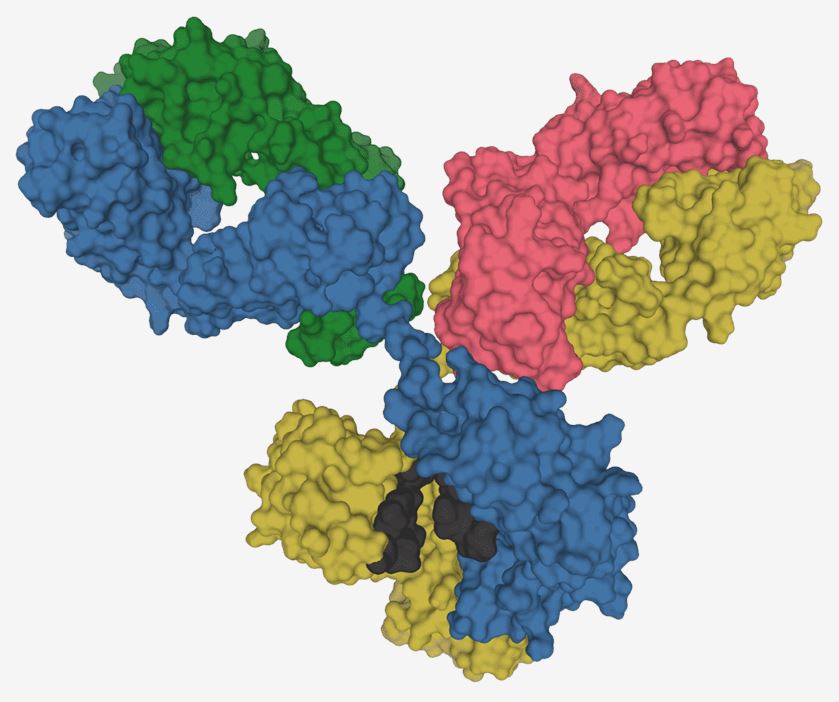 Fig.1 IgG antibody structure. (Marino, 2015) Distributed under CC BY-SA 4.0, from Wiki, without modification.
The Necessity for HOS Analysis
As HOS of mAbs can influence antibody characteristics and functions, it is essential to understand the role of HOS in the mechanism of mAb therapeutics and the structure-activity relationships. Besides, regulatory agencies now have increasing expectations on HOS characterization of biologics for quality control and set an especially high bar for biosimilar products. Moreover, detecting or monitoring the HOS changes of mAbs in development offers an in-depth understanding of the impact of process conditions on protein quality and may lead to further improvement of product and process performance. In short, it is important to use different technologies to thoroughly measure mAb HOS and provide useful information for making the right bioprocess and formulation choices during mAb development and production.
Antibody HOS Analysis Services Provided by Creative Biolabs
Creative Biolabs offers a suite of orthogonal techniques for your mAb HOS analysis:
- Fourier transform infrared spectroscopy (FTIR) and circular dichroism (CD) can be used to determine the secondary structure, including α-helix, β-sheet, and random coils.
- The far-UV CD can be used to examine the peptide backbone and estimate the secondary structure content of a protein while near-UV CD spectra is generally used to characterize disulfide pairing and aromatic residues.
- Fluorescence spectroscopy can be used to study the change of tertiary structure.
- Nuclear magnetic resonance spectroscopy (NMR) and hydrogen-deuterium exchange mass spectrometry (HDX-MS) can also be rapid and sensitive methods for monitoring HOS.
- Size-exclusion chromatography (SEC) with multi-angle light scattering (MALS) and dynamic light scattering (DLS) can be used to investigate the aggregation of mAbs.
- Differential scanning calorimetry (DSC) can be used to measure protein melting transition temperature (Tm) and thermal profiles monitoring subtle changes in HOS and stability.
Creative Biolabs is able to provide the following services:
- The above techniques can be combined to yield a complete profile of HOS.
- The HOS can be characterized under normal conditions or by exposing it to sub-optimal temperatures, pH, and so forth.
- Comparative HOS analysis between the biosimilar and the innovator of different lots.
If you are interested in our services, please do not hesitate to contact us for more details.
For Research Use Only.