
Depression Modeling & Pharmacodynamics Services
Introduction
Depression is a globally prevalent psychiatric disorder and a leading cause of disability, characterized by persistent emotional distress, anhedonia, and complex physiological symptoms such as sleep and appetite disturbances. Given the clinical heterogeneity of the disease and the significant side effects associated with conventional antidepressants, such as selective serotonin reuptake inhibitors (SSRIs), noradrenergic reuptake inhibitors (NARIs), and serotonin and noradrenaline reuptake inhibitors (SNRIs), there is an urgent need for safer, more efficient therapeutic agents. Creative Biolabs' platform addresses this challenge by offering a spectrum of validated models that replicate diverse etiological theories, ranging from the Monoamine Hypothesis to Stress-Induced Neuroplasticity and Neuroinflammatory theories. By integrating etiologically relevant modeling with multi-dimensional molecular analytics, including neurotransmitter regulation, HPA-axis neuroendocrine profiling, and neurotrophic factor assessments, we provide the comprehensive data packages necessary to de-risk novel candidates across monoaminergic, glutamatergic, and inflammatory pathways, effectively bridging the gap between behavioral despair and neurobiological recovery.
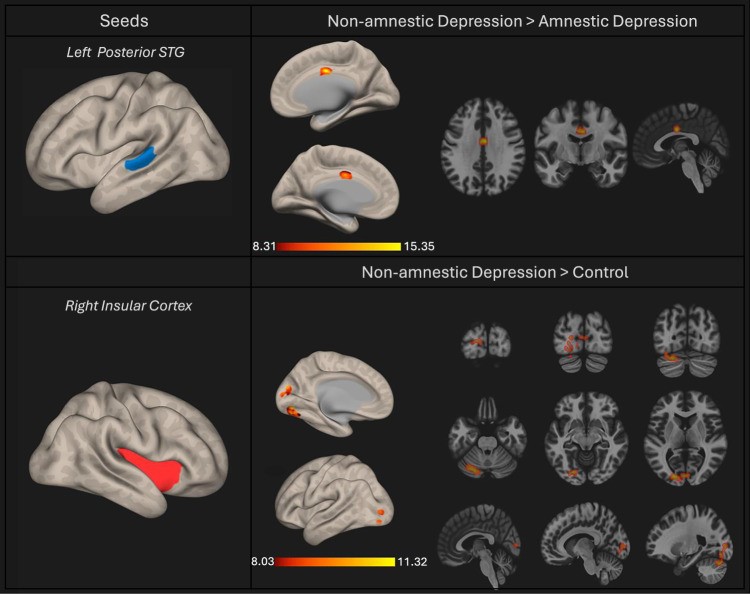 Fig.1 The left posterior STG, in the non-amnestic depression group, exhibited higher connectivity to the anterior cingulate compared to the amnestic depression group. The red patches indicate an increase in functional connectivity.1
Available Depression Models
To support the development of diverse therapeutic modalities, ranging from traditional monoaminergic reuptake inhibitors to rapid-acting glutamatergic modulators, our platform offers a robust selection of etiologically relevant depression models (rodents, NHPs). Each model is strategically designed to replicate specific clinical endophenotypes, such as anhedonia, social withdrawal, and cognitive despair, by targeting distinct pathological pathways like HPA axis dysregulation or neuroplasticity deficits. We deliver the rigorous evidence required to de-risk next-generation treatments of depressive disorder. We offer models categorized by their induction method to match your drug's specific mechanism of action:
| Depression Models | Modeling Methods | Application Values | Animal Species |
| Chronic Unpredictable Mild Stress (CUMS) Model | Exposure to a randomized sequence of mild environmental stressors (e.g., damp bedding, tilted cage, noise) for 4-8 weeks. | Mimics the accumulative impact of chronic life stress on the HPA axis. Ideal for evaluating long-term antidepressant efficacy and anhedonia rescue. | Mouse, Rat |
| Chronic Social Defeat Stress (CSDS) Model | Subjection of a test mouse to repeated bouts of physical subordination and sensory contact with a larger, aggressive "intruder" mouse. | Replicates social stress and social avoidance behaviors. Used to study stress resilience vs. susceptibility and rapid-acting therapeutics. | Mouse |
| Learned Helplessness (LH) Model | Exposure to inescapable and uncontrollable stressors (e.g., foot shocks), followed by assessment of the animal's failure to escape. | Models cognitive despair and the loss of agency. Primarily used for high-throughput screening of acute antidepressant responses. | Mouse, Rat |
| Corticosterone (CORT) induced Depression Model | Chronic exogenous administration of high-dose CORT via drinking water or subcutaneous injection. | Directly mimics HPA axis hyperactivity and glucocorticoid-mediated neurotoxicity/hippocampal atrophy. Focuses on endocrine-driven depression mechanisms. | Mouse |
Evaluation Platform
Our platform is dedicated to delivering high-precision, reproducible data that meets the rigorous standards required for international regulatory filings and top-tier academic publication. By utilizing automated behavioral tracking systems to eliminate observer bias and maintaining stringently controlled environmental conditions, we ensure a high signal-to-noise ratio in every study. To provide a truly multidimensional profile of drug efficacy, we combine these robust behavioral readouts with deep molecular validation:
- Anhedonia Assessment: Sucrose Preference Test (SPT) to quantify the loss of interest in rewarding stimuli.
- Despair-like Behavior: Forced Swim Test (FST) and Tail Suspension Test (TST) to measure the duration of immobility (behavioral despair).
- Social & Anxiety Profiling: Social Interaction Test and Elevated Plus Maze (EPM) to evaluate social withdrawal and comorbid anxiety.
- Cognitive Flexibility: Novel Object Recognition (NOR) and Y-Maze to assess the cognitive deficits associated with MDD.
- Neuroplasticity & Biomarkers: To provide a deeper mechanistic understanding of therapeutic efficacy, we integrate Dendritic Spine Analysis with Neuroendocrine Profiling. By quantifying spine density in the prefrontal cortex and hippocampus alongside ELISA/Western Blot assessments of BDNF and Corticosterone, we simultaneously evaluate synaptic plasticity, neurotrophic support, and HPA-axis reactivity.
Applications
- Standard Antidepressant Screening: Rigorous evaluation of monoaminergic agents, including Selective Serotonin Reuptake Inhibitors (SSRIs), Serotonin-Norepinephrine Reuptake Inhibitors (SNRIs), and Monoamine Oxidase Inhibitors (MAOIs), to establish baseline efficacy and long-term therapeutic profiles.
- Rapid-Acting Antidepressant (RAAD) Validation: Targeted testing of NMDA antagonists (Ketamine-like) or GABA-NAMs utilizing acute and chronic stress models to validate accelerated onset of action and sustained neuroplasticity.
- Treatment-Resistant Depression (TRD) Research: Utilizing advanced CUMS and CSDS paradigms to screen for novel candidates capable of rescuing behavioral phenotypes in subjects that show resistance to conventional therapeutic interventions.
- Mechanism of Action (MoA) Mapping: Multi-dimensional profiling of drug effects on HPA axis feedback loops, neuroinflammatory markers, and synaptic plasticity (e.g., dendritic spine density and BDNF expression).
Our Advantages
- Etiologically Diverse Model Library: We offer a versatile portfolio of validated models, from the "gold standard" CUMS and CSDS for depression to Kainic Acid and 6-Hz models for epilepsy, ensuring the induction method perfectly aligns with your drug's specific mechanism of action.
- High-Precision Automated Analytics: To eliminate observer bias, we utilize advanced automated tracking for behavioral assays (e.g., SPT, FST, EPM) and high-resolution Video-EEG telemetry to provide clinical-grade quantification of seizure activity and therapeutic rescue.
- Deep Mechanistic "Synapse-to-System" Validation: We combine behavioral data with structural and molecular proof, integrating high-resolution Dendritic Spine Analysis and Neuroendocrine Profiling (BDNF/CORT) to evaluate synaptic plasticity and HPA-axis normalization.
- Specialized Rapid-Acting & TRD Pipelines: Our platform features optimized workflows to detect the accelerated onset of Rapid-Acting Antidepressants (RAAD) and evaluate efficacy in Treatment-Resistant Depression (TRD) or refractory epilepsy models.
- Regulatory-Grade Data & Benchmarking: By maintaining rigorous environmental controls and standardized benchmarking against SSRIs, Ketamine, and established ASMs, we deliver high signal-to-noise ratios and the robust evidence required to de-risk next-generation therapies for IND filings
Work with Us
- Summarize the project requirements and fill in the information collection form.
- Sign a CDA from both parties to further communicate information, such as targets.
- Select an animal model, discuss experimental design, and determine assay parameters.
- Project costing and project schedule forecasting.
- We provide a detailed project plan, including the required sample quantities, methods, and protocols.
- Both parties confirm the project details and start the project.
- Confirm the timeline of the project.
- We provide periodic results and information on the animal's condition.
- We will work together to make project adjustments as necessary.
- We provide a comprehensive project report promptly.
- We arrange transportation for the produced samples.
- We provide a discussion of the project results and help to arrange the next steps.
- Data storage and archiving.
FAQs
-
Q: How do I select the right model for my drug's mechanism?
A: We match the model to your target; CUMS is the gold standard for long-term stress and SSRIs; CSDS is ideal for social avoidance and rapid-acting drugs; LH is best for screening acute antidepressant effects.
-
Q: How do you confirm "true" antidepressant effects vs. temporary stimulant activity?
A: We use chronic dosing schedules and cross-validate behavioral recovery with neuroplasticity biomarkers (e.g., increased BDNF and dendritic spine density) to ensure long-term neurobiological rescue.
-
Q: How do you ensure data reproducibility in behavioral tests?
A: To eliminate bias, all tests (FST, TST, SPT) are monitored via AI-powered automated tracking in sound-attenuated environments, ensuring a high signal-to-noise ratio and consistent benchmarking.
-
Q: Can you evaluate drugs for Treatment-Resistant Depression (TRD)?
A: Yes. We identify "non-responder" animals within CUMS/CSDS cohorts that fail to improve with standard SSRIs, providing a high-value model to test the rescue potential of your novel candidate.
-
Q: How is "speed of onset" measured for rapid-acting drugs (RAADs)?
A: We assess behavior and synaptic markers (e.g., mTOR pathway activation) within hours to days post-administration, rather than the weeks required for traditional antidepressants.
-
Q: What biomarkers are included for Mechanism of Action (MoA) validation?
A: We offer a standardized suite including Corticosterone/ACTH (HPA-axis), Pro-inflammatory cytokines (Neuroinflammation), and DCX/Dendritic Spine quantification (Synaptic Plasticity).
-
Q: How do you ensure the stressors in CUMS are "unpredictable"?
A: We use a randomized stress schedule (e.g., varying light cycles, cage tilt, damp bedding, social isolation) to prevent habituation and ensure a robust depressive phenotype.
Published Data
Chicory Inulin-type Oligosaccharide (CIO) significantly improves depression-like behaviors in CUMS-induced mice by reversing anhedonia and shortening immobility time in both the FST and TST. These antidepressant-like effects are mediated by elevating 5-HT levels in the hippocampus, activating the BDNF/ERK and PI3K/Akt/mTOR signaling pathways, and preserving hippocampal neuronal integrity.
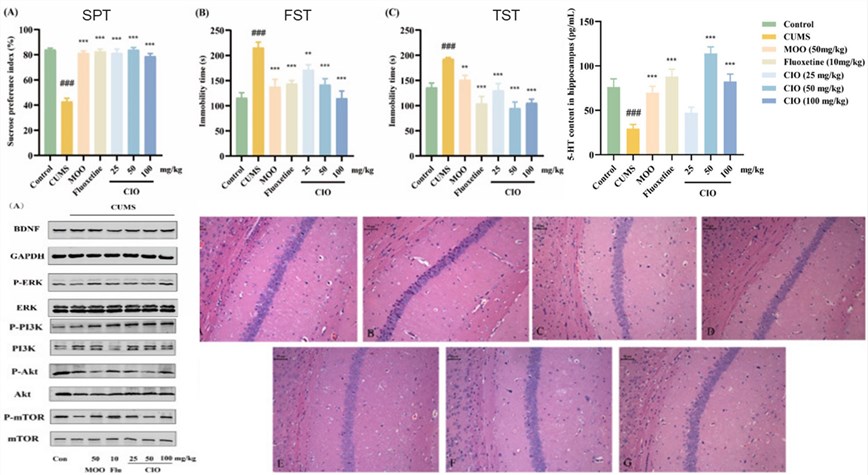 Fig. 2 Effects of CIO on Depression-like Behaviors, Hippocampal 5-HT Levels, and the BDNF/ERK and PI3K/Akt/mTOR Signaling Pathways in CUMS-Induced Mice.2
References
- Yulug, Burak et al. "Subjective cognitive decline in major depressive patients is associated with altered entropy and connectivity changes of temporal and insular region." Translational Psychiatry vol. 15,1 335. Distributed under Open Access license CC BY 4.0, without modification. https://doi.org/10.1038/s41398-025-03518-w
- Luo, Yanqin et al. "Cichorium intybus L. Oligo-Polysaccharides (CIO) Exerts Antianxiety and Antidepressant Effects on Mice Experiencing Behavioral Despair and Chronic Unpredicted Mild Stress." Foods (Basel, Switzerland) vol. 14,1 135. Distributed under Open Access license CC BY 4.0, with modification. https://doi.org/10.3390/foods14010135
For Research Use Only.