
Social Behavior Test Services
Introduction
Social interaction is a fundamental component of the behavioral repertoire in rodents, reflecting complex neural processing across the prefrontal cortex, amygdala, and nucleus accumbens. Deficits in social motivation or social recognition are key endophenotypes of several neuropsychiatric conditions. Creative Biolabs' platform provides standardized social behavior assays centered on the Three-Chamber Social Test, offering a highly reproducible environment to evaluate how novel therapeutic candidates affect social preference and social memory.
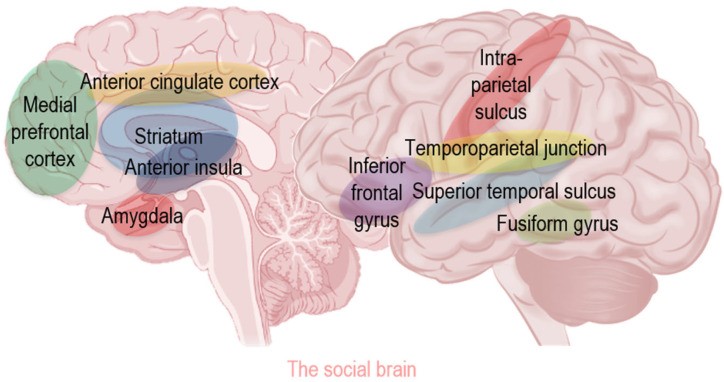 Fig.1 The social brain: a network of interconnected brain regions that regulate various aspects of social behavior.1,3
Available Social Behavior Tests
The Three-Chamber Social Test is the industry-standard behavioral assay for evaluating social motivation and social recognition in rodents. By providing a structured environment where an animal must choose between social and non-social stimuli, this platform quantifies endophenotypes relevant to Autism Spectrum Disorder (ASD), Schizophrenia, and Social Anxiety. Our services bridge behavioral observation with high-resolution automated tracking to provide objective data on social preference and memory.
| Social Behavior Tests | Modeling Methods | Application Values |
| Three Chamber Social Test | Utilizes a rectangular box with three communicating chambers. The test consists of a Habituation Phase, a Sociability Phase (Social vs. Object), and a Social Novelty Phase (Familiar vs. Novel Social Stimulus). | Used to evaluate Social Preference and Social Recognition Memory. Critical for testing therapeutic rescue in genetic models (e.g., Shank3, Fmr1) or induced models of social withdrawal, allowing for the robust evaluation of therapeutic interventions targeting oxytocinergic, glutamatergic, and GABAergic circuits. |
Evaluation Platform
Our platform utilizes a multi-layered approach to quantify social behavior with high precision:
- Sociability Index (SI): Quantification of the innate drive to engage with a conspecific versus an inanimate object.
- Social Novelty Index: Assessment of short-term social memory based on the preference for an unfamiliar "stranger" over a familiar one.
- AI-Driven Kinematics: Integration of DeepLabCut to track "sniffing time" specifically within the interaction zones, ensuring that time spent near a cage is differentiated from active social investigation.
- Automated Scoring: Real-time data acquisition of chamber entries, total distance traveled, and mean speed to ensure social deficits are not confounded by motor impairment.
Applications
Developmental Neurotoxicity: Assessing the long-term impact of early-life exposure to environmental toxins on adult social behavior.
CNS Disorders Research & Drug Discovery: Evaluate the efficacy of novel therapeutics, such as oxytocin modulators or glutamatergic agents, in restoring social preference.
Schizophrenia & Negative Symptom: Screening Quantify social withdrawal and the "deficit syndrome" associated with schizophrenia. Our platform utilizes pharmacological induction via PCP or MK-801 to assess the ability of candidate compounds to alleviate negative symptoms and improve social motivation.
Stress-Induced Disorders: Social Anxiety & PTSD test the anxiolytic effects of compounds on social avoidance. Using the Chronic Social Defeat Stress (CSDS) paradigm, we model the transition from social resilience to social withdrawal, providing a robust environment for evaluating PTSD and anxiety treatments.
Developmental & Safety Neurotoxicity: Screen for the long-term impact of environmental factors, toxins, or novel CNS drugs on the development of social behavior. We assess offspring social endophenotypes following early-life exposure to ensure developmental safety and identify potential social impairment as an adverse side effect.
Our Advantages
Standardized "Stranger" Management: We utilize age- and sex-matched conspecifics habituated to the wire enclosures to ensure they remain socially passive, preventing confounding variables such as inter-animal aggression.
Strict Olfactory & Environmental Control: Testing is conducted in sound-attenuated suites with specialized airflow systems to eliminate pheromone carry-over. Standardized low-lux lighting (red or dim white) minimizes HPA-axis activation and maximizes exploratory drive.
High-Throughput Scalability: Our multi-apparatus suites enable simultaneous testing of large cohorts, significantly accelerating project timelines while maintaining environmental consistency.
Methodological Rigor: All experiments are conducted via double-blinded protocols to eliminate experimenter bias, ensuring that all findings are objective and reproducible.
Work with Us
- Summarize the project requirements and fill in the information collection form.
- Sign a CDA from both parties to further communicate information, such as targets.
- Select an animal model, discuss experimental design, and determine assay parameters.
- Project costing and project schedule forecasting.
- We provide a detailed project plan, including the required sample quantities, methods, and protocols.
- Both parties confirm the project details and start the project.
- Confirm the timeline of the project.
- We provide periodic results and information on the animal's condition.
- We will work together to make project adjustments as necessary.
- We provide a comprehensive project report promptly.
- We arrange transportation for the produced samples.
- We provide a discussion of the project results and help to arrange the next steps.
- Data storage and archiving.
FAQs
-
Q: Does the sex of the "stranger" mouse matter?
A: Yes. We typically use same-sex "strangers" to avoid the confounding effects of mating drives or inter-sex aggression, unless the study specifically targets reproductive or sexual behavior.
-
Q: How do you prevent the test animal from just sitting in the middle chamber?
A: A pre-test habituation period (usually 10 minutes) allows the animal to explore the entire apparatus. If an animal shows low exploratory drive during habituation, it may be excluded based on pre-defined criteria to ensure data quality.
-
Q: Can this test be used for rats?
A: Yes. While more common in mice, we have specialized large-scale three-chamber arenas specifically designed for the dimensions and behavioral patterns of rats.
-
Q: How do you ensure the test animal isn't just "wall-hugging" (thigmotaxis)?
A: Our tracking software differentiates between the peripheral zone and the central "interaction zone" immediately surrounding the wire cages. We also provide "Center Time" data from the habituation phase to assess baseline anxiety.
-
Q: Can this test be used for both mice and rats?
A: Yes. We provide scaled apparatuses specifically designed for the size and exploratory patterns of both species to ensure naturalistic behavior.
Published Data
Prenatal Valproic acid (VPA) exposure induces persistent ASD-like social impairments, including diminished social motivation and flexibility. Darbepoetin alfa (DPO) treatment during P21-25 (the developmental equivalent of the human diagnostic period), not only failed to rescue these core deficits but also exacerbated non-social preferences. These findings confirm that DPO intervention at this stage is ineffective against VPA-induced social dysfunction.
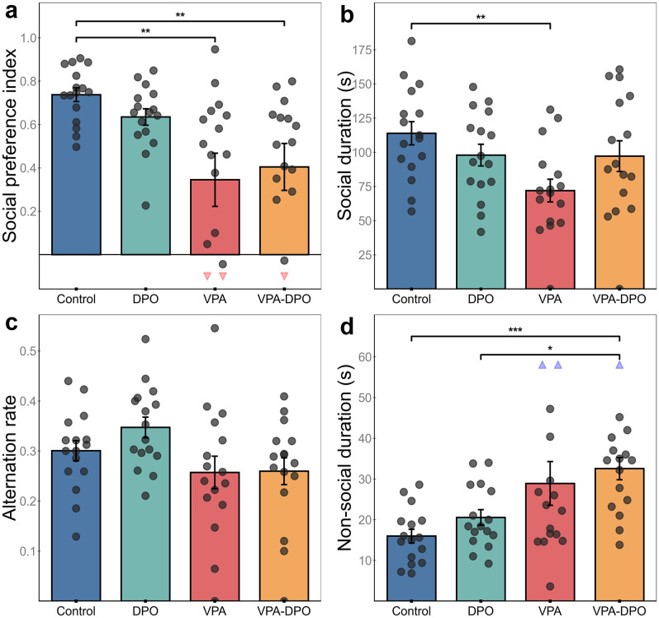 Fig. 2 Three-chamber test behavioral outcomes and spatial patterns.2,3
References
- Ohi, Kazutaka et al. "Clinical features and genetic mechanisms of anxiety, fear, and avoidance: A comprehensive review of five anxiety disorders." Molecular Psychiatry vol. 30,10 (2025): 4928-4936. Distributed under Open Access license CC BY 4.0, without modification. https://doi.org/10.1038/s41380-025-03155-1
- Laighneach, Aodán et al. "Behavioural, immunological and transcriptomic consequences of post-weaning social isolation and chronic celecoxib administration in mouse." PloS One vol. 20,10 e0334451. https://doi.org/10.1371/journal.pone.0334451
- Distributed under Open Access license CC BY 4.0, with modification. https://doi.org/10.3390/molecules30040867
For Research Use Only.