
Schizophrenia Modeling & Pharmacodynamics Services
Introduction
Schizophrenia (SZ) is a severe and debilitating psychiatric disorder affecting approximately 1% of the global population. It is characterized by a complex constellation of symptoms traditionally categorized into three overlapping clusters: Positive Symptoms (e.g., hallucinations and delusions), Negative Symptoms (e.g., social withdrawal, anhedonia, and blunted affect), and Cognitive Dysfunction (e.g., deficits in executive function, memory, and attention). While the exact pathogenesis remains elusive, SZ is highly heritable (70–85%). Its genetic architecture is a mosaic of rare mutations, copy number variations (CNVs) such as 22q11.2 and 3q29, and over 150 common risk loci identified through GWAS. Beyond genetics, SZ is driven by a convergence of neurotransmitter imbalances (e.g., dopaminergic, glutamatergic, and GABAergic) and structural pathologies, including neuroinflammation, epigenetic dysregulation, and white matter degradation. Creative Biolabs provides high-fidelity preclinical models precisely designed to replicate these clinical endophenotypes. By bridging sophisticated behavioral observations with advanced neurophysiological readouts, we enable the robust evaluation of novel therapeutic candidates targeting the full spectrum of SZ pathophysiology.
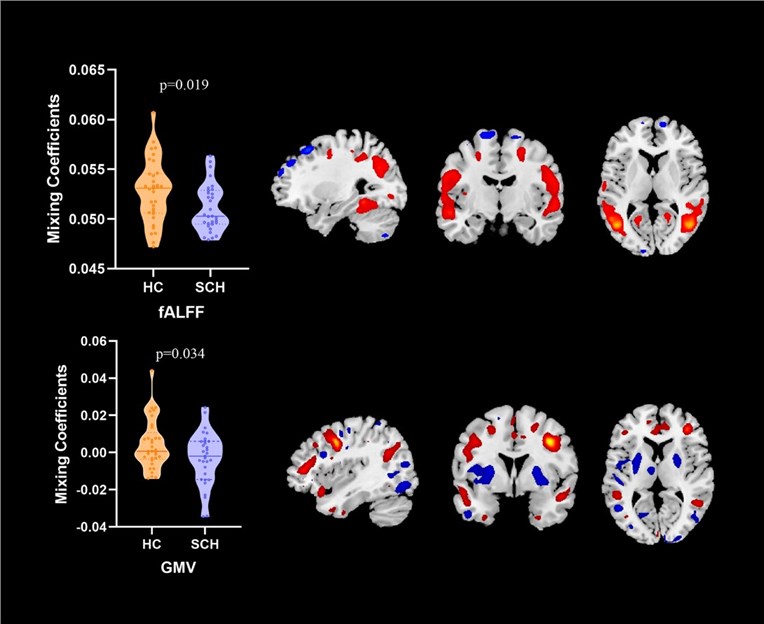 Fig.1 Gray matter volume abnormalities in the cerebello-thalamo-cortical network of SZ patients with prominent negative symptoms (PNS).1,3
Available Schizophrenia Models
Our platform offers a specialized suite of drug induced models meticulously designed to replicate the diverse neurochemical imbalances observed in SZ. These models provide high translational value for the rapid screening and validation of diverse therapeutic classes, ranging from typical/atypical antipsychotics and glutamatergic enhancers (e.g., GlyT1 inhibitors) to pro-cognitive and neuromodulatory agents like α7 nAChR and GABAergic modulators.
| Schizophrenia Models | Modeling Methods | Application Values | Animal Species |
| Amphetamine induced Schizophrenia Model | Systemic administration of dopamine agonists to induce hyperlocomotion. | Primarily used to replicate the Dopamine Hypothesis and evaluate the efficacy of antipsychotics against positive symptoms. Ideal for evaluating D2 receptor antagonists (e.g., Haloperidol, Clozapine). | Mouse, Rat |
| Phencyclidine (PCP) induced Schizophrenia Model | Administration of Phencyclidine, an NMDAR antagonist. | Simulates the Glutamate Hypothesis, capturing a broad spectrum of positive, negative, and cognitive symptoms. Ideal for evaluating Atypical Antipsychotics (e.g., Risperidone, Olanzapine). | Mouse, Rat |
| MK-801 induced Schizophrenia Model | Acute or sub-chronic administration of the potent NMDAR antagonist MK-801 (Dizocilpine). | High-fidelity replication of cognitive rigidity and sensory gating deficits. Ideal for testing cognitive enhancers. Used to test α7 nAChR agonists or GlyT1 inhibitors (e.g., Donepezil, Bitopertin). | Mouse, Rat |
Evaluation Platform
Our platform employs a multi-layered approach to quantify SZ endophenotypes, bridging behavioral manifestations with circuit-level neurophysiology:
- Positive Symptom Assays: We quantify psychomotor agitation and hyperlocomotion, hallmarks of dopamine-driven psychosis, using the Open Field Test (OFT).
- Negative Symptom & Affective Assays: Social withdrawal and anhedonia are evaluated through Social Interaction tests (dyadic or three-chamber) and Sucrose Preference assays, capturing the deficit syndrome of SZ.
- Cognitive Deficit & Executive Function: We assess core cognitive impairments, including working memory and executive dysfunction, using Novel Object Recognition (NOR) and Y-Maze tasks.
- Sensory Gating (Translational Biomarker): We utilize prepulse inhibition (PPI) of the acoustic startle reflex. As a gold-standard translational biomarker, PPI allows for direct comparison of sensory filtering deficits between preclinical models and clinical patients.
- Advanced Neurophysiology & Circuit Dynamics: By integrating in vivo EEG/LFP monitoring of Gamma-band oscillations with high-resolution Multi-Electrode Array (MEA) analysis, we provide comprehensive insights into cortical network synchronization and synaptic Excitatory/Inhibitory (E/I) balance.
Applications
- Target Validation: Unravelling the molecular mechanisms of newly identified GWAS loci.
- Therapeutic Screening: Evaluating the efficacy of small molecules and gene therapy candidates in restoring neurotransmitter balance.
- Biomarker Discovery: Identifying epigenetic and inflammatory markers to improve diagnostic accuracy and treatment monitoring.
- Antipsychotic Efficacy & Positive Symptom Screening: Rapidly evaluate the potency of therapeutic candidates in rescuing dopamine-driven positive symptoms. We quantify the reversal of hyperlocomotion induced by amphetamines or MK-801 to establish dose-response profiles for novel antipsychotics.
- Cognitive Enhancer Validation & Executive Function: Verify the efficacy of compounds designed to restore executive function, attention, and working memory. Our platform utilizes NMDAR-antagonist models (e.g., PCP or MK-801) to simulate the cognitive deficits seen in SZ, providing a robust environment for testing cognitive enhancers.
- In-depth Mechanism of Action (MoA) Dissection: Investigate the modulation of critical neurotransmitter systems, including D2, 5-HT2A, and NMDA receptor signaling. We further analyze the drug's impact on the E/I balance and network-level synaptic firing patterns to define the molecular mechanism of your candidate.
- High-Throughput Lead Optimization: Accelerate the drug discovery pipeline with standardized, high-throughput behavioral screening of CNS-active molecules. We provide high-resolution data to identify lead candidates with the most favorable pharmacodynamic profiles early in development.
Our Advantages
- High-Fidelity Clinical Replication: Our models achieve high-fidelity replication of hallmark clinical features, including sensory gating deficits and cognitive rigidity. By mirroring the core pathological domains of SZ, we provide a robust framework for assessing therapeutic efficacy.
- AI-Driven Deep Phenotyping: We utilize DeepLabCut and other AI-driven behavioral tracking systems for objective, high-resolution analysis of nuanced social interactions and motor patterns. This eliminates observer bias and captures subtle behavioral phenotypes that traditional scoring methods often overlook.
- Translational Biomarkers & Circuit Analysis: Our platform integrates Gamma-band oscillations and PPI, readouts directly comparable between rodents and humans. Furthermore, we utilize a unique integration of electrophysiology and biochemistry to quantify the GABA/Glutamate ratio, providing a clear molecular-to-circuit validation of drug action.
- Standardized & Controlled Environment: To ensure high reproducibility and stable baselines, all testing is conducted in sound-attenuated, low-stress, and light-controlled suites. This rigorous environmental control eliminates confounding factors and ensures the reliability of longitudinal data.
Work with Us
- Summarize the project requirements and fill in the information collection form.
- Sign a CDA from both parties to further communicate information, such as targets.
- Select an animal model, discuss experimental design, and determine assay parameters.
- Project costing and project schedule forecasting.
- We provide a detailed project plan, including the required sample quantities, methods, and protocols.
- Both parties confirm the project details and start the project.
- Confirm the timeline of the project.
- We provide periodic results and information on the animal's condition.
- We will work together to make project adjustments as necessary.
- We provide a comprehensive project report promptly.
- We arrange transportation for the produced samples.
- We provide a discussion of the project results and help to arrange the next steps.
- Data storage and archiving.
FAQs
-
Q: Which model is best suited for testing "Negative Symptoms" of SZ?
A: We recommend the sub-chronic MK-801 or PCP induced models. These NMDAR-antagonist models consistently produce robust social withdrawal and anhedonia patterns, mimicking the negative symptom domain more effectively than acute dopamine-based models.
-
Q: How do you differentiate between drug induced sedation and a rescue of "Positive Symptoms"?
A: We utilize the OFT to monitor baseline locomotor activity alongside the Amphetamine induced hyperlocomotion assay. A true antipsychotic effect reverses hyperlocomotion without dropping the animal's activity significantly below baseline, whereas sedation results in a generalized decrease in all movement.
-
Q: What is the significance of measuring "PPI" in your platform?
A: PPI is a gold-standard translational biomarker for sensory gating deficits. Since sensory gating is impaired in both schizophrenic patients and our pharmacological models (like MK-801), PPI allows for a direct comparison of efficacy between preclinical results and clinical observations.
-
Q: Do you offer "Positive Control" benchmarks for SZ studies?
A: Yes, we provide validated data for standard antipsychotics such as Clozapine, Haloperidol, or Risperidone. These can be included as reference groups to validate the sensitivity of the model and provide a performance baseline for your candidate compound.
-
Q: How do you assess the "Cognitive Deficits" associated with SZ?
A: We employ a battery of tasks including NOR for episodic-like memory and Y-Maze for working memory. Additionally, we use Reversal Learning protocols to quantify Cognitive Rigidity, a key executive dysfunction hallmark.
-
Q: What advanced neurophysiological readouts are available for SZ models?
A: We provide in vivo EEG/LFP monitoring to assess Gamma-band oscillations, which are typically disrupted in SZ. We also utilize MEA recordings to quantify synaptic firing synchronization and network-level E/I imbalance.
Published Data
Natural protoalkaloid Methyl-2-Amino-3-Methoxybenzoate (MAM) dose-dependently reverses PPI deficits induced by PCP (an NMDAR antagonist) and DOI (a 5-HT2A/2C agonist) in Wistar rats, effectively modeling the rescue of impaired sensorimotor gating in SZ. This efficacy is comparable to the atypical antipsychotic clozapine, while exerting minimal to no impact on baseline startle responses, further validating MAM's profile as a putative atypical antipsychotic.
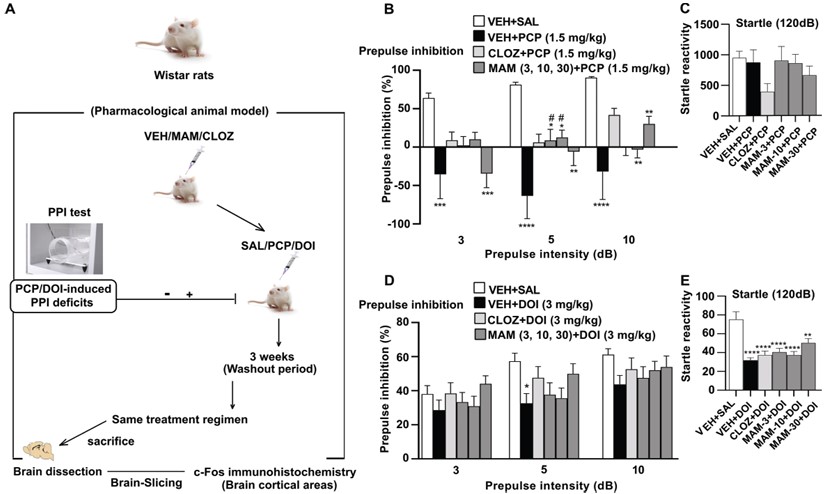 Fig. 2 Effects of acute subcutaneous MAM and clozapine pretreatments on the startle reactivity and prepulse inhibition (PPI) deficits induced by PCP or DOI in Wistar rats.2,3
References
- Kong, Li et al. "The network characteristics in schizophrenia with prominent negative symptoms: a multimodal fusion study." Schizophrenia (Heidelberg, Germany) vol. 10,1 10. https://doi.org/10.1038/s41537-023-00408-2
- Bright, Yami et al. "The Natural Protoalkaloid Methyl-2-Amino-3-Methoxybenzoate (MAM) Alleviates Positive as well as Cognitive Symptoms in Rat and Mouse Schizophrenia Models." Current Neuropharmacology vol. 22,2 (2024): 323-338. https://doi.org/10.2174/1570159X21666230720122354
- Distributed under Open Access license CC BY 4.0, with modification.
For Research Use Only.