
Cognition Behavioral Test Services
Introduction
Cognitive function encompasses the mental processes of learning, memory, attention, and executive decision-making. Disruptions in these processes are hallmark features of numerous neurological and psychiatric disorders. Creative Biolabs' platform provides a sophisticated battery of validated behavioral assays designed to probe specific cognitive domains, from spatial navigation and working memory to associative learning and recognition. By combining traditional ethological observations with automated tracking and standardized protocols, we offer high-sensitivity readouts to evaluate the pro-cognitive effects of novel therapeutic candidates.
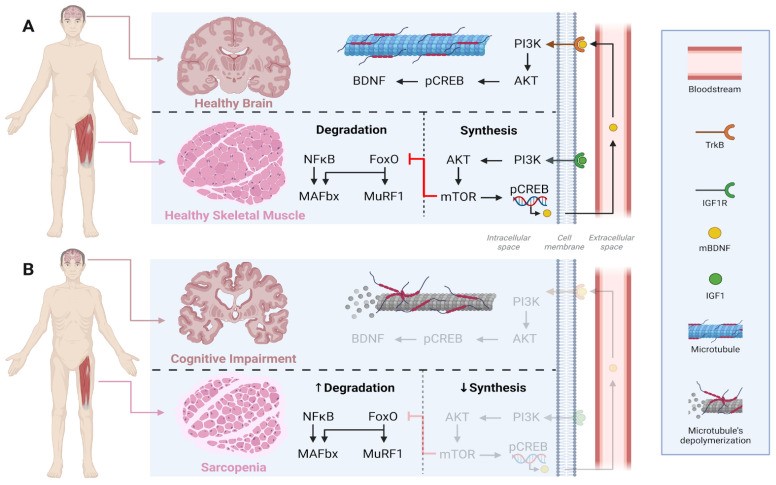 Fig.1 Comparison of crosstalk between skeletal muscle and brain in health (A) versus sarcopenia and cognitive impairment (B).1,3
Available Behavioral Tests for Cognition
To provide a clear understanding of our technical capabilities, the following table details our validated cognitive behavioral paradigms, including their specific modeling methodologies and their strategic application values in assessing learning, memory, and executive function.
| Behavioral Tests for Cognition | Modeling Methods | Application Values |
| Morris Water Task | Animals learn to find a hidden escape platform in a pool of opaque water using spatial cues. | The "gold standard" for assessing hippocampus-dependent spatial learning and long-term memory. |
| Radial Arm Maze | Animals navigate an 8-arm apparatus to find food rewards, relying on spatial memory. | Evaluates working memory and reference memory; highly sensitive to hippocampal and prefrontal cortex lesions. |
| Y Maze Test | Based on the innate tendency of rodents to explore novelty (spontaneous alternation). | A non-invasive, quick screen for short-term spatial working memory and general exploratory behavior. |
| Novel Object Recognition Task | Assessing the time spent exploring a new object versus a familiar one in a known environment. | Measures recognition memory and preference for novelty without requiring external rewards or stressors. |
| Fear Conditioning Test | Associating a neutral stimulus (tone/light) or context with an aversive event (mild foot shock). | Analyzes associative learning and emotional memory, specifically involving the amygdala and hippocampus. |
| Passive Avoidance Test | Animals learn to inhibit their natural tendency to enter a dark compartment to avoid a foot shock. | Measures fear-motivated long-term memory and the ability to suppress innate behavioral responses. |
Evaluation Platform
Our Cognitive Evaluation Platform is a specialized, high-throughput facility designed to transform complex rodent behaviors into actionable, quantitative data. We provide a seamless integration of hardware precision, sophisticated analytics, and neuroscientific expertise. Our facility is equipped with industry-leading technology to ensure the highest degree of sensitivity and reliability:
- Automated Video Tracking Systems: We utilize ANY-maze platforms for real-time tracking. These systems provide sub-second temporal resolution and high-definition spatial mapping, eliminating the subjectivity of manual scoring.
- Environmentally Controlled Suites: Testing is conducted in sound-attenuated, light-regulated (Lux-calibrated) rooms. We utilize infrared lighting for nocturnal assessments or tests requiring low-light conditions to minimize animal stress.
-
Specialized Apparatus:
- Morris Water Task (MWT): Temperature-controlled pools with non-reflective surfaces and configurable distal cues.
- Fear Conditioning: Fully automated chambers with precise programmable shock grids (0.1–3.0 mA) and integrated acoustic/visual stimulus modules.
- Mazes (Y, Radial Arm, NOR): Constructed from high-contrast, non-porous materials to prevent olfactory residue and ensure easy sterilization between subjects.
- Automated Video Tracking: Utilizing systems like Any-Maze to quantify distance, latency, zone entries, and velocity.
- Heatmap Generation: Visualizing spatial occupancy and search strategies (e.g., thigmotaxis vs. direct swimming) in the Morris Water Maze.
- AI-Pose Estimation: Using DeepLabCut to detect subtle behaviors like "head-dipping" or "sniffing" in recognition tasks to eliminate human subjectivity.
Applications
Neurodegenerative Disease & Dementia: We specialize in phenotyping and evaluating memory rescue in Alzheimer's (e.g., APP/PS1, Tau models), Parkinson's, and Huntington's diseases. Paradigms like the Morris Water Task and Radial Arm Maze are utilized to quantify improvements in hippocampal-dependent spatial memory.
Neuropsychiatric Disorder Screening: Our platform assesses executive dysfunction and working memory deficits in models of Schizophrenia (e.g., MK-801, PCP models), Depression, and Attention Deficit Hyperactivity Disorder (ADHD), using sensitive assays such as the Y Maze and Novel Object Recognition (NOR).
Safety Pharmacology & Toxicology: We conduct rigorous screening for potential cognitive side effects of New Chemical Entities (NCEs). Passive Avoidance and Fear Conditioning are employed to detect impairments in associative learning or unintended drug-drug interactions.
Neuroprotection & Injury Recovery: We measure the efficacy of candidates in preventing cognitive decline or promoting functional recovery following Stroke (MCAO), Traumatic Brain Injury (TBI), or chronic neuroinflammation.
Developmental & Aging Research: From assessing social-cognitive memory in Autism Spectrum Disorder (ASD) models to benchmarking cognitive enhancers in aged rodent cohorts, we provide longitudinal data to address neurodevelopmental disorders and age-associated memory impairment.
Our Advantages
Advanced Automated Tracking: We utilize state-of-the-art video tracking systems to eliminate observer bias, providing objective measurements of speed, distance, path integration, and precise zone-based interactions.
Highly Validated Standard Operating Procedures (SOPs): Every test, from the Morris Water Task to Fear Conditioning, follows rigorous SOPs to minimize environmental stress and inter-animal variability, ensuring high statistical power and reproducible results.
Diverse Disease Model Compatibility: Our cognitive assays are seamlessly integrated with a wide array of models, including transgenic rodents (e.g., APP/PS1, 5xFAD), chemically induced models (e.g., MK-801, STZ, Scopolamine), and surgical models (e.g., MCAO, TBI).
Multidimensional Data Analysis: Beyond simple "latency to fall" or "time in arm," we provide deep behavioral profiling, including thigmotaxis analysis, search strategy classification, and discrimination indices for a more nuanced understanding of drug effects.
Environmental & Stress Control: We maintain strictly controlled testing environments (e.g., lighting, acoustics, and handling protocols) to ensure that behavioral outputs reflect cognitive capacity rather than anxiety or external interference.
Customizable Study Designs: Whether you require longitudinal studies to track age-related decline or acute screening for rapid efficacy readouts, our team tailors the trial design to meet your specific therapeutic goals.
Work with Us
- Summarize the project requirements and fill in the information collection form.
- Sign a CDA from both parties to further communicate information, such as targets.
- Select an animal model, discuss experimental design, and determine assay parameters.
- Project costing and project schedule forecasting.
- We provide a detailed project plan, including the required sample quantities, methods, and protocols.
- Both parties confirm the project details and start the project.
- Confirm the timeline of the project.
- We provide periodic results and information on the animal's condition.
- We will work together to make project adjustments as necessary.
- We provide a comprehensive project report promptly.
- We arrange transportation for the produced samples.
- We provide a discussion of the project results and help to arrange the next steps.
- Data storage and archiving.
FAQs
-
Q: How do you account for "Ceiling" or "Floor" effects in cognitive screening?
A: We optimize the "sensitivity window" by modulating task difficulty, such as adjusting inter-trial intervals in NOR or increasing spatial interference in MWT. This ensures that both pro-cognitive enhancements and neurotoxic impairments are captured within a linear range.
-
Q: In the MWT, how do you differentiate between spatial memory and procedural learning?
A: We utilize the probe trial (platform removal) to verify if the animal has formed a true "allocentric" spatial map. Analysis focuses on quadrant dwell time and crossing frequency, distinguishing genuine memory from repetitive motor loops.
-
Q: Is the Fear Conditioning test specific enough to distinguish between Hippocampal and Amygdala function?
A: Yes. We differentiate between contextual fear (primarily hippocampal-mediated) and cued fear (primarily amygdala-mediated). This allows us to pinpoint exactly which neural circuits a candidate drug is modulating.
-
Q: How do you address the confounding factor of "Anxiety-like Behavior" in cognitive tasks?
A: Since stress inhibits cognition, we assess baseline anxiety via the Open Field Test (OFT) or thigmotaxis in the MWT. If a drug alters anxiety levels, we utilize Analysis of Covariance (ANCOVA) to statistically isolate the cognitive effect from emotional interference.
Published Data
Apolipoprotein E4 (ApoE4) and Type 2 Diabetes Mellitus (T2DM) synergistically exacerbate cognitive deficits in T2DM mice, profoundly impairing recognition, spatial location, and spatial learning/memory, without affecting anxiety-like behaviors.
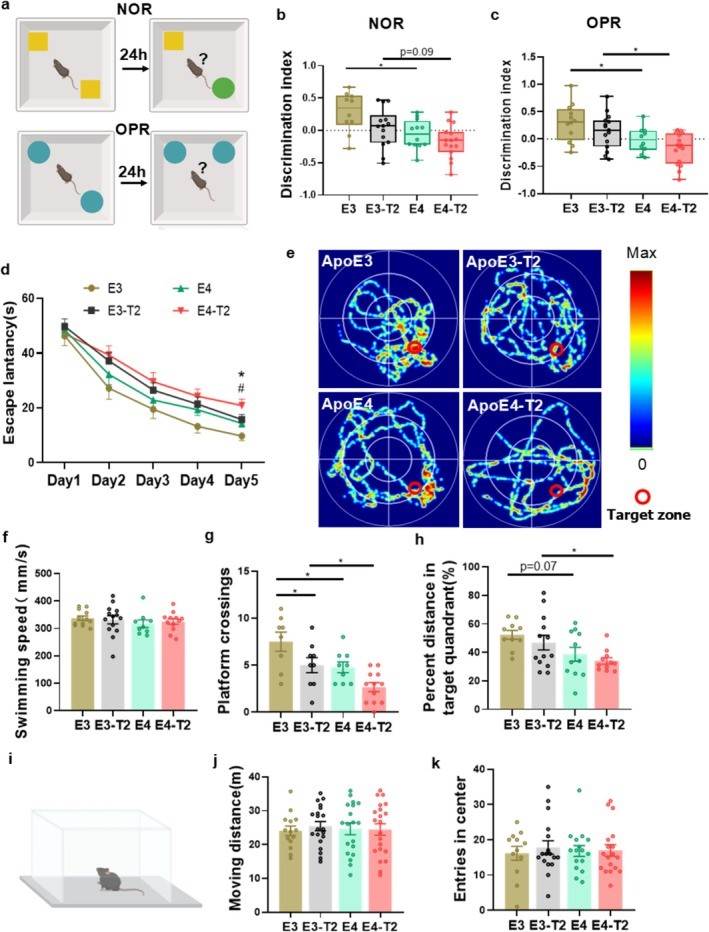 Fig. 2 ApoE4 exacerbated learning and memory impairments in T2DM mice.2,3
References
- Oporto-Colicoi, Valeria et al. "Mild Cognitive Impairment and Sarcopenia: Effects of Resistance Exercise Training on Neuroinflammation, Cognitive Performance, and Structural Brain Changes." International Journal of Molecular Sciences vol. 26,22 11036. https://doi.org/10.3390/ijms262211036
- Wang, Yuying et al. "ApoE4 Upregulates GSK-3β to Aggravate Alzheimer-Like Pathologies and Cognitive Impairment in Type 2 Diabetic Mice." CNS Neuroscience & Therapeutics vol. 31,9 (2025): e70575. https://doi.org/10.1111/cns.70575
- Distributed under Open Access license CC BY 4.0, without modification.
For Research Use Only.