
Addiction Modeling & Pharmacodynamics Service
Introduction
Sleep is a critical physiological process, occupying one-third of a human life, that facilitates essential functions such as homeostatic regulation, neurotoxin clearance (e.g., β-amyloid via NREM sleep), and memory consolidation through specific neural oscillations like thalamic theta waves. While Rapid Eye Movement (REM)sleep is uniquely pivotal for emotional desensitization and social memory, modern society faces a global insomnia epidemic driven by aging, psychological disorders, and environmental factors, leading to severe comorbidities ranging from Alzheimer's to metabolic disease. Given that current pharmacotherapies, including benzodiazepines and orexin antagonists, are often limited by distressing side effects like cognitive impairment and rebound insomnia, there remains an urgent medical need for high-fidelity preclinical modeling to develop next-generation sleep interventions that restore natural sleep architecture without residual dysfunction. Creative Biolabs' platform provides a sophisticated suite of preclinical models and gold-standard polysomnography (PSG) services to address global disorders like insomnia and narcolepsy. By integrating high-resolution EEG/EMG recording with AI-driven automated scoring, we deliver a comprehensive neurophysiological profile that goes beyond simple "sleep time" to analyze the impact of novel therapeutics on sleep architecture, latency, and circadian stability. This precise ability to differentiate between non-specific sedation and high-quality restorative sleep is a critical differentiator for successfully positioning and de-risking novel hypnotics in a competitive clinical landscape.
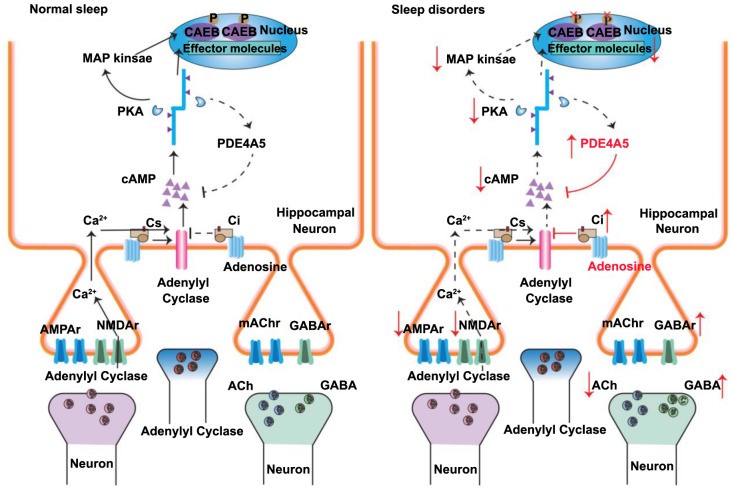 Fig.1 Signal transmission in the hippocampus under different sleep states. PKA: Protein kinase A; cAMP: Cyclic adenosine monophosphate; GABA: Gamma-aminobutyric acid.1
Available Sleep Disorder Models
Our sleep disorder evaluation platform offers a robust translational framework for studying the complexities of circadian disruption and neurotransmitter-driven insomnia. By integrating specialized environmental controls with targeted pharmacological interventions, we provide researchers with the tools to assess both the physiological and behavioral dimensions of sleep-wake cycles. Additionally, we provide intermittent hypoxia induced rodent models for sleep apnea, along with innovative models for narcolepsy and restless legs syndrome (RLS). These models are essential for characterizing the efficacy of novel sedative-hypnotics and circadian regulators under conditions that mimic human clinical challenges such as jet lag, chemical induced arousal, and serotonergic depletion.
| Sleep Disorder Models | Modeling Methods | Application Values | Animal Species |
| Day-Night Reversal Model | Sudden 12-hour shift in the light-dark cycle to induce circadian rhythm misalignment. | Evaluates treatments for Jet Lag and Shift Work Sleep Disorder. Measures the rate of circadian re-entrainment. | Mouse |
| Para-chlorophenylalanine (PCPA) induced Sleep Deprivation Model | Administration of PCPA to deplete endogenous serotonin (5-HT) by inhibiting tryptophan hydroxylase. | Simulates chronic insomnia related to neurotransmitter imbalance. Used to screen 5-HT related sedative-hypnotic drugs. | Rat |
| Caffeine induced Sleep Disorder Model | Administration of caffeine (adenosine receptor antagonist) to increase sleep latency and reduce sleep depth. | Models psychostimulant induced insomnia. Ideal for testing the antagonistic effects of sleep aids on adenosine-related pathways. | Mouse, Rat |
Evaluation Platform
To assess the efficacy of sleep-modulating therapeutics, our platform integrates gold-standard neurophysiological recordings with advanced behavioral analytics. We focus on high-fidelity data acquisition that captures the nuances of sleep architecture and its subsequent impact on functional recovery. By combining real-time physiological monitoring with automated data processing, we ensure a comprehensive evaluation of a compound's impact on sleep quality and cognitive restoration. Our Sleep Evaluation Platform utilizes the following state-of-the-art detection methods and analytical tools:
-
Polysomnography (PSG) - EEG/EMG: Continuous, high-fidelity recording of brain activity (EEG) and muscle tone (EMG) to differentiate between Wake, NREM (Non-REM), and REM sleep stages.
- Wireless telemetry for stress-free, long-term monitoring in the animal's home cage.
- Automated Sleep Scoring: AI-driven algorithms provide rapid, objective quantification of Sleep Latency (SL), Total Sleep Time (TST), and Power Spectral Analysis (Delta/Theta power).
- Cataplexy Detection: Integrated video-EEG/EMG to identify sudden loss of muscle tone during wakefulness in narcolepsy models.
-
Vigilance & Cognitive Recovery:
- Psychomotor Vigilance Task (PVT): Measuring attention deficits following sleep deprivation.
- Novel Object Recognition (NOR): Assessing the restorative power of sleep-promoting agents on memory.
Applications
- Screening and Discovery of Novel Hypnotics: We assist in identifying and validating new chemical entities (NCEs) targeting traditional and novel sleep pathways (e.g., GABAergic, Melatonergic, and Orexin systems).
- Evaluation of Wake-Promoting Agents: For disorders of excessive daytime sleepiness (EDS), we evaluate the efficacy of stimulants and eugeroics. Testing therapies for Narcolepsy Type 1 & 2 and Sleep Apnea-related fatigue.
- Circadian Rhythm and Jet Lag Research: By utilizing Day-Night Reversal models, we facilitate the development of therapeutics for circadian desynchronosis, including Shift Work Sleep Disorder (SWSD) and non-24-hour sleep-wake rhythm disorders.
- Cognitive Restoration and Neuroplasticity: We investigate the functional benefits of improved sleep quality on cognitive health. Evaluating the restorative effects of sleep aids on memory consolidation in models of Alzheimer's Disease or Age-Related Cognitive Decline.
- Safety Pharmacology and Side-Effect Profiling: Monitoring for drug induced sleep disturbances or REM sleep suppression. Ensuring that CNS-active drugs do not disrupt Sleep Architecture or lead to Cataplexy-like symptoms.
Our Advantages
- Gold-Standard Polysomnography (PSG): We provide high-fidelity, continuous EEG/EMG recording to precisely categorize sleep architecture into Wake, NREM, and REM stages. This allows for the detection of subtle shifts in sleep microstructure that traditional activity monitoring might miss.
- Wireless Telemetry Systems: Our use of wireless telemetry allows for stress-free, long-term monitoring of animals in their home-cage environment. By eliminating tether induced stress, we obtain more naturalistic and representative sleep-wake data.
- Sophisticated Circadian Modeling: Beyond simple insomnia, our platform excels in Circadian Re-entrainment assays. Using automated light-dark control systems, we can model complex shift-work and jet-lag scenarios to evaluate the phase-shifting properties of chronotherapeutics.
- Integrative PD Assessment: We correlate sleep quality with functional outcomes. By combining PSG with Psychomotor Vigilance Tasks (PVT) or Cognitive Recovery assays (e.g., Novel Object Recognition), we quantify the "restorative power" of a sleep aid rather than just its sedative effect.
- Mechanistic Target Validation: Our platform supports deep mechanistic deep-dives, including local field potential (LFP) recordings or neurotransmitter monitoring (e.g., Orexin or GABA levels) to confirm target engagement in specific sleep-regulating nuclei like the VLPO or LH.
Work with Us
- Summarize the project requirements and fill in the information collection form.
- Sign a CDA from both parties to further communicate information, such as targets.
- Select an animal model, discuss experimental design, and determine assay parameters.
- Project costing and project schedule forecasting.
- We provide a detailed project plan, including the required sample quantities, methods, and protocols.
- Both parties confirm the project details and start the project.
- Confirm the timeline of the project.
- We provide periodic results and information on the animal's condition.
- We will work together to make project adjustments as necessary.
- We provide a comprehensive project report promptly.
- We arrange transportation for the produced samples.
- We provide a discussion of the project results and help to arrange the next steps.
- Data storage and archiving.
FAQs
-
Q: How do you differentiate between NREM and REM sleep in rodents?
A: We use the combination of EEG and EMG. NREM is characterized by high-amplitude slow waves (Delta) and reduced muscle tone, while REM shows low-amplitude, high-frequency EEG (Theta) and complete muscle atonia (flat EMG).
-
Q: Can your platform test "Orexin Antagonists" (DORAs)?
A: Yes, we have validated protocols using both nocturnal (dark phase) administration to see sleep induction and light-phase administration to monitor potential "sleepiness" side effects.
-
Q: Do you provide "Sleep Rebound" data?
A: Yes. Following sleep deprivation or hypnotic treatment, we monitor the subsequent "recovery sleep" to assess the homeostatic sleep drive.
Published Data
Ziziphi Spinosae Semen (ZSS) exerts its hypnotic effects by synergistically improving the pathological state of the hypothalamus through dual structural and functional dimensions: it repairs PCPA induced neuronal damage (structural level) and upregulates the expression of GABAARα1 and γ2 receptors (functional level) within this brain region.
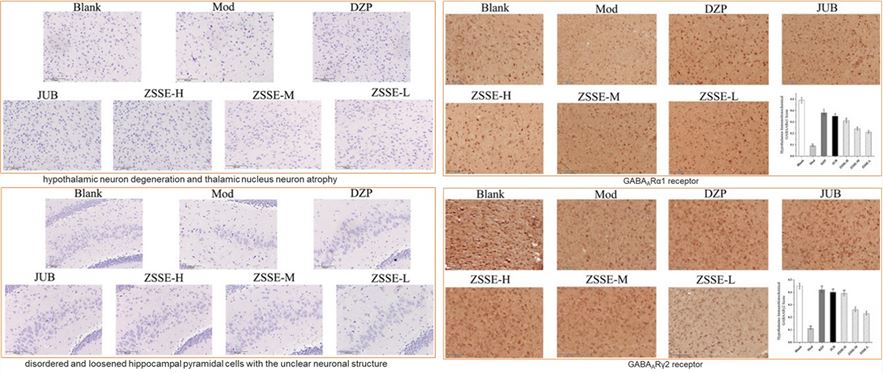 Fig. 2 Effects of ZSSE on pathological examination and the expression of GABAARα1 and γ2 in the hypothalamus of PCPA induced insomnia rats (n = 5).2
References
- Ding, Wenjun et al. "Research progress on melatonin, 5-HT, and orexin in sleep disorders of children with autism spectrum disorder." Biomolecules & biomedicine vol. 25,3 525-533. Distributed under Open Access license CC BY 4.0, without modification. https://doi.org/10.17305/bb.2024.11182
- Xiao, Fengqin et al. "Neuroprotective effect of Ziziphi Spinosae Semen on rats with p-chlorophenylalanine induced insomnia via activation of GABAA receptor." Frontiers in Pharmacology vol. 13 965308. Distributed under Open Access license CC BY 4.0, with modification. https://doi.org/10.3389/fphar.2022.965308
For Research Use Only.