
Motor Function Behavioral Test Services
Introduction
Insults to the central nervous system (CNS) often manifest as debilitating motor impairments, ranging from gross locomotor deficits to nuanced disruptions in fine motor coordination. To accelerate the development of transformative therapies, Creative Biolabs' Motor Function Evaluation Platform integrates high-fidelity kinematic profiling with deep neurobiological expertise to characterize the functional integrity of the central and peripheral nervous systems. By deploying a multi-dimensional testing battery, ranging from Digital Force Transduction for neuromuscular tension to Accelerating Rotarod and Gait Analysis for sensorimotor coordination, we capture the full spectrum of motor pathology. Whether screening for subtle off-target sedation in safety pharmacology or quantifying the restorative kinetics of therapies in Neurological Disorder Models, we provide the longitudinal, objective datasets essential for bridging the translational gap between preclinical discovery and clinical success. This multi-dimensional approach is essential for identifying therapeutic windows and validating efficacy in complex disease models such as Parkinson's Disease, Stroke, Amyotrophic Lateral Sclerosis (ALS), and Traumatic Brain Injury (TBI).
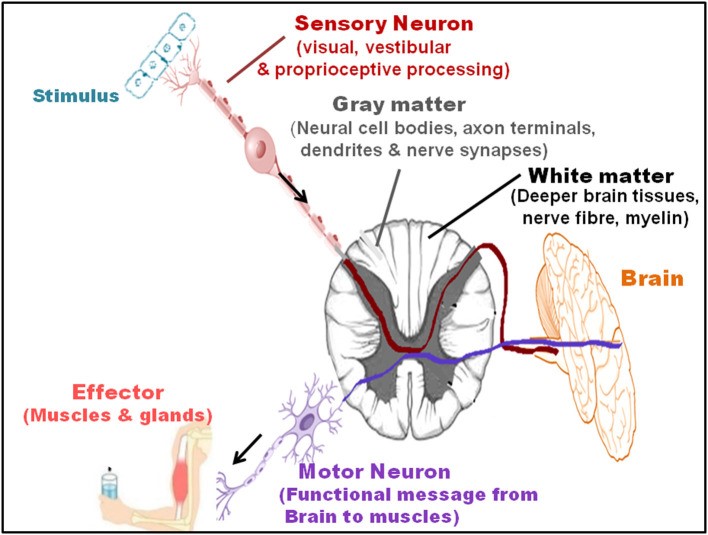 Fig.1 Sensory and motor pathways and interaction with the brain.1
Available Behavioral Tests for Motor Functions
To provide an integrated assessment of therapeutic efficacy and safety profiles, we utilize a validated suite of behavioral assays tailored to evaluate specific neurological and muscular dimensions. The following table details our core motor function testing battery, highlighting the methodologies and strategic application values for various CNS and neuromuscular disease models.
| Behavioral Tests for Motor Function | Methods | Application Values |
| Rotarod Test | Animals are placed on a rotating rod that accelerates at a constant or varying rate. | Assesses motor coordination, balance, and endurance. Highly sensitive to sedative side effects or cerebellar ataxia. |
| Open Field Test | Automated tracking of an animal's movement within a novel square or circular arena. | Measures locomotor activity and exploratory drive. Used to differentiate between stimulant effects and motor suppression. |
| Grip Strength Test | Measures the peak force exerted by an animal using its forelimbs or all four paws when pulled across a sensor. | Quantifies neuromuscular function and skeletal muscle strength. Critical for models of ALS, sarcopenia, or myasthenia gravis. |
| Beam Walking Test | Animals are trained to cross a narrow wooden or metal beam to reach a home box. | Evaluates fine motor coordination and hindlimb function. Used primarily in TBI, Stroke, and Parkinson's Disease models. |
| Other Motor Function Test | Includes the Pole Test, Tail Suspension Test, Cylinder Test, Wire Suspension Test, and Catalepsy. | Provides high-resolution data on postural stability, limb-use asymmetry (unilateral models), and extrapyramidal side effects like rigidity or bradykinesia. |
Evaluation Platform
To deliver the high-resolution data required for modern drug discovery, our platform integrates advanced computational tools with precision instrumentation. By moving beyond traditional manual observation, we provide a quantitative, objective, and longitudinal assessment of motor function through the following technical capabilities:
- Rotarod Apparatus: A sound-attenuated, semi-enclosed testing chamber designed to minimize environmental interference. Integrated with automated data collection software to precisely record latency to fall and the rotational speed (RPM) at the moment of displacement.
- Automated Behavioral Analysis Platform (e.g., ANY-maze): A high-throughput video tracking system that provides comprehensive gait and movement analytics. The platform automatically calculates total distance traveled, mean speed, time spent in the center zone, and rearing frequency.
- Grip Strength Meter: Equipped with a high-precision force transducer and interchangeable gripping grids or bars to accommodate different species. The design ensures the meter is aligned with the animal's pulling axis, significantly reducing operational errors and ensuring data fidelity.
- Beam Walking Apparatus: Equipped with integrated infrared sensor pairs or high-speed lateral cameras for automated data capture. Specifically designed to automatically record transit time (crossing duration) and the frequency of foot slips (paw placement errors).
- Other Motor Function Tests: This suite of specialized instruments and automated platforms enables the precise quantification of diverse motor symptoms, ranging from bradykinesia and limb asymmetry to muscular endurance and cataleptic states, ensuring high-fidelity functional phenotyping in neurological research
Applications
- Neuro-drug R&D: Providing a robust platform for the preclinical evaluation of pharmacological profiles and therapeutic efficacy in neurological disease models.
- Disease Progression: Evaluating and monitoring the progression of animal models through scheduled behavioral assessments.
- Efficacy Screening: In the early stages of drug discovery, these behavioral tests, including Rotarod, Grip Strength, and Pole tests, serve as quantitative tools to evaluate the efficacy of candidates in restoring motor coordination, muscle strength, and fine motor control across various neurological models.
- Safety Pharmacology: Prior to clinical trials, behavioral assays such as the Open Field and Tail Suspension tests are essential for safety pharmacology to ensure that drug candidates do not disrupt central nervous system homeostasis or trigger unintended behavioral impairments, such as abnormal sedation, hyperexcitability, or secondary mood disorders.
- Toxicity Monitoring: Motor function indices serve as sensitive biomarkers for monitoring neurotoxicity and muscular toxicity, utilizing specialized tests like Catalepsy, Wire Suspension, and Rotarod to detect critical adverse reactions, including extrapyramidal symptoms, ataxia, and drug-induced sedation.
Our Advantages
- Synchronized Video-Sensors: Infrared sensors (IR) in Rotarod and Beam systems ensure millisecond accuracy for latency-to-fall data.
- Automated Scoring: Software-integrated platforms for Open Field Test (OFT) and Grip Strength provide raw data files and statistical summaries instantly.
- Automated Gait Analysis: Utilizing high-speed videography to move beyond basic observation. We provide a high-definition map of motor deficits by analyzing stride length, paw pressure, and inter-limb coordination.
- Synchronized Kinematics: For advanced mechanistic studies, we synchronize real-time video tracking with in vivo electrophysiology, allowing researchers to correlate motor performance directly with neuronal firing patterns in the motor cortex.
- Non-Invasive Longitudinal Tracking: Our protocols are optimized for repeated, non-invasive testing. This enables the assessment of chronic disease progression or the long-term efficacy of regenerative and gene therapies over time.
- Customizable Disease Batteries: We tailor screens to specific indications. For Parkinson's Disease, we emphasize the Pole Test and Gait analysis; for Sarcopenia or ALS, we focus on longitudinal Grip Strength and Wire Hang endurance.
- Differentiation of CNS Effects: Our protocols are specifically designed to distinguish between general sedation (CNS depression) and specific motor deficits (ataxia), which is critical for de-risking candidates during safety pharmacology.
- High Sensitivity & Reproducibility: Through standardized acclimation protocols and low-stress handling, we minimize variability, ensuring that behavioral readouts reflect true motor capability rather than acute stress responses.
Work with Us
- Summarize the project requirements and fill in the information collection form.
- Sign a CDA from both parties to further communicate information, such as targets.
- Select an animal model, discuss experimental design, and determine assay parameters.
- Project costing and project schedule forecasting.
- We provide a detailed project plan, including the required sample quantities, methods, and protocols.
- Both parties confirm the project details and start the project.
- Confirm the timeline of the project.
- We provide periodic results and information on the animal's condition.
- We will work together to make project adjustments as necessary.
- We provide a comprehensive project report promptly.
- We arrange transportation for the produced samples.
- We provide a discussion of the project results and help to arrange the next steps.
- Data storage and archiving.
FAQs
-
Q: Why is motor testing essential for CNS drug development?
A: It serves two critical roles. Primary Efficacy for quantifying recovery in movement disorders like PD or ALS, and Safety Pharmacology for screening for off-target effects like ataxia or sedation that could confound other behavioral data.
-
Q: How do you differentiate laziness from motor deficit?
A: We implement a pre-selection training phase to establish baseline performance. During testing, we monitor "passive rotations" (clinging to the rod), which typically indicates a loss of coordination rather than exhaustion or lack of motivation.
-
Q: How do you ensure Grip Strength Test consistency?
A: To minimize operator dependency, we use a standardized pull rate and record the average peak force from 5–6 consecutive trials, ensuring high data fidelity.
-
Q: Rotarod vs. Beam Walking: Which one to choose?
A: While both assess coordination, the Rotarod is better for measuring general motor endurance and drug-induced sedation. The Beam Walking Test is more sensitive to fine motor deficits and subtle paw-placement errors, making it the preferred choice for detecting unilateral deficits in Stroke, TBI, or early-stage neurodegeneration.
-
Q: Can the OFT distinguish between anxiety and motor suppression?
A: Yes. We analyze the data using a two-pronged approach: Total Distance Traveled (motor index) vs. Time Spent in the Center Zone (anxiety index). If an animal moves less overall but maintains a normal ratio of center-to-periphery exploration, it suggests motor suppression rather than increased anxiety.
Published Data
Behavioral tests for motor function revealed that the core behavioral abnormality in Gomafu knockout (KO) mice is a specific mild hyperactivity. Importantly, this hyperactive phenotype is independent of neuromuscular deficits, anxiety-like levels, or stereotypical behaviors, representing a distinct and autonomous dysregulation of behavioral control.
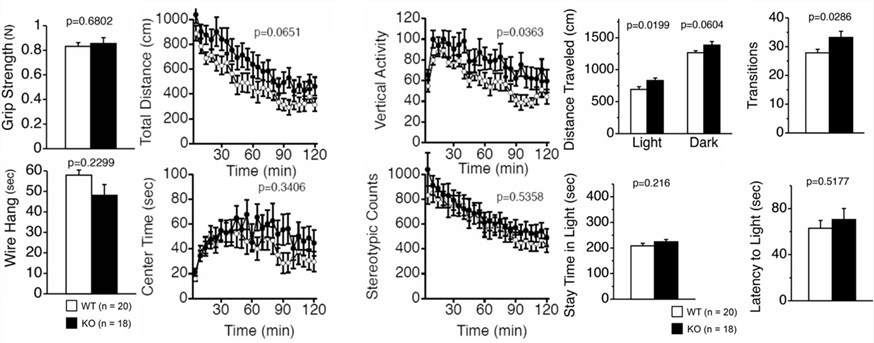 Fig. 2 The results of the grip strength test, tail suspension test (TST), open field test (OFT), and light/dark box transition test.2
References
- Xiang, Ke et al. "Motoric Cognitive Risk Syndrome: Symptoms, Pathology, Diagnosis, and Recovery." Frontiers in Aging Neuroscience vol. 13 728799. Distributed under Open Access license CC BY 4.0, without modification. https://doi.org/10.3389/fnagi.2021.728799
- Ip, Joanna Y et al. "Gomafu lncRNA knockout mice exhibit mild hyperactivity with enhanced responsiveness to the psychostimulant methamphetamine." Scientific Reports vol. 6 27204. Distributed under Open Access license CC BY 4.0, with modification. https://doi.org/10.1038/srep27204
For Research Use Only.