
Subtractive Library Method (Physical Enrichment of Differentially Expressed Clone)
Gene expression profiles are diverse and play an important role in the detection of tumor-associated antigens. Among them, the subtractive library, also called deducting libraries, is a representative method for identifying antigens. Creative Biolabs has extensive research experience and cutting-edge research directions in the identification of tumor-associated antigens, especially through the use of subtractive libraries.
Subtractive Library at Creative Biolabs
Creative Biolabs has an advanced technology platform for building subtractive library, which can quickly acquire the expressed genes in two non-biological materials with high sensitivity and low false-positive rate. Generally, the recognition of tumor-associated antigens can rapidly be identified by generating subtractive library and tracking the expression profiles of the resulting genes.
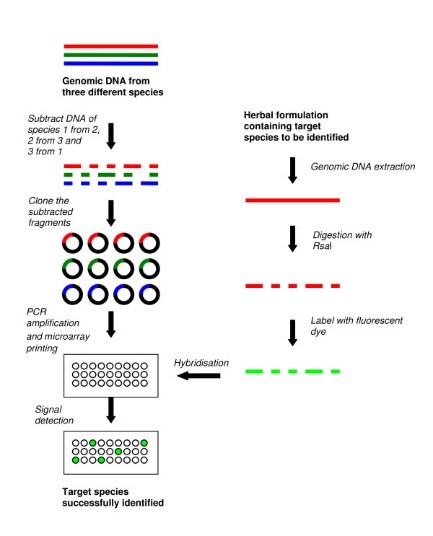 Fig. 1 Method of manufacturing and using oligonucleotide or gene-probe based microarray for fingerprinting herbal plants.1
Example: Gene Expression Profiling by Subtractive Library
Scientists used a subtractive library to isolate differentially expressed genes from Kaposi's sarcoma (KS) and established corresponding cDNA libraries, laying a good foundation for revealing the pathogenesis of KS at the molecular level. Total RNA was extracted from KS sarcoma and normal skin tissue from the same patient. Then, dscDNA was synthesized by reverse transcriptase, and digested with Rsa I, at the same time, normal tissues and tumor tissues were used as testers and drivers, respectively. Next, two-way suppression subtractive hybridization was performed to obtain differentially expressed genes between KS sarcoma and normal skin after preliminary screening. The differential gene was subjected to PCR amplification, and the resulting product was ligated to the cloning vector. White positive colonies were obtained by transforming DH5α E. coli and screening with blue and white spots. The bacteria were boiled and the PCR was used to amplify the unknown gene fragment. In the experiment, two gene libraries representing up-regulation and down-regulation in KS tumor tissues were successfully constructed. It was also confirmed that suppression subtractive hybridization is a rapid, convenient and effective method for establishing differential gene libraries.
Protocol of Subtractive Library Methods
- Tissue total RNA extraction
- Synthesis of ds-cDNA
- Differential suppression hybridization
- Joint connection efficiency and detection efficiency
- Detection of cDNA fragment size in subtracted library
- Dot hybridization screening
- Sequencing and comparative analysis of subtracted cDNA library
Our Highlights
- Multiple antigen recognition detection methods to speed up your experiment
- Advanced screening equipment and perfect laboratory platform
- Excellent medical team with extensive experience in physical enrichment of differentially expressed clones
Creative Biolabs has customized antigen detection methods to provide high-quality technical services and experimental help for your experiments. If you want to know more information, please contact us and we will happy to help you.
Reference
- Niu, L.; et al. Array-based techniques for fingerprinting medicinal herbs. Chinese Medicine. 2011, 6(1):18. Distributed under Open Access license CC BY 2.0, without modification.
For Research Use Only.